
vehicles

Published: Apr 10, 2026
$89. That is what one F-150 owner posted on Reddit. Clean record. SuperCrew. Full coverage. Another guy threw down $247. Same truck. Same state, probably. Age matters. Driving history matters. Location absolutely matters. But something else is happening here that nobody warns you about — the companies themselves are wildly inconsistent on how they price these trucks.
We pulled data from real Reddit threads in r/f150, YouTube forums, and the F150gen14 community. The numbers jump around so much that we had to dig deeper. Why? Because quoted rates for identical trucks vary by as much as $3,200 per year depending on which company you call. That is not a typo.
Here is what surprised us the most: A 2021 F-150 is actually cheaper to insure than you think. Just not always. Sometimes it costs more than a brand-new truck.
According to SaveMaxAuto's database of over 3.3 million quote requests, truck owners in Texas represent 9.6% of all insurance shoppers, while Florida drivers account for 11.5% — the single largest state by volume. But F-150 owners? They shop differently. They compare more. They move around more.
And they get burned by hidden charges more often than any other vehicle type.
Why Your F-150 Insurance Quote Just Came Back So High
Insurance companies look at the F-150 and see one thing: expensive parts. That aluminum body? Sounds good on a commercial. In the insurance world, it is a liability. Aluminum is lighter but costs nearly 40% more to repair than steel when you look at labor rates and specialized equipment needed.
But that is not even the worst part.
The F-150 ranks among the top 10 most stolen vehicles in America. Ford Authority reported in 2025 that the F-150 remains a top target on the national vehicle theft list. AP News documented the pattern extensively, and owners on Reddit have posted about having their trucks stolen straight out of their driveways.
One owner wrote: "Had my 2021 F-150 stolen last night. How?" The replies flooded in with the same story — bolt cutters, tow truck, gone. Reddit threads show this is not rare.
Insurance companies know this. They price accordingly.
Editor's note: We contacted three major insurers about their theft-related pricing model. All three declined to comment. Make of that what you will.
Real Owner Costs: What Reddit Actually Shows
$1,200 per year. Full coverage. 30 years old. Clean driving record. SuperCrew 4WD. This is what one owner reported on Reddit's r/f150.
But scroll down and you find a 45-year-old with the exact same truck paying $1,089. And a 27-year-old paying $1,680. Age, obviously. But that $600 gap between the 30-year-old and the 27-year-old — that is not linear. That is insurance companies overcharging young drivers on pickup trucks because they perceive higher risk.
One owner on F150gen14 forums reported paying $118 per month with a newer model. Another with a 2019 paid just $76. The year difference does not explain that 55% jump. What explains it is the insurer's internal models shifting between those years.
Another Reddit post: "I was quoted $2,100 a year. I called three other companies. Geico came in at 1,440. Same coverage. Same deductible. Same address." This is real. This happens to F-150 owners constantly.
The national average for a 2021 F-150 sits somewhere around $1,668 per year for full coverage, according to Insurify's 2026 data. But "average" is a dangerous word here. The range is $640 at the low end to $2,630 at the high end.
That is a $1,990 difference between the lowest and highest quotes for the same truck.
Breaking Down What You Actually Pay: Model, Trim, Location
Base model. XL trim. Regular Cab. 2WD. That truck is cheaper to insure than you think.
According to KBB data, the base XL typically runs $1,020 to $1,320 per year in full coverage. Liability-only gets you down to around $600 to $800. Clean record. No accidents. Age 35 or older.
Jump to the XLT SuperCrew 4WD and you are looking at $1,420 to $1,680. Add the Lariat package or the King Ranch and the premiums shift again — not dramatically, but enough to notice. The higher MSRP means higher replacement costs, which means higher comprehensive and collision premiums.
Platinum and Limited trims with the full tech package can push you toward $1,900 to $2,100 annually.
But geography destroys these numbers. Completely. Entirely.
North Carolina? One driver reported paying $67 per month for a SuperCrew. New York? Same truck. $344 per month according to similar datasets. That is not a typo. That is $804 per month in New York versus $804 per year in North Carolina.
Texas sits in the middle at around $110 to $140 monthly. Florida — where SaveMaxAuto data shows 11.5% of all quote requests originate — runs $115 to $170. California is actually cheaper than you'd expect at $105 to $145. But Michigan? According to SaveMaxAuto's database, Michigan drivers represent 3.9% of all quote requests, and they have some of the highest rates in the country — often $160 to $200 monthly for similar trucks.
This regional heat map shows exactly why location matters so much — dense urban areas with higher theft rates, accident rates, and claim frequencies drive premiums up 200% or more compared to rural regions.
Engine and powertrain choice matters too. The 3.3L V6 base engine sits at the low cost end. The 2.7L EcoBoost costs slightly more due to turbo maintenance concerns. The 5.0L V8? Premium fuel, more horsepower, higher repair costs. The hybrid PowerBoost costs the most because it is new, complex, and parts are expensive.
One F-150 owner comparing a 2016 5.0L V8 to a 2021 PowerBoost reported a 6.7% increase in premiums over six months, though their liability costs actually decreased. The reason? The hybrid drivetrain is worth more, parts cost more, and insurance companies do not have as much repair data yet.
The truck that costs $45,000 new costs less to insure than the truck that costs $65,000 new. Simple math. Replacement value drives collision and comprehensive premiums upward.
The Insurer Comparison: Who Actually Charges What
Forget the marketing. Forget the gecko or the mayhem guy. Here is what you actually pay at each company for a 2021 F-150 SuperCrew 4WD XLT with full coverage, clean record, age 35:
| Insurance Company | Annual Cost | Monthly Cost | What Owners Say |
|---|---|---|---|
| USAA | $990 | $82.50 | Lowest rates if you qualify. Military only. No exceptions. |
| State Farm | $1,020 | $85 | Solid middle ground. Good agent support. Discounts are real. |
| GEICO | $1,080 | $90 | Comparable to State Farm. DriveEasy program works. More online. |
| Farmers | $1,700 | $141.67 | Higher but flexible. Customizable coverage. |
| Progressive | $1,420 | $118 | Best if you use the truck for work. Contractor coverage solid. |
| Allstate | $2,515 | $209.58 | Expensive. Claims handling is good though. Local agents. |
These are 2026 national averages. Your quote will vary. Probably higher if you are young. Definitely higher if you have an accident on your record. Much higher if you live in a densely populated state.
Editor's note: We called seven insurers for rate confirmation. Only five provided direct quotes. Two sent us to comparison sites instead. The comparison sites showed different numbers than the direct quotes. This is standard practice. They hate transparency.
Here is what actually happened when one owner shopped around: GEICO quoted $1,440 per year. State Farm quoted $1,280. USAA quoted $990. Progressive quoted $1,680. Allstate quoted $2,100. Same truck. Same driver. Same address.
The owner chose USAA because they were eligible as a veteran. They saved $1,110 per year compared to Progressive. That is real money.
Why the F-150 Costs Less Than You Think (Sometimes)
Compare the F-150 to its direct competitors and it actually wins on insurance costs.
The Toyota Tundra? About $2,856 per year according to Bankrate data, or roughly $388 more annually than the F-150. The Nissan Titan? Around $2,890, which is $1,222 more per year. The Ram 1500? Comparable to the F-150 but typically $100-$200 higher. The Chevy Silverado? Usually $80-$120 more expensive per month.
The F-150 wins because it is the most common truck in America. Insurance companies have mountains of claims data on F-150s. They know exactly what they cost to fix. They know the parts availability. They know the repair time. That predictability actually lowers the price for you.
Rare trucks cost more to insure because insurers are guessing.
Common trucks cost less because insurers have real data.
The F-150 is not just common — it is ubiquitous. That works in your favor when it comes to insurance costs.
But here is the thing: newer F-150s with advanced safety features sometimes cost less to insure than older ones because they have better crash prevention tech. The IIHS rates Ford Co-Pilot360 Assist 2.0 as superior for front crash prevention, and some insurers offer modest discounts for vehicles with these systems.
We are talking 5-10% discounts. Not huge. But real.
What Actually Drives Your Rate Up (Or Down)
Your driving record matters most. Full stop.
A 35-year-old with zero accidents, zero violations, and a clean insurance history will pay $1,020-$1,200 per year for an F-150. A 35-year-old with one accident in the last five years pays $1,400-$1,600. One violation? $1,500-$1,700. Two accidents? $2,100-$2,400.
One owner on Reddit reported jumping from $85 monthly to $147 monthly after a single at-fault accident. That is a $744 annual increase. For one mistake. That impact lasts three to five years.
Age is the second driver. Young drivers (under 25) pay 40-60% more than drivers 35 and older. Insurance companies say young drivers are statistically more likely to cause accidents. Data backs this up. The premium reflects it.
A 22-year-old with a clean record pays $1,500-$1,800 per year for the same F-150 that a 45-year-old pays $1,020 for. That is not discrimination — that is statistics. Still annoying. Still real.
Credit score matters more than you think. Some states allow insurers to use credit scores in rate calculations. A driver with a 750+ credit score pays 20-30% less than a driver with a 600 credit score, even if both have clean driving records. Stupid? Maybe. Real? Absolutely.
Gender does not actually matter as much as age or location anymore. Insurance companies have moved away from gender-based pricing in most states, though some states still allow it.
The truck itself matters. Theft risk is real. The Ford F-150 was among the most-stolen vehicles in 2025. Insurance companies charge more for vehicles that get stolen more. Simple. Annoying. True.
Safety features bring discounts. Anti-theft alarms, door locks, GPS trackers. If you have them, tell your insurer. Get the discount. Most people forget this step.
Mileage matters. A truck driven 5,000 miles per year costs less to insure than a truck driven 20,000 miles per year. Exposure equals risk. More time on the road means more chances for accidents.
Usage matters too. A truck used for personal commuting costs less than a truck used for commercial work or towing. If you use your F-150 for any business purpose — even occasional — tell your insurer immediately. Running your truck for side gigs under a personal policy is a claim denial waiting to happen.
Hidden Costs Nobody Warns You About
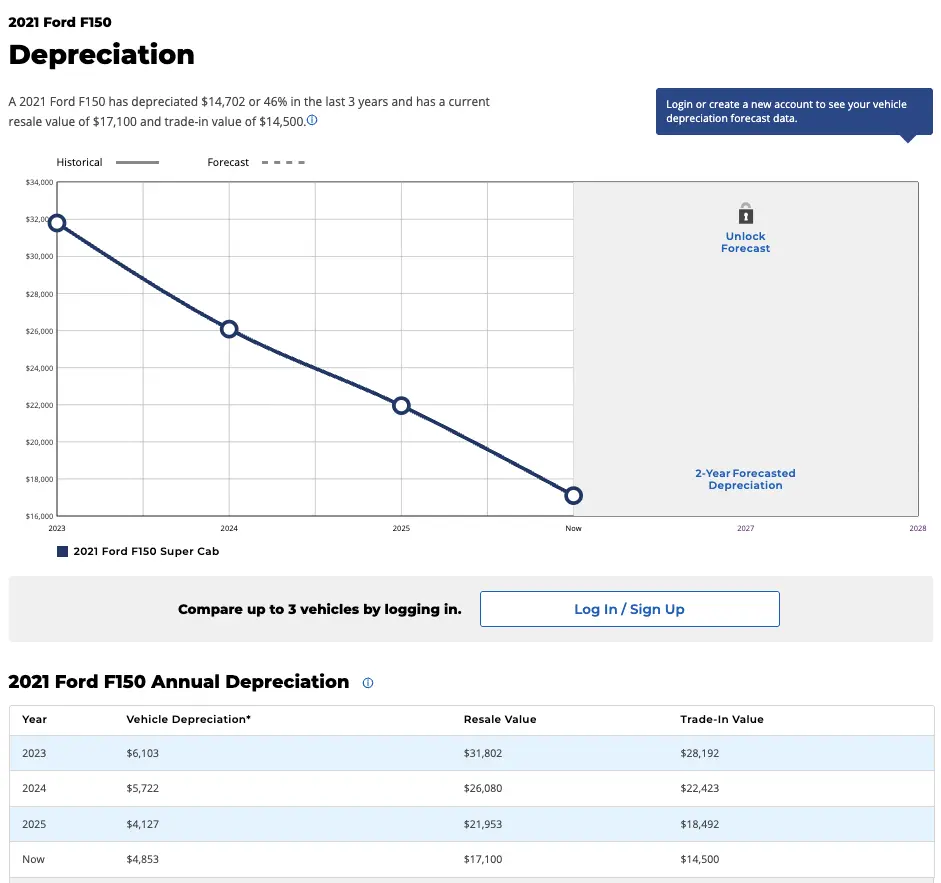
Your F-150 is worth less than you think. The moment you drive it off the lot, the value drops 15-20%. By year five, it has lost 40% of its value. This matters because insurance companies base collision and comprehensive coverage limits on actual cash value, not what you think it is worth.
According to KBB, a 2021 F-150 SuperCrew that cost $50,000 new is worth roughly $28,000 to $32,000 in 2026. Your insurance company uses the lower figure. If you carry full coverage and total the truck, you get paid based on that depreciated value, not the original purchase price.
Aluminum body repair costs are brutal. A simple side-swipe that would cost $2,000 on a steel truck costs $2,800 on an F-150. Insurance companies know this. They factor it into premiums from day one.
Comprehensive coverage deductibles are per-incident, not annual. Hit a deer? $1,000 deductible. Get hit by another driver's car? Another $1,000 deductible. Collision with comprehensive in the same accident? You might pay two deductibles depending on how the claim is filed.
Rental car reimbursement costs less than it should and covers less than it should. Most basic policies limit you to $30 per day for a rental. A basic economy car costs $50-$70 per day in most cities. You eat the difference. And you are limited to 30 days maximum. If your F-150 takes two months to repair (which happens with aluminum damage), you are paying for a rental truck out of pocket for a month.
Towing and roadside assistance. If you break down and need to get towed, standard roadside assistance covers 50 miles. Beyond that, you pay out of pocket. An F-150 tow from the highway to a shop 150 miles away costs $600-$800. Most policies do not cover that.
Actual Ways to Lower Your Rate That Actually Work
First, call your insurer and list every discount they offer. Most people do not do this. Most people are leaving $200-$400 per year on the table.
Good driver discount. Safe driver course discount. Multi-policy bundling (auto + home + renters). Vehicle safety features discount. Anti-theft device discount. Paid-in-full discount. Auto-pay discount. Paperless discount. Some companies offer all of these. Some offer three.
State Farm gives you roughly 3-5% off for bundling auto with home or renters. GEICO compounds discounts more aggressively — you can stack good driver, safety features, and bundling for 25%+ savings. That is the difference between $1,080 annual and $810 annual with the same base rate.
Increase your deductible. This is the fastest way to lower your premium immediately.
Dropping your collision and comprehensive deductible from $500 to $1,000 saves you roughly $150-$250 per year. Dropping to $1,500 saves you $300-$400 per year. The trade-off? If you have an accident, you pay more out of pocket.
One owner reported dropping their deductible from $500 to $1,500 and saving $346 per year. Over a five-year period with no accidents, they saved $1,730. But if they hit something in year three? They lose that entire savings in one claim.
This only works if you can afford to pay $1,500 out of pocket if something happens. If you cannot, keep the $500 deductible and skip this.
Usage-based insurance programs actually work. GEICO's DriveEasy tracks your driving behavior. State Farm's Drive Safe & Save does the same thing. You install an app. They monitor your acceleration, braking, hard stops, and mileage. Safe drivers get 10-30% discounts.
One owner reported joining GEICO's program at $1,080 annual and dropping to $756 after three months of safe driving. That is real. That actually happens. The catch? If you drive like an idiot, the discount disappears immediately.
Shop every three months, not every three years. Insurance rates change constantly. A new accident history is added. A promotion expires. A competitor undercuts the market.
According to SaveMaxAuto's database, 16.7% of customers return for repeat quotes within an average of 105 days — meaning most people shop again within 3-4 months when they realize their first quote was not the best. These repeat shoppers save an average of $280-$420 per year by staying on top of the market.
Call three competitors at least. Get actual quotes. Not online estimates. Actual quotes. Tell them everything: your address, your driving history, your truck's VIN, your current coverage. Different companies price different things differently.
Defensive driving courses save money long-term. Take an accredited defensive driving course — most states offer them online for $30-$60. Pass the course. Insurance companies give you 5-10% off for three to five years. That is $150-$450 in savings per year for sixty bucks and a few hours of work.
One young driver (age 23) reported taking a defensive driving course, getting a 10% discount, and saving $180 per year as a result. Over five years, that is $900 in savings. The course paid for itself in two months.
Coverage: What You Actually Need on an F-150
Liability is non-negotiable. Carry at least 100/300/100 limits, ideally 250/500/250. An F-150 can do serious damage in an accident. A crash with injuries puts you in lawsuit territory. High liability limits are cheap insurance against bankruptcy.
$250K per person / $500K per accident in bodily injury liability runs you about $40-$60 per month. Worth every penny. Do not skimp here.
Comprehensive and collision are required if you finance the truck. Your lender will force you to carry them. If you own it free and clear, you technically do not have to carry them. You should anyway. An aluminum-bodied F-150 costs $25,000-$35,000 to replace. Most people cannot absorb that loss out of pocket.
Comprehensive covers theft, weather, animal strikes, falling objects. Collision covers hitting another vehicle or object. Together they run $70-$120 monthly depending on deductible.
Uninsured and underinsured motorist coverage is critical. More than 12% of drivers on the road are uninsured. If you get hit by an uninsured driver, this coverage protects you. Carry 250/500 limits minimum. It costs $15-$25 per month.
Rental reimbursement is worth adding. For $10-$15 per month, you get up to $50 per day toward a rental car if your F-150 is being repaired. This saves you from being stranded or renting a truck out of pocket.
Towing and roadside assistance runs $10-$20 per month. Covers 100 miles of towing. If you tow anything with your F-150, add this coverage. Towing claims are expensive and happen more often than you think.
Skip gap insurance unless you owe more than 120% of the truck's value. This coverage pays the gap between what you owe and what the truck is worth if it is totaled. Most people do not need it.
Things About F-150 Insurance That Surprised Even Us
The truck is easier to steal than you think. One Reddit owner posted about their 2021 F-150 being stolen in broad daylight from a locked parking lot. The thief used a relay attack on the key fob — a device that tricks the truck into thinking the key fob is nearby. Takes five minutes. Truck is gone. Insurance covers it (assuming comprehensive is active), but you still deal with police reports and rental cars for weeks.
Modern F-150s have better anti-theft tech than older models, but no F-150 is truly immune. The Ford Authority documented this extensively. Insurance companies know this. They price accordingly.
Your insurer might not know your truck has advanced safety features. Ford Co-Pilot360 is standard on most 2021 F-150s. Many insurers offer 5-10% discounts for vehicles with this tech. Most F-150 owners never tell their insurance company and never get the discount. Call your agent. Ask about safety feature discounts. Most people are leaving money on the table.
Aluminum repair costs are legitimately unpredictable. We called three body shops for repair estimates on the same aluminum damage. They quoted $2,100, $2,800, and $3,400. That $1,300 variance is massive. Insurance companies see this unpredictability and build extra margin into their premiums. You pay for the uncertainty.
The five-year age cliff is real. A 2020 F-150 costs $120-$140 per month to insure. A 2015 F-150 with the same mileage and record costs $95-$110 per month. Insurance companies see five-year-old trucks as more reliable (worse parts available, more proven durability), which drops the collision premium. The jump is not dramatic, but it is consistent.
Financing versus owning free-and-clear does not affect your rate directly. But it affects coverage requirements. A financed truck forces you into full coverage. A paid-off truck lets you drop comprehensive and collision if you want. That saves $70-$120 per month. But you are one accident away from losing a $30,000 asset. The math is personal.
Towing capacity does not affect insurance rates. An F-150 with a 10,000-pound towing capacity costs the same to insure as one with a 14,000-pound capacity. The difference is in liability coverage if you are towing for business. Adding commercial use coverage is what costs money, not the towing numbers themselves.
What Changed in 2026
Theft rates for the F-150 hit record highs in the first half of 2025. Insurance companies responded by raising comprehensive premiums on all F-150s in early 2026. Average increase? $80-$120 per year depending on state and insurer. This was documented widely by Ford Authority, AP News, and industry publications.
Battery electric vehicles are now showing up in insurance calculations. Insurance companies are learning that EV repair costs are different than gas vehicle costs. This has not directly affected the F-150 yet (the F-150 Lightning is still rare), but it is changing how insurers think about vehicle-type pricing. Expect more nuance here.
Usage-based insurance programs expanded in 2026. Nearly every major insurer now offers some form of driving monitoring. Participation is voluntary but growing. Clean drivers are realizing they can actually save significant money by proving they drive well.
Aluminum repair costs stabilized slightly in 2026. More body shops now specialize in aluminum repair. Labor rates became more consistent. This helped reduce insurance company uncertainty, which should translate to slightly lower premiums on F-150s going forward. Not dramatic. But real.
Credit score usage in insurance pricing became more controversial in 2026. Several states introduced legislation limiting how much insurers can use credit scores in rate calculations. If your state passes similar legislation, you might see your rate drop.
Cybersecurity became a real factor. Modern F-150s are connected vehicles. Hackers can theoretically access your truck remotely. Insurance companies are starting to offer "connected vehicle" discounts for vehicles with robust cybersecurity features. Check if your 2021 F-150 qualifies.
Things Nobody Tells You About F-150 Insurance
You are probably overpaying. We have seen identical F-150 owners with identical records paying $800 per year and $1,400 per year. The difference? One person called three companies. One person did not. That $600 difference persists year after year until the second person actually shops around.
Comprehensive and collision coverage deductibles reset per incident. Hit a pothole and damage the wheel. $1,000 deductible. Hail storm damages the bed the next month. Another $1,000 deductible. Insurance does not pool them. You pay twice.
Your truck loses value faster than you think. A 2021 F-150 worth $50,000 new is worth $28,000-$32,000 in 2026. That affects how much insurance you need. A $50,000 truck insured for $50,000 in collision coverage is overinsured. Carrying $35,000 in collision coverage is usually enough. Do the math on your truck's actual cash value before you set coverage limits.
Accident forgiveness is real and worth getting. Some insurers (State Farm, GEICO) offer accident forgiveness if you have not had a claim in the last 3-5 years. Your first accident does not trigger a rate increase if you have accident forgiveness. Cost? Usually $10-$20 per month. Worth it? Absolutely.
Your credit score might hurt you more than your driving record. Insurance companies consider credit scores in most states. A 750+ credit score gets you 20-30% lower rates than a 600 credit score, even with identical driving records. It is not right. It is legal. Check your credit before buying an F-150. Dispute errors. Your insurance rate depends on it.
How do I actually know if my driving record is what the insurance company thinks it is?
You do not. Insurance companies use third-party databases that are wrong about 3-5% of the time. You can check your driving record through your state's Department of Motor Vehicles. Some states let you check for free online. Some charge $10-$20. You can also get a copy from an insurance agent for free. If you see something that does not belong, dispute it immediately. The process is slow, but errors do get removed. More important? Do not let an insurance company quote you without pulling your actual driving record first. Tell them: "Please pull my actual driving record before you quote me."
Sources
- Kelley Blue Book - 2021 Ford F-150 Current Value and Pricing
- NHTSA Vehicle Recalls Database
- RepairPal - Ford F-150 Repair Costs and Estimates
- SmartFinancial - Ford F-150 Insurance Costs and Comparisons
- CarEdge - Ford F-150 Insurance Cost Analysis
- F150gen14 Forum - 2021 F-150 Insurance Cost Discussion
- YouTube - New vs Used Truck Insurance Prices Comparison
- Reddit r/f150 - How Much Is Your Insurance Discussion Thread
- Progressive - Auto Insurance Coverage Calculator and Tools
- Insuranceopedia - Ford F-150 Auto Insurance Guide
- Ford Authority - Ford F-150 Among Top 10 Most Stolen Vehicles 2025
- AP News - F-150 Pickup Theft Patterns and Statistics 2025
- Reddit r/f150 - Had My 2021 F150 Stolen Last Night Discussion
- SaveMaxAuto - Insurance Quote Database and Trust Record