
830,000 Florida Drivers Qualify for USAA's $500 Million Auto Insurance Dividend
More than 830,000 Florida USAA members began receiving a share of a $500 million auto insurance dividend starting June 15, 2026, with the average payment projected at roughly $760 per eligible member.


Published: Jul 31, 2026
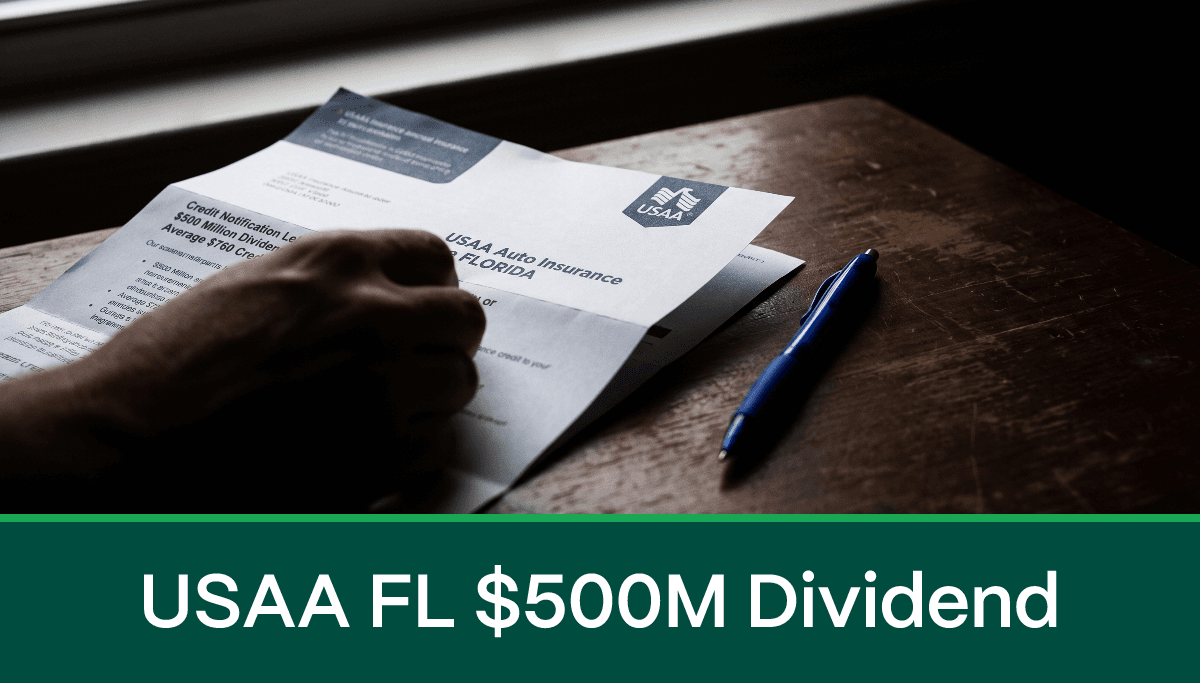
More than 830,000 Florida USAA members began receiving a share of a $500 million auto insurance dividend starting June 15, 2026, with the average payment projected at roughly $760 per eligible member.
Reporting from North American Community Hub (nchstats.com) confirms the distribution is already underway, making this one of the largest single-state member relief actions in USAA's recent history. The Save Max Quote Index, drawn from 3.3 million+ real quote requests, consistently shows Florida among the nation's most expensive auto insurance markets, which makes a payout of this scale especially significant for local households. According to North American Community Hub (nchstats.com), the dividend is part of a broader nearly $1 billion Florida relief package spanning December 2025 through July 2026.
830,000 Florida Drivers Are Receiving USAA Dividend Checks
The June 15, 2026 distribution marks the latest and largest single installment in USAA's Florida member-return program. Roughly 830,000 members qualify, and more than one in four of those recipients, over 25 percent, should receive above $1,000 from this round alone.
What makes the delivery unusual is the format. Some members will not receive a traditional check. Instead, North American Community Hub (nchstats.com) reports that at least some dividends are appearing as credits applied directly to members' insurance-account balances. One Florida policyholder interviewed by ClickOrlando confirmed receiving a $1,100 credit applied to his bill, demonstrating that account credits are already reaching real households.
Delivery may vary depending on individual account circumstances. USAA has not announced a final date by which every eligible member must receive their payment, so members should check official account notices rather than waiting for a paper check that may never arrive.
The scale is hard to overstate. A $500 million dividend spread across 830,000 members represents a meaningful per-household benefit in a state where Florida drivers consistently rank among the highest-paying in the country.
How the $500 Million Dividend Fits Into a Larger Florida Relief Package
USAA's June 2026 dividend does not stand alone. It is the centerpiece of a broader commitment that the company says will total nearly $1 billion in Florida member returns and premium savings between December 2025 and July 2026.
Here is how the three components break down:
| December 2025 dividend | $160 million | December 2025 |
| Rate reductions (two filings) | $250 million in estimated savings | 2025 through 2026 |
| June 2026 dividend | $500 million | Starting June 15, 2026 |
| **Total program** | **Nearly $1 billion** | **December 2025 through July 2026** |
The $250 million in savings stems from two separate rate filings that lowered Florida auto rates by an average of 14 percent. That figure translates into ongoing savings across multiple policy periods, not a one-time credit. The December 2025 dividend of $160 million was a separate, earlier distribution to Florida members before the June round began.
Together, the three components represent a staged approach. USAA first cut rates, then delivered an end-of-year dividend, and is now following with a larger mid-2026 payment as market conditions continued improving.
Who Qualifies, and Who May Be Left Out
Eligibility for the USAA Florida auto insurance dividend centers on a specific coverage window. Members generally need a qualifying connection to a Florida USAA auto policy held during 2023, 2024, or 2025. USAA also describes recipients as eligible current auto policyholders in Florida.
That second condition is where edge cases arise.
"USAA also describes recipients as eligible current auto policyholders in Florida, wording that matters for people who moved, canceled coverage, or changed insurers before the June 2026 distribution."
If you held a Florida USAA policy during the qualifying years but then canceled, moved out of state, or switched to a different insurer before payments began, your eligibility may be affected. USAA has not released a public eligibility calculator or a complete payment formula, so the company has not publicly clarified every edge-case scenario.
Premiums paid, time insured, and policy structure may seem like logical factors driving individual payment amounts, but USAA has not published a methodology that confirms or weights any specific variable. Assigning a calculation formula without that confirmation would be speculation.
Members in neighboring high-cost markets should note that similar reform-driven dynamics are playing out elsewhere. Georgia drivers are also watching rate changes as litigation reform spreads across the Southeast, and North Carolina's auto market has seen its own regulatory shifts in recent years.
Why Florida's Legal Reforms Drove the Payout
USAA has been direct about its reasoning. The company attributes the Florida dividend to lower legal costs and improved market conditions following the state's 2023 civil litigation and tort reforms.
"Florida's 2023 House Bill 837 changed civil-remedy rules involving negligence deadlines, attorney fees, bad-faith actions and evidence for medical expenses."
HB 837 was a sweeping overhaul. By tightening rules around attorney fee arrangements, modifying negligence deadlines, and changing how medical expense evidence is presented in claims, the legislation targeted the litigation-driven cost spiral that had made Florida one of the most expensive auto insurance markets in the country.
The numbers from regulators support a broader improvement trend. In March 2026, the Florida Office of Insurance Regulation reported that the five largest auto insurance groups, representing 78 percent of the state market, indicated an average rate change of negative 8 percent for 2026. Those same groups had requested an aggregate negative 7.4 percent change for 2025.
Regulators attribute broader market improvement to multiple forces. Collision frequency, repair prices, claim severity, weather losses, and insurer underwriting results all play a role. USAA's explanation reflects the company's own assessment, supported by improving market data rather than an independent audit of reform savings.
How Individual Payment Amounts Vary, and What Drives the Difference
The average payment of $760 is a projection, not a guaranteed floor. One member could receive less than $760 while another household receives well above $1,000. More than one-quarter of qualifying members are due to receive over $1,000.
Payment size should not be read as a fixed per-vehicle amount. USAA describes the distribution in terms of members, not vehicles.
For context, consider how this compares to other dividend programs running in 2026:
- USAA Florida dividend: Average $760 per member, with more than 25 percent exceeding $1,000
- State Farm national auto dividend (2026): Announced as averaging $100 per vehicle, varying by state and premiums paid
The two programs operate under entirely different rules and geographic scope. State Farm's dividend is national; USAA's is Florida-specific. Neither figure is directly comparable to the other in terms of methodology.
The SMQI tracks how Florida quote requests trend against national benchmarks, and Florida consumers requesting quotes in 2026 are seeing a market in transition, with rates pulled lower by both regulatory action and carrier-level relief programs like this one.
A dividend is also distinct from a rate reduction. The dividend is a one-time return of value. A rate reduction changes what you pay going forward across multiple policy periods. Members receiving both benefit from compounding relief.
What this means for you
Log into your USAA account through the official app or by typing the address directly into your browser, and check your billing, secure messages, and recent transactions. If you see a credit, review how it was applied before adjusting any automatic payments, since a $760 credit could cover several monthly installments. If you believe you qualify but see nothing, contact USAA through a verified account channel and never respond to unsolicited texts or calls claiming to offer your dividend. Scammers target large payout announcements, and a legitimate dividend will never require an upfront fee.
FAQ
How do I know if I qualify for the USAA Florida auto insurance dividend?
You generally qualify if you held a USAA auto policy in Florida at some point between 2023 and 2025 and remain an eligible current Florida auto policyholder. USAA has not published a public eligibility calculator, so the clearest way to confirm is to log into your official USAA account and review your billing and secure messages.
Will I receive a check or a credit on my account?
Delivery varies by member. Some recipients will see a credit applied directly to their insurance-account balance rather than receiving a physical check. One Florida policyholder confirmed receiving a $1,100 credit applied to his bill. Check your account rather than waiting for postal mail.
How is the $760 average USAA dividend different from my renewal rate change?
The dividend is a one-time return of value, either as a check or an account credit. A rate change affects the premium you pay going forward across future policy periods. USAA has separately filed rate reductions averaging 14 percent for Florida, which are distinct from and in addition to the dividend payment.
Why did USAA specifically return money to Florida members rather than all states?
USAA cites lower legal costs and improved market conditions specifically in Florida following the state's 2023 House Bill 837 tort reforms, which changed rules around attorney fees, negligence deadlines, and bad-faith actions. Florida's regulator also reported broad market improvement, with the five largest auto groups indicating an average rate change of negative 8 percent for 2026.
Could my dividend be delayed or missing?
USAA has not announced a final deadline by which every eligible member must receive a payment. If you believe you qualify and see no credit or communication, contact USAA directly through your verified account portal. Do not rely on social media posts or unsolicited messages to track your payment status.
About Taleah McGuire
Taleah McGuire is a Regional Analyst at Save Max Auto with 11+ years of insurance experience including senior roles at Kentucky Farm Bureau. She covers regulatory news, state-specific reform legislation, and traditional carrier coverage. Read more from Taleah McGuire →
Edited by Aaren Ramon.
Methodology
This article is grounded in the source linked above. Save Max Auto data points referenced here are drawn from the Save Max Quote Index (SMQI), a proprietary instrument reflecting 3,364,317 real consumer quote requests submitted to savemaxauto.com. State and carrier rankings reflect the lifetime dataset; year-over-year shifts reflect a rolling 12-month window. The index is refreshed monthly. External authority figures referenced (NAIC, NHTSA, state regulators) reflect the most recent public data releases available at time of writing.
Sources
- Primary source: North American Community Hub (nchstats.com), "USAA Starts Sending Florida Auto Insurance Credits As 830,000 Drivers Qualify For Dividend Payments"