
Florida Court Refuses to Void Progressive's $500,000 UM Policy After Unauthorized Settlement
A policyholder's lawyers made a critical mistake, and a Florida appeals court just decided it was not enough to wipe out half a million dollars in coverage. On September 9, 2026, Florida's Fourth District Court of Appeal handed down a ruling that Insurance Business covered in detail: Progressive tried to void a customer's $500,000 uninsured...


Published: Sep 10, 2026
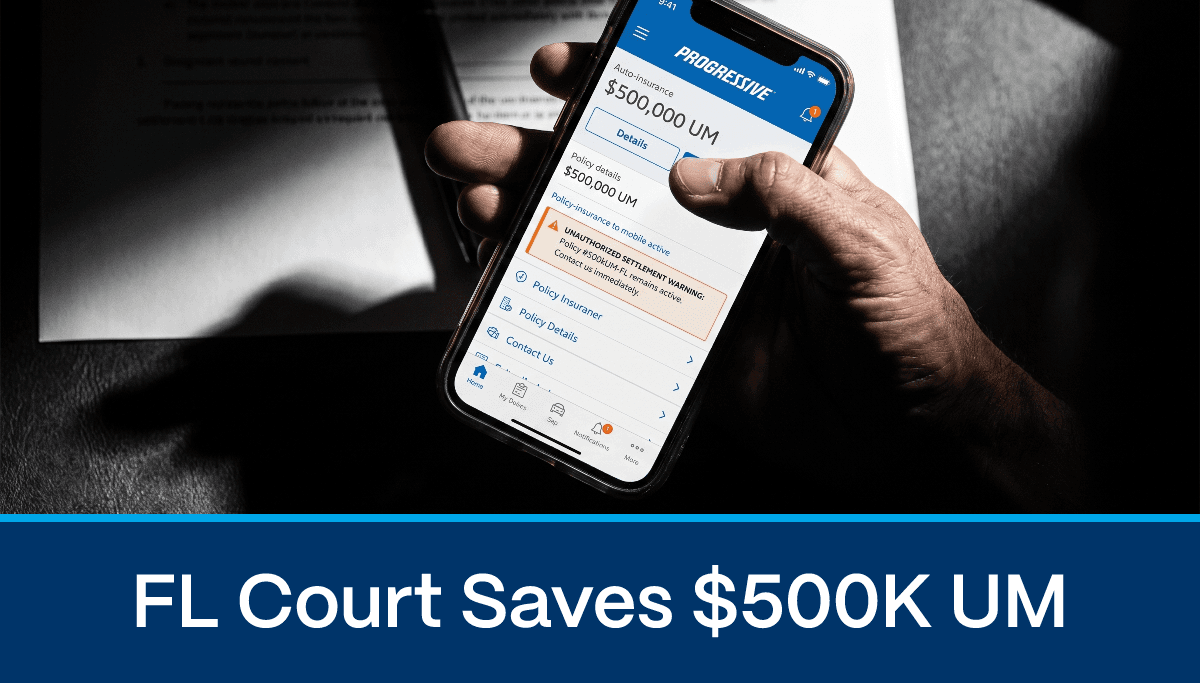
A policyholder's lawyers made a critical mistake, and a Florida appeals court just decided it was not enough to wipe out half a million dollars in coverage.
On September 9, 2026, Florida's Fourth District Court of Appeal handed down a ruling that Insurance Business covered in detail: Progressive tried to void a customer's $500,000 uninsured motorist coverage after that customer settled with the at-fault driver's insurer without getting Progressive's permission first. The court said no. As Insurance Business reports, the key principle is this, breaking a consent-to-settle clause only voids coverage if the breach actually harmed the insurer. That distinction matters enormously for anyone carrying uninsured motorist coverage consent to settle language in their own policy.
A $500,000 policy, an unauthorized settlement, and a court fight
The trouble started with a crash on April 30, 2022. The at-fault driver carried just $10,000 in liability coverage through Liberty Mutual. The other driver, Progressive's policyholder, held $500,000 in uninsured/underinsured motorist (UM/UIM) coverage, the kind designed to step in precisely when the person who hit you cannot cover your losses.
So far, so routine. Then came the misstep.
Before filing a claim against Progressive, the policyholder signed a release, accepted the $10,000 from Liberty Mutual, and closed out that portion of the case. He never asked Progressive for permission. New lawyers caught the error after the fact, tried to reverse the transaction by writing Progressive a request to waive its subrogation rights and mailing Liberty Mutual a $10,000 check to undo the payout. Progressive was not impressed.
The insurer argued the policyholder had breached the policy and asked the court to rescind coverage entirely. The stage was set for a fight over what that breach actually cost.
Why Florida law requires insurer sign-off before you settle
Florida Statute 627.727 is the rule at the center of this case. It requires an injured driver to send "written notice of the proposed settlement ... by certified or registered mail to all underinsured motorist insurers that provide coverage" before accepting any money from the at-fault driver's carrier.
Once that notice goes out, the insurer gets "a period of 30 days" to either approve the settlement or preserve its subrogation rights, its legal ability to pursue the at-fault driver later and recover what it paid you.
Both sides agreed the policyholder skipped this step entirely. The question was whether skipping it should cost him his coverage.
The reason the law exists is straightforward. When you accept money from the at-fault driver and sign a release, you can extinguish the insurer's ability to chase that driver for reimbursement. If Progressive eventually paid out on the $500,000 policy, it would normally be entitled to step into the policyholder's shoes and sue the driver who caused the crash. A secret settlement can destroy that right permanently.
For Florida drivers navigating already-expensive auto insurance, understanding this notice requirement before any settlement conversation begins is not optional, it is essential to keeping your UM/UIM benefits alive.
The prejudice test: how courts decide if a breach actually matters
Here is where Florida law cuts in the policyholder's favor. Settling without consent does not automatically void coverage. It only voids coverage if the breach prejudiced, actually harmed, the insurer.
Florida courts start from a presumption that the breach caused harm. But that presumption can be rebutted. The burden then shifts to the policyholder to prove the insurer suffered no real loss.
The appeals court, quoting an earlier ruling, put it plainly:
"The probable insolvency of the tortfeasor can be sufficient to overcome the presumption of prejudice."
That single sentence turned the entire case into an investigation of the at-fault driver's finances.
How the at-fault driver's finances decided the case
The trial court took a hard look at whether Progressive's lost subrogation rights were worth anything in practice. Here is what the evidence showed:
| At-fault driver's annual income | Approximately $20,000 |
| Business status | Ran a small business |
| Property | Carried a mortgage |
| Prior settlement funds | Already spent |
| Trial court's finding | "Apparent and probable insolvency" |
That profile told a straightforward story. Even if Progressive had been notified and refused to consent, the practical upside of pursuing this particular defendant was negligible.
The court framed the prejudice question as a practical business judgment: would a sensible insurer have blocked the settlement and gone after this at-fault driver instead? The trial judge decided no. Chasing someone with nothing worth collecting costs more in legal fees than it could ever recover. No real loss meant no prejudice.
This same financial calculus plays out quietly in UM/UIM claims across states where underinsured drivers are common. The Save Max Quote Index, drawn from 3.3 million+ real quote requests, consistently shows that drivers in states with higher rates of minimally insured motorists tend to shop for larger UM/UIM limits, a pattern that makes cases like this one directly relevant to millions of policyholders.
What the appeals court did, and did not, decide
The Fourth District Court of Appeal was careful about the scope of its ruling. It did not declare the trial judge was correct, only that the decision was a reasonable one on the evidence presented.
"Reasonable minds may disagree," the panel wrote, but found the evidence supported the outcome.
Appeals courts do not re-run trials. They ask whether the lower court's call was one a reasonable judge could make. Here, the panel concluded it was, and let the ruling stand.
Crucially, the policyholder did not walk away with a check. This was a partial judgment. It keeps the coverage alive but does not resolve the injury claim itself. A separate trial on negligence, causation, and damages is still ahead. The decision is also not final until the court rules on any timely motion for rehearing.
For anyone watching this case as a precedent, the holding is narrow but meaningful: a consent-to-settle breach is not a blank check for an insurer to cancel your policy.
What this means for you
Before you accept any payment from an at-fault driver's insurer, contact your own UM/UIM carrier in writing first, send that notice by certified or registered mail, just as Florida Statute 627.727 requires. If you have already settled without notifying your insurer, consult a coverage attorney immediately, document the at-fault driver's financial situation thoroughly, and consider whether returning the settlement funds and requesting a subrogation waiver is still possible. Protecting your UM/UIM benefits starts with one phone call before you sign anything.
Drivers in neighboring states should also check their own consent-to-settle requirements, Georgia car insurance policies and South Carolina auto insurance policies each carry their own notice rules that can affect UM/UIM claims in similar ways.
FAQ
Does settling with the at-fault driver's insurer automatically cancel my UM/UIM coverage?
No. In Florida, settling without your UM/UIM insurer's consent only voids coverage if the breach actually prejudiced, harmed, the insurer. If the at-fault driver had no meaningful assets to pursue, a court may find the lost subrogation rights were worth nothing and keep your coverage in force.
What is a consent-to-settle clause in an auto insurance policy?
It is a policy condition requiring you to notify your own insurer and get approval before accepting any settlement from an at-fault driver's carrier. The clause protects the insurer's right to later recover money from the driver who caused your injuries, known as subrogation.
What does "subrogation" mean in a UM/UIM claim?
Subrogation is your insurer's legal right to step into your shoes and sue the at-fault driver to recover what the insurer paid you. When you settle with and release that driver without permission, you can eliminate the insurer's ability to pursue that recovery.
What is Florida Statute 627.727 and why does it matter?
Florida Statute 627.727 governs UM/UIM coverage in the state. It requires injured drivers to send written notice of any proposed settlement to their UM/UIM insurer by certified or registered mail and gives that insurer 30 days to approve or protect its subrogation rights. Skipping this step can put your entire claim at risk.
If I already settled without notifying my UM/UIM insurer, what can I do?
Act quickly. Some courts have accepted a returned settlement check and a request for a subrogation waiver as an attempt to cure the breach. Document the at-fault driver's financial situation carefully, because evidence of insolvency can be the key to overcoming the presumption of prejudice against you. Consult a coverage attorney before taking any further steps.
About Brooke Grissom
Brooke Grissom is an Independent Insurance Analyst at Save Max Auto, licensed in Property & Casualty and Health insurance. She covers data-driven market trends, cross-state premium comparisons, and carrier financial analysis. Read more from Brooke Grissom →
Edited by Cassidy Richey.
Methodology
This article is grounded in the source linked above. Save Max Auto data points referenced here are drawn from the Save Max Quote Index (SMQI), a proprietary instrument reflecting 3,364,317 real consumer quote requests submitted to savemaxauto.com. State and carrier rankings reflect the lifetime dataset; year-over-year shifts reflect a rolling 12-month window. The index is refreshed monthly. External authority figures referenced (NAIC, NHTSA, state regulators) reflect the most recent public data releases available at time of writing.
Sources
- Primary source: Insurance Business, "Florida court won't void Progressive's UM/UIM policy despite unauthorized settlement"