
Federal Judge Dismisses Uber's RICO Lawsuit Against NY Fraud Network
Could a federal court ruling in Brooklyn quietly push your auto insurance bill higher? A federal judge just dismissed Uber's sweeping racketeering case against a network of injury law firms, doctors, and pain clinics accused of orchestrating staged-accident fraud in New York, according to Insurance Journal.


Published: Aug 18, 2026
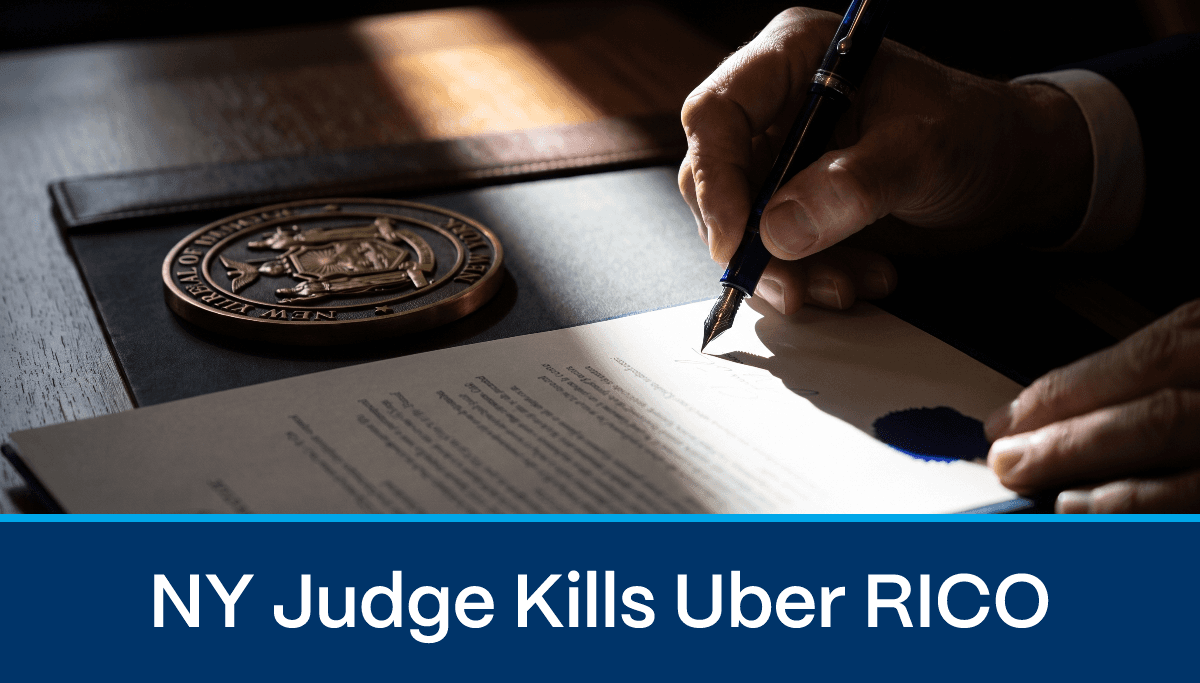
Could a federal court ruling in Brooklyn quietly push your auto insurance bill higher?
A federal judge just dismissed Uber's sweeping racketeering case against a network of injury law firms, doctors, and pain clinics accused of orchestrating staged-accident fraud in New York, according to Insurance Journal. The ruling, handed down by Judge Orelia E. Merchant in Brooklyn, is a significant setback for the ride-share giant's aggressive legal campaign against what it calls systemic insurance fraud. Insurance Journal reports that Uber called the opinion "wrongly decided" and is weighing all available next steps.
Federal Judge Throws Out Uber's Racketeering Case Against NY Lawyers and Doctors
Judge Merchant ruled that Uber failed to meet the demanding legal standard required to sustain a civil claim under the federal Racketeer Influenced and Corrupt Organizations Act (RICO). The court was direct: RICO claims must offer "more than labels and conclusions" and must satisfy a "heightened particularity requirement" when pleading fraud.
Uber fell short on multiple grounds. The judge found no provable common enterprise among defendants, no demonstrated coordination, and no clearly established injury. Three of the five cases Uber cited as evidence of harm are still pending in court, meaning the actual dollar amount of Uber's losses remains unproven and Uber lacks standing under RICO.
Uber wasted no time pushing back. An Uber spokesperson told Insurance Journal:
"We believe this is a wrongly decided opinion and are considering all options available to us moving forward."
The dismissal covers only Uber's federal RICO claims. The federal court declined to rule on the accompanying state-law claims, leaving that door open.
What Uber Actually Alleged: Staged Accidents, False Diagnoses, and Inflated Settlements
Uber's lawsuit painted a detailed picture of coordinated fraud that it says has been running since at least 2019.
According to Uber's allegations, injury law firms recruited passengers involved in minor collisions and referred them to participating doctors and clinics. Those passengers were described as "uninjured or only lightly injured," but false evidence was allegedly manufactured to make injuries appear serious.
The end goal, Uber argued, was to bypass New York's no-fault auto insurance law, which bars non-economic damages below a certain injury threshold. By inflating diagnoses and using doctors' causation statements, the law firms could claim serious injury and "fraudulently induce larger settlements" from Uber.
Uber pointed to five state court cases in which it was named as a defendant and alleged similar schemes in 12 additional instances. Across those cases, Uber identified at least 17 distinct schemes involving different combinations of defendants.
That breadth, ironically, worked against Uber in court.
Why the Judge Said No: Three Legal Hurdles Uber Couldn't Clear
The judge's dismissal rested on three distinct failures in Uber's legal argument. Each one independently undermined the RICO claim.
- No common enterprise. Uber could not show that the lawyers and medical providers formed an "association-in-fact" enterprise with a shared purpose, defined relationships, and sufficient longevity. The court found the only plausible inference was that doctors and lawyers shared ordinary business referral relationships, not a criminal conspiracy.
- No proven coordination. Uber alleged 17 different schemes involving different subgroups of defendants, but in six of those cases only a single law firm was alleged to have directed passengers to a doctor. The judge concluded that allegations of "various defendants and subgroups agreeing at different times to engage in various fraudulent schemes" do not plausibly support a finding of common purpose or interpersonal coordination.
- No definite injury. Uber claimed "substantial expense" from defending false or inflated claims. But three of the five cited cases are still active in court. Because the actual amount of harm is not yet provable, Uber does not yet have legal standing to sue under RICO.
The judge acknowledged that doctors may have received benefits from the referral arrangements, but characterized those benefits as "incidental to an ordinary and lawful client-referral relationship and third-party litigation financing of medical treatment."
How New York Stacks Up Against California and Pennsylvania
The Brooklyn dismissal is not the full story of Uber's RICO strategy. Uber has filed similar lawsuits in Florida, Pennsylvania, and California, and the outcomes are far from uniform.
| New York | Motion to dismiss GRANTED | Federal RICO claims dismissed |
| Pennsylvania | Motion to dismiss DENIED | Case moving forward |
| California | Motion to dismiss DENIED | Case moving forward |
| Florida | Filed | Status not yet reported |
Uber views the Pennsylvania and California results as validation. The spokesperson stated:
"We are fully confident in the merits of our claims and our legal theories, which the recent denials of defendants' motions to dismiss in similar filings in Pennsylvania and California only provide more evidence for. We look forward to having these claims vindicated at the appropriate time."
Uber explicitly noted that the New York judge's dismissal "is inconsistent with what judges have decided in similar cases in other states," framing the Brooklyn ruling as an outlier rather than a verdict on the underlying legal theory.
No-Fault Fraud and Rising Costs: The Bigger Battle Behind the Lawsuit
Staged-accident fraud schemes like the one Uber described are not fringe events. They are a persistent and expensive feature of no-fault insurance states, where the structure of the law creates financial incentives to inflate claims beyond the threshold for non-economic damages.
New York is ground zero for this dynamic. New York auto insurance costs are among the highest in the country, and fraud is widely cited as a contributing factor. Uber itself has been active on the legislative front, supporting reforms that passed in New York state.
The Save Max Quote Index, drawn from 3.3 million+ real quote requests, consistently shows that drivers in no-fault states face elevated premiums compared to tort states with similar risk profiles. The SMQI data reflects real market pressure from fraud-related claim costs being absorbed into rate filings across carriers.
Pennsylvania car insurance and California auto insurance shoppers are watching those parallel RICO cases closely, since successful outcomes there could eventually pressure insurers to reduce fraud-driven rate loads.
Uber is not the only party fighting these schemes. Insurers have long pursued their own litigation and legislative strategies to combat no-fault fraud, and the cost ultimately flows downstream to every driver paying a premium.
What this means for you
If you drive or ride in New York, the dismissal of Uber's RICO case means the alleged fraud networks face no immediate federal accountability, and the legal costs of contested claims continue to pressure insurance rates in the state. Monitor how Uber's surviving state-law claims and its pending cases in Pennsylvania and California develop, since favorable rulings there could reshape the legal playbook against staged-accident rings. Compare your New York auto insurance options now, because rate pressure from fraud-related litigation is an ongoing market reality that will not pause for court calendars. If you notice suspicious behavior after an Uber ride involving any pressure to file injury claims, report it to your insurer immediately.
FAQ
What is the Uber RICO lawsuit auto insurance fraud case about?
Uber sued a group of New York injury lawyers, doctors, and pain clinics under the federal RICO statute, alleging they conspired since at least 2019 to stage or exploit minor accidents, fabricate serious injuries, and extract inflated settlements from Uber's auto insurance program. A federal judge in Brooklyn dismissed the racketeering claims in August 2026, finding Uber failed to prove a common enterprise, coordination, or definite injury.
Why did the judge dismiss Uber's RICO claims?
Judge Orelia E. Merchant found three core problems: Uber could not show the defendants shared a common fraudulent purpose rather than independent business interests; it could not demonstrate interpersonal coordination beyond routine referral relationships; and three of the five cases it cited as evidence of injury are still pending, leaving its actual damages unproven and its RICO standing unestablished.
Does the dismissal affect Uber's cases in other states?
No. Uber has filed similar RICO suits in Florida, Pennsylvania, and California. In both Pennsylvania and California, judges denied motions to dismiss and those cases are actively moving forward. Uber described those results as evidence that its legal theories are sound and characterized the New York ruling as inconsistent with decisions in other jurisdictions.
How does staged-accident fraud affect my auto insurance premium?
When insurers pay inflated settlements on fraudulent or exaggerated claims, they recover those losses through higher premiums across their entire policyholder base. No-fault states like New York are particularly vulnerable because the law creates a financial threshold that incentivizes inflating injury claims. Every driver in affected states absorbs a portion of those fraud costs in their rates.
What happens to Uber's state-law claims in New York?
The federal court dismissed the federal RICO claims but explicitly declined to rule on the accompanying state-law claims. That means Uber could potentially pursue those claims in state court, and the legal battle in New York is not entirely over despite the RICO setback.
About Aaren Ramon
Aaren Ramon is a Senior Analyst at Save Max Auto and owner of Elite Shield Agency. He covers carrier moves, regional insurance markets, and consumer-impact reporting from the agency-owner perspective. Read more from Aaren Ramon →
Edited by Cassidy Richey.
Methodology
This article is grounded in the source linked above. Save Max Auto data points referenced here are drawn from the Save Max Quote Index (SMQI), a proprietary instrument reflecting 3,364,317 real consumer quote requests submitted to savemaxauto.com. State and carrier rankings reflect the lifetime dataset; year-over-year shifts reflect a rolling 12-month window. The index is refreshed monthly. External authority figures referenced (NAIC, NHTSA, state regulators) reflect the most recent public data releases available at time of writing.
Sources
- Primary source: Insurance Journal, "Judge Nixes Uber's RICO Suit Alleging NY Lawyers, Doctors Conspired on Auto Claims"