
Auto Loans and Insurance Now Cost the Average Household $7,140 a Year
American households with automotive obligations are paying a combined median of $595 every month just to finance and insure their vehicles, according to Car Dealership Guy News. That figure adds up to $7,140 annually, and it doesn't include a single gallon of gas. Reporting by Car Dealership Guy News draws on Doxo's 2026 U.S.


Published: Jun 22, 2026
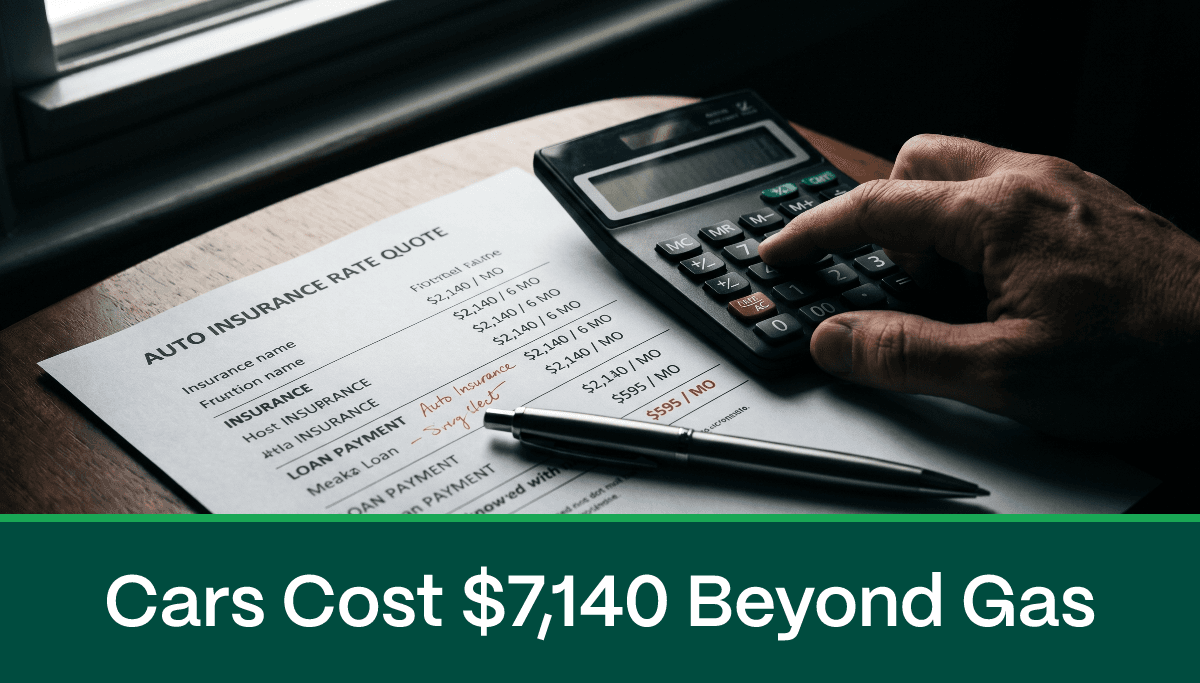
American households with automotive obligations are paying a combined median of $595 every month just to finance and insure their vehicles, according to Car Dealership Guy News.
That figure adds up to $7,140 annually, and it doesn't include a single gallon of gas. Reporting by Car Dealership Guy News draws on Doxo's 2026 U.S. Auto Loan and Auto Insurance Market Spending Reports, which frame financing and insurance, not fuel, as the dominant pressure points reshaping the true cost of vehicle ownership. The Save Max Quote Index, drawn from 3.3 million+ real quote requests, consistently reflects the same pattern: insurance premiums are a fixed monthly obligation that most drivers underestimate when shopping for a vehicle.
$7,140 a Year: The Hidden Fixed Costs Now Driving Vehicle Affordability
When most people think about what a vehicle costs, they picture the sticker price or the gas pump. But the numbers tell a different story.
Doxo's research identifies auto loans and insurance together as what it calls the "invisible" fixed costs of car ownership. These aren't variable expenses that rise and fall with your commute. They are locked-in monthly obligations that follow you regardless of whether you drive 500 miles or 5,000 miles in a given month.
Together, auto loans and insurance account for $754 billion of the $5.03 trillion Americans spend annually on household bills. That's a staggering share of the national household budget, and it's concentrated in two line items that many families still treat as separate financial decisions.
The framing matters. If you're budgeting for a vehicle purchase primarily around fuel costs, you may be dramatically underestimating what you'll actually owe every month for years.
How Doxo Measured the $754 Billion Burden
Doxo is a finance technology company that tracks how U.S. households spend on recurring bills. Its 2026 reports specifically examined the auto loan and auto insurance categories as distinct but interconnected markets.
The methodology involved measuring household-level payment data across both categories, not self-reported estimates, but actual billing and payment behavior. That approach gives the findings a grounding in real consumer financial activity rather than survey responses.
The scope is national. The reports cover 62% of U.S. households that carry auto loans and 82% that pay for auto insurance. Those penetration figures alone signal how deeply these two costs are embedded in American household finances.
"A car loan and an insurance bill are often budgeted separately, but together they make up the true cost of car ownership," said Steve Shivers, Co-Founder and CEO of Doxo.
That quote captures the central finding precisely. The problem isn't that either cost is unknown, it's that consumers rarely calculate them as a unified monthly obligation before committing to a purchase.
Auto Loans vs. Auto Insurance: Breaking Down Who Pays What
The two categories carry very different market footprints, median costs, and household penetration rates. Understanding the distinction helps you see where your own budget may be most exposed.
| Auto Loans | 62% of U.S. households | $492 billion | $485/month | $5,820/year |
| Auto Insurance | 82% of U.S. households | $261 billion | $110/month | $1,320/year |
| Combined | Varies | $754 billion | $595/month | $7,140/year |
The gap in penetration is notable. Insurance reaches 20 percentage points more households than auto loans, meaning millions of Americans who own their vehicles outright are still absorbing a significant fixed monthly cost.
The median monthly insurance premium of $110 may look modest next to the $485 loan payment. But insurance is essentially universal for drivers, while not every household carries a loan. That universality makes insurance a policy and budget issue that affects a broader population.
For drivers in high-cost states or cities, both numbers climb sharply above these national medians. The SMQI captures significant regional spread in insurance premiums, reinforcing that the national median understates the burden for millions of households.
The Most Expensive States and Cities for Vehicle Ownership
Geography shapes your monthly burden more than most drivers realize.
New Hampshire ranks as the most expensive state for vehicle ownership, with combined median monthly auto loan and insurance costs totaling $713 per month. For context, that's $118 above the national combined median of $595. If you're evaluating a move or a vehicle purchase in the Granite State, New Hampshire auto insurance costs deserve serious attention before you sign anything.
San Jose, California, takes the top spot among cities. Combined median monthly auto loan and insurance costs in San Jose reach $918 per month, more than $300 above the national median. California auto insurance is already among the most closely watched markets in the country, and San Jose's city-level figure reflects both high vehicle values and elevated insurance pricing in the region.
The data doesn't break down every city or state in the source reports, but the New Hampshire and San Jose findings illustrate a consistent principle: local market conditions, including vehicle prices, claim frequencies, and state regulatory environments, can push your true monthly ownership cost well above what national averages suggest.
Neighboring states can vary dramatically. Drivers just across state lines in Massachusetts or New York face their own distinct insurance pricing dynamics that compound or offset loan cost differences.
Why Fuel Prices Are No Longer the Main Story
There's a structural reason that fuel has lost its position as the defining affordability story for vehicle owners.
Gas prices fluctuate. A spike at the pump is painful, but it's also temporary, and it doesn't change your financial commitments. A high month of fuel spending doesn't extend your loan term or increase your insurance renewal rate.
Auto loans and insurance work differently. Once you sign a loan at a given rate, that payment is fixed for the life of the term. Once your insurer sets your renewal premium, you're paying that figure every month until you shop for a new policy or your risk profile changes.
Doxo explicitly describes financing and insurance costs as the primary sources of financial pressure for vehicle owners, a direct contrast with the fuel-price narrative that dominated affordability discussions during earlier periods of price volatility.
This structural shift has real implications for how you should think about vehicle affordability. A car that looks affordable at the pump may be quietly straining your budget through a loan payment you locked in two years ago and an insurance premium that renewed upward this spring.
Rising loan and insurance costs "continue to pressure vehicle affordability, shaping how consumers shop, finance, and budget for vehicle ownership while increasingly influencing vehicle choice, financing preferences, and demand for lower-payment options," according to Doxo's findings.
That's not a fuel story. That's a fixed-cost story.
What this means for you
Start by calculating your combined loan-plus-insurance number as a single monthly figure before you shop for your next vehicle, not after you've already committed to a purchase price. Review your insurance premium at renewal time every year and actively compare quotes, because the Save Max Quote Index shows that shopping the market regularly is one of the few levers consumers control on the fixed-cost side. If your combined monthly obligation is pushing past the national median of $595, explore whether adjusting your loan term, down payment, or coverage structure can bring that number down. Drivers in high-cost states like New Hampshire or cities like San Jose should factor geographic pricing into their vehicle budgets from the start, not as an afterthought.
The Road Ahead for Vehicle Affordability
The $754 billion that Americans spend annually on auto loans and insurance is not a temporary spike. It reflects years of rising vehicle prices feeding into larger loan balances, combined with insurance markets repricing risk upward in response to claims inflation and repair costs.
Doxo's framing of these as "invisible" fixed costs points to a consumer behavior gap. Most households haven't yet internalized that their vehicle's true monthly cost is the loan payment plus the insurance premium, not the loan payment alone.
As lenders and insurers both adjust to affordability pressures, the expectation from Doxo's reporting is that flexible financing solutions and payment-focused purchasing conversations will become more central to how vehicles are sold and bought. Consumers who understand the full fixed-cost picture before entering a dealership are better positioned to make choices that hold up across the life of a loan.
The numbers are already locked in for millions of households. For everyone else still in the consideration phase, the $595 monthly combined median is the benchmark to beat.
FAQ
What is the true cost of vehicle ownership beyond the car payment?
The true cost of vehicle ownership includes both your auto loan payment and your insurance premium as a unified monthly obligation. According to Doxo's 2026 reports, the national combined median is $595 per month, or $7,140 annually. Fuel, maintenance, and registration are additional costs on top of that baseline.
Which state has the highest combined auto loan and insurance costs?
New Hampshire ranks as the most expensive state, with combined median monthly auto loan and insurance costs totaling $713. That figure is $118 above the national combined median of $595 per month.
How much does the average American household pay for auto insurance per month?
The national median monthly auto insurance premium is $110, according to Doxo's 2026 U.S. Auto Insurance Market Spending Report. That translates to $1,320 annually, and 82% of U.S. households carry this cost.
What city has the highest vehicle ownership costs in the United States?
San Jose, California, is the most expensive U.S. city for vehicle ownership. Combined median monthly auto loan and insurance costs in San Jose reach $918 per month, well above the national median.
Why are auto loans a bigger financial burden than auto insurance for most households?
The median monthly auto loan payment of $485 is more than four times the median insurance premium of $110. However, insurance has broader reach, 82% of households pay for it compared to 62% that carry loans, making both costs significant contributors to the $754 billion Americans spend annually on these two categories alone.
About Brooke Grissom
Brooke Grissom is an Independent Insurance Analyst at SaveMaxAuto, licensed in Property & Casualty and Health insurance. She covers data-driven market trends, cross-state premium comparisons, and carrier financial analysis. Read more from Brooke Grissom →
Edited by Taleah McGuire.
Methodology
This article is grounded in the source linked above. SaveMaxAuto data points referenced here are drawn from the Save Max Quote Index (SMQI), a proprietary instrument reflecting 3,364,317 real consumer quote requests submitted to savemaxauto.com. State and carrier rankings reflect the lifetime dataset; year-over-year shifts reflect a rolling 12-month window. The index is refreshed monthly. External authority figures referenced (NAIC, NHTSA, state regulators) reflect the most recent public data releases available at time of writing.
Sources
- Primary source: Car Dealership Guy News, "Rising auto loan and insurance costs redefine the true cost of vehicle ownership"