
Will Tariffs Erase the 6% Car Insurance Drop Drivers Just Got?
A 6% drop in average full-coverage auto insurance premiums in 2025 gave American drivers their first meaningful relief in years, but a new wave of tariff-driven cost pressure is building that could erase those gains and then some.


Published: Jun 26, 2026
A 6% drop in average full-coverage auto insurance premiums in 2025 gave American drivers their first meaningful relief in years, but a new wave of tariff-driven cost pressure is building that could erase those gains and then some.
Insurify projects that average annual full-coverage premiums will rise roughly 1% in 2026 under a baseline scenario, but warns that figure could balloon to 4% if tariffs on imported vehicles and auto parts significantly raise repair and replacement costs. That gap between 1% and 4% is not a rounding error. It represents billions of dollars spread across tens of millions of American households. The Save Max Quote Index, drawn from 3.3 million+ real quote requests, consistently shows that even modest national average increases translate into outsized sticker shock for drivers in high-cost states like Florida and Michigan, where baseline premiums are already elevated. The underlying mechanism, as Insurify explains, runs straight from tariffs through supply chains, into repair shops, and onto your renewal notice.
The Brief Rate Reprieve Drivers Just Enjoyed Is Already Under Threat
Between 2022 and 2024, average auto insurance premiums surged 46% nationwide. That number is staggering, and it burned through household budgets so aggressively that regulators, consumer advocates, and insurers themselves acknowledged the market had overheated. Then, in 2025, something unusual happened. Rates actually fell.
That 6% decline was real relief. For many drivers, it was the first time their renewal notice looked manageable in half a decade. But describing it as a return to normalcy would be premature.
Industry analysts and insurance professionals are increasingly pointing to tariffs as the force most likely to interrupt this pause. The 25% tariffs imposed on imported vehicles and many automotive components, along with 15% tariffs established through recent trade agreements with Japan, South Korea, and the European Union, are not abstract trade-policy headlines. They are cost inputs that will work their way through the repair economy and land, eventually, on your premium.
The key word is "eventually." The insurance market does not reprice in real time.
How Tariffs on Vehicles and Parts Flow Into Your Insurance Bill
Understanding why tariffs affect car insurance premiums requires following the money through a supply chain that is far more internationally entangled than most drivers realize.
Modern vehicles, even those assembled in North America, depend on globally sourced components. Bumpers, headlights, sensors, electronic modules, radar components, and advanced driver-assistance systems frequently cross multiple international borders before they reach a repair shop. When tariffs raise the cost of those parts, repair bills rise. When repair bills rise, insurers pay more to settle claims.
"Insurance claims are ultimately tied to repair costs. If replacement parts, wheels, tires, sensors, electronics, and other vehicle components become more expensive, the cost of repairing damaged vehicles rises as well.", Saleh Taebi, founder and CEO at USAWheels
That dynamic is well understood inside the insurance industry. What catches consumers off guard is the timing.
"Historically, insurers adjust premiums based on claims costs, so there is often a lag between cost increases in the supply chain and what consumers eventually see reflected in their insurance rates.", Saleh Taebi, USAWheels
Insurers typically need 12 to 18 months to collect claims data, evaluate cost trends, and obtain regulatory approval for rate changes. Many tariffs took effect in April 2025. That means the regulatory clock that converts supply-chain inflation into higher premiums is already running. Drivers shopping for coverage in Texas or California may not see the full impact on their renewal notices until late 2026 or into 2027, but the pressure is accumulating now.
Body shops are already feeling it. Tom Firestine, founder of Longmeadow Insurance in Wilmette, Illinois, noted that OEM parts from overseas are becoming more expensive to source and lead times are stretching. "When a repair that used to cost $4,200 now costs $5,800, the whole claim landscape shifts," Firestine said.
The Numbers: A 1% Rise Could Become 4%, or Worse
The spread between Insurify's two scenarios deserves attention. A 1% national average increase in full-coverage premiums is barely noticeable. A 4% increase is painful but manageable for most households. Neither figure, however, captures the ceiling.
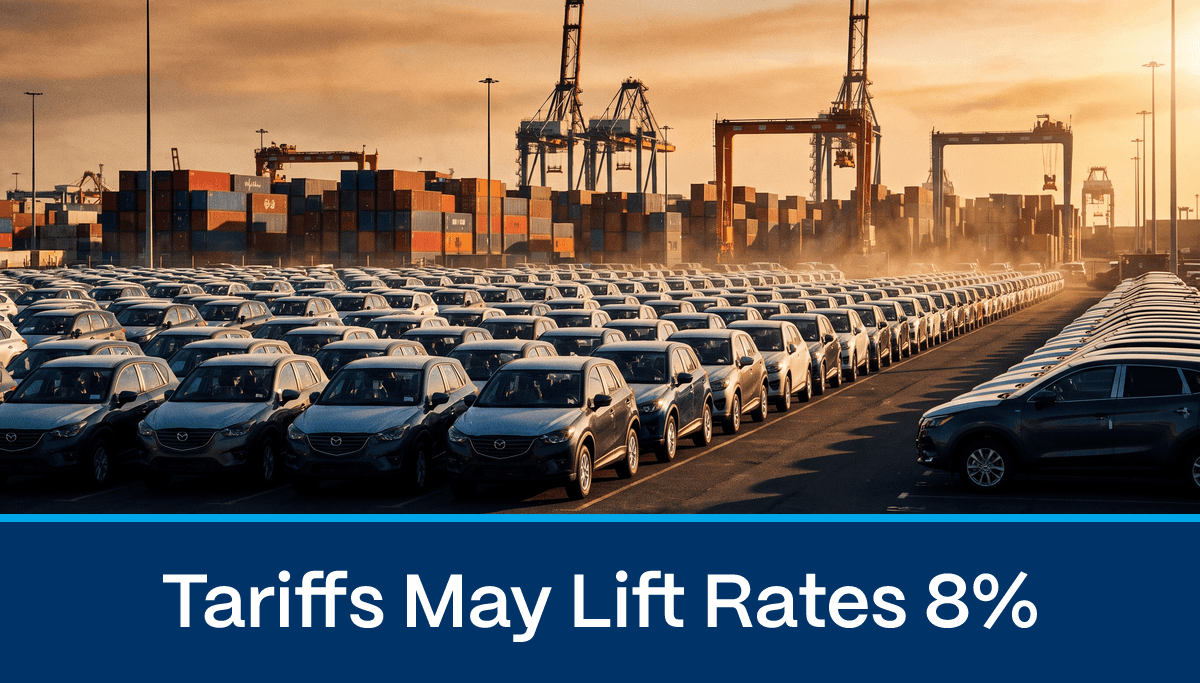
Some industry analysts estimate that the 25% tariffs imposed on imported vehicles and many automotive components would increase insurance costs by roughly 8% on average, beyond underlying inflation and other existing cost pressures. And that estimate may be conservative.
"The tariff math worries me more than the 8% headline suggests. That number assumes a clean pass-through. But parts inflation tends to compound. Repair costs go up, claims get more expensive, and insurers price that risk forward. So consumers can see the hit before the tariff even fully lands, which is part of why rates feel jumpy.", Josh Katz, CPA and founder of Universal Tax Professionals, Ohio
Katz's point about compounding deserves attention. An 8% tariff-driven increase layered on top of baseline rate increases that have not fully stopped does not average out. It stacks.
Firestine made the same observation from the policyholder side: "Customers on the North Shore [of Chicago] who renewed last spring at a 6% increase are going to face another 10% or more when tariff-driven parts costs work through the system. These things don't average out. They compound."
Katz also noted that repair shop owners among his clients are already stockpiling parts ahead of expected price increases, a behavior that ties up cash while doing nothing to reduce the eventual cost to consumers.
Which Vehicles Face the Highest Tariff Exposure
Not every driver faces the same level of risk. Insurify's analysis identified five vehicle brands whose owners could face some of the largest premium increases, specifically because of their reliance on imported vehicles and components.
| Buick | Heavy reliance on vehicles imported from outside the U.S. |
| Hyundai | Significant South Korean production and parts sourcing |
| Kia | South Korean manufacturing base, trade agreement tariff impact |
| BMW | European production, 15% trade-agreement tariff on imports |
| Mazda | Japanese manufacturing, 15% trade-agreement tariff on imports |
Ownership of one of these vehicles does not guarantee an immediate rate increase. Insurance pricing reflects a wide range of individual factors: driving record, age, gender, location, claims history, and the competitive behavior of insurers in a given market.
However, the directional logic is consistent: vehicles with higher repair costs generally become more expensive to insure over time. When imported parts for a Hyundai or BMW cost more because of tariffs, the claims economics for those vehicles shift, and insurers eventually price that into policies.
Drivers in states with already-competitive insurance markets, like Ohio or North Carolina, may see insurers absorb some of this pressure in the short term to retain customers. Drivers in markets with fewer competitive options may see the impact more quickly.
Total Losses Are Hitting a Record High, and Tariffs Will Push the Threshold Lower
A record 23.1% of auto insurance claims now result in total losses, according to industry data. That number was already climbing before tariffs became a significant factor, driven largely by the growing complexity and cost of modern vehicle electronics, cameras, radar sensors, and advanced driver-assistance systems.
Tariffs will accelerate this trend.
The math that determines a total loss is relatively simple. When the cost of repairing a vehicle exceeds a certain percentage of its actual cash value, typically somewhere between 70% and 80% depending on the state and insurer, the vehicle is declared a total loss and the insurer pays out replacement value rather than repair costs.
Rising parts costs from tariffs shrink the gap between "repairable" and "totaled." Firestine described it directly: "A 35 mph collision that damages a bumper, a camera mount, and an ADAS module can push repair costs past 70% to 80% of actual cash value on a vehicle that drives away from the scene. Tariffs on parts will push that threshold lower, meaning more vehicles get totaled, insurers pay out more actual cash value claims, loss ratios rise, and that feeds directly back into next year's premiums."
For the insurance industry, more total-loss claims means higher aggregate payouts. Higher payouts mean deteriorating loss ratios. Deteriorating loss ratios are what regulators typically approve rate increase filings to address. The feedback loop runs directly from a tariffed bumper to your next renewal notice.
The SMQI tracks how total-loss trends and regional parts availability affect quote spreads across markets, and the pattern is consistent: as total-loss rates rise in a given region, the premium gap between minimum-coverage and full-coverage policies widens.
What this means for you
Shop your policy before your next renewal rather than letting it auto-renew, especially if you drive one of the high-exposure brands identified in Insurify's analysis. Consider raising your deductible if you have an emergency fund that can absorb a claim, a move that Katz specifically recommends for drivers on fixed incomes who want to offset premium increases. Ask your insurer about telematics and safe-driver programs, which can produce discounts that partially offset tariff-driven rate pressure. Bundling auto with home or renters coverage remains one of the most consistent ways to reduce your overall insurance spend regardless of what the broader market is doing.
FAQ
How much could tariffs raise car insurance premiums?
Insurify projects a baseline increase of about 1% in 2026 for average full-coverage premiums. If tariffs significantly raise vehicle repair and replacement costs, that estimate rises to about 4%. Some industry analysts estimate that the 25% tariffs on imported vehicles and components could push costs roughly 8% higher beyond other existing pressures.
Which car brands face the highest tariff-related insurance risk?
Insurify's analysis identified Buick, Hyundai, Kia, BMW, and Mazda owners as potentially facing the largest premium increases, due to those brands' reliance on imported vehicles and components. This does not mean immediate rate hikes are guaranteed, as many individual factors influence pricing.
When will tariff costs show up in my car insurance premium?
The 12-to-18-month regulatory lag means that even though many tariffs took effect in April 2025, most consumers will not see the full pricing impact on their policies until late 2026 or 2027. Insurers must collect claims data, evaluate cost trends, and obtain regulatory approval before implementing rate changes.
Why are total losses rising, and what does that have to do with tariffs?
A record 23.1% of auto insurance claims now result in total losses, driven by the increasing cost of modern vehicle electronics and advanced safety systems. Tariffs on imported parts raise repair costs further, pushing more vehicles past the total-loss threshold sooner, which increases insurer payouts and puts upward pressure on future premiums.
What can drivers do right now to protect themselves from rising premiums?
Experts recommend shopping rates annually, increasing deductibles when financially feasible, bundling policies, maintaining continuous coverage, and asking about telematics or safe-driver discounts. Comparing quotes before renewal, particularly for drivers who own vehicles with high import-parts dependency, is especially important while insurer competition remains relatively strong.
The Timeline to Watch: When Tariff Costs Are Likely to Hit Policies
The sequence from tariff implementation to policyholder impact follows a predictable pattern, even if the exact timing varies.
Many tariffs on imported vehicles and automotive components took effect in April 2025. Repair shops began seeing parts cost increases shortly after, with some shop owners stockpiling inventory in anticipation of further increases. That behavior drives up demand, which can accelerate price inflation beyond what the tariff rate alone would imply.
Over the following months, claims costs begin rising as those more expensive parts flow into repairs. Insurers accumulate data on the shift. The 12-to-18-month regulatory approval process means that rate filings based on early 2025 tariff impacts could reach consumers in late 2026. Rate filings reflecting the compounded effect of ongoing parts inflation could arrive in 2027.
The signals to monitor at each renewal are straightforward: - Whether your insurer is filing for rate increases in your state - Whether your vehicle's make and model has appeared in high-exposure analyses - Whether your current deductible is still appropriate given your emergency fund - Whether competing insurers are offering materially lower quotes for equivalent coverage
The same forces that drove insurance costs sharply higher during the pandemic, supply-chain disruptions, rising repair costs, and more expensive claims, are gathering again. This time, tariffs are the accelerant.
About Brooke Grissom
Brooke Grissom is an Independent Insurance Analyst at SaveMaxAuto, licensed in Property & Casualty and Health insurance. She covers data-driven market trends, cross-state premium comparisons, and carrier financial analysis. Read more from Brooke Grissom →
Edited by Taleah McGuire.
Methodology
This article is grounded in the source linked above. SaveMaxAuto data points referenced here are drawn from the Save Max Quote Index (SMQI), a proprietary instrument reflecting 3,364,317 real consumer quote requests submitted to savemaxauto.com. State and carrier rankings reflect the lifetime dataset; year-over-year shifts reflect a rolling 12-month window. The index is refreshed monthly. External authority figures referenced (NAIC, NHTSA, state regulators) reflect the most recent public data releases available at time of writing.
Sources
- Primary source: Insurify, "What Do Tariffs Mean for Car Insurance Relief?"