
State Farm Dropped Roadside Assistance After 4 Calls Despite 17 Years of Premiums
A woman who paid State Farm premiums for 17 straight years received a letter at renewal stripping her Emergency Road Service, after just four roadside calls in two years. That story, reported by Gadget Review, exposes a threshold State Farm never publishes in its marketing: roughly 3 to 5 uses within a two-year window can trigger removal of the...


Published: Sep 15, 2026
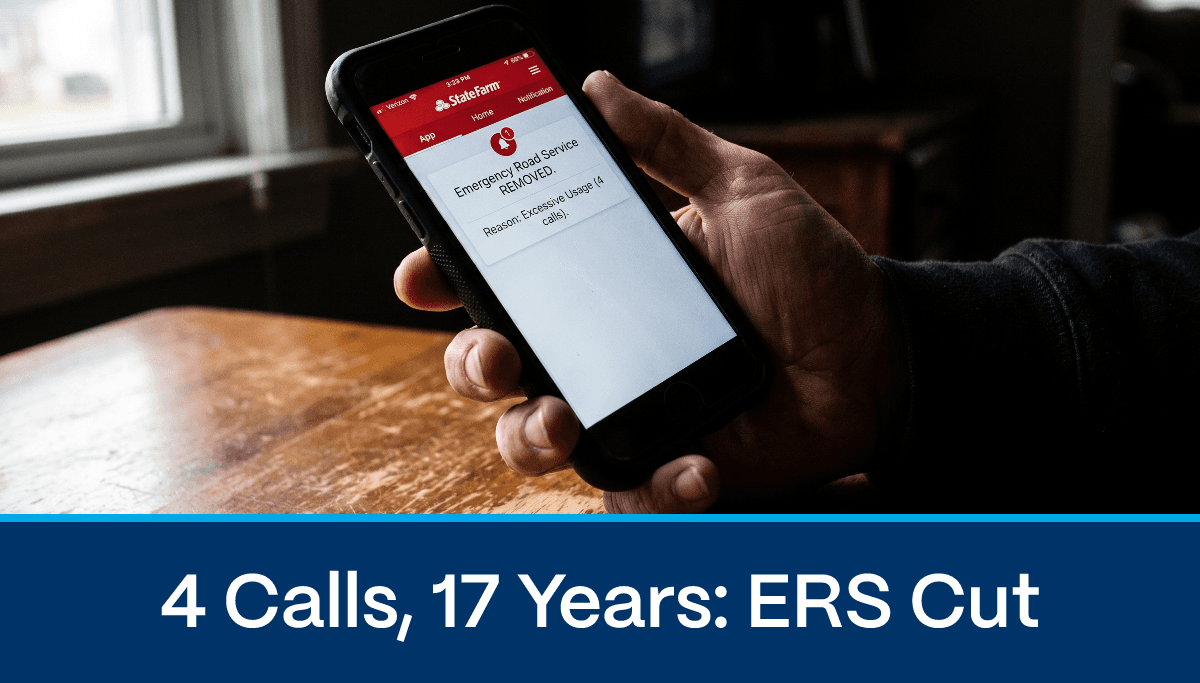
A woman who paid State Farm premiums for 17 straight years received a letter at renewal stripping her Emergency Road Service, after just four roadside calls in two years.
That story, reported by Gadget Review, exposes a threshold State Farm never publishes in its marketing: roughly 3 to 5 uses within a two-year window can trigger removal of the ERS endorsement at renewal. If you carry State Farm roadside assistance and have ever called for a tow or a jump-start, Gadget Review confirms that each call is logged as a claim in State Farm's underwriting system, whether your premium changes or not.
The primary keyword here answers your search directly: State Farm roadside assistance dropped is not a glitch. It is a documented, legal, industry-wide practice that most policyholders never see coming.
17 Years of Premiums, Then a Letter
She had been paying for State Farm's Emergency Road Service since the early 2000s. Seventeen years of uninterrupted premiums. Then came four service calls across two years, and a letter.
State Farm removed the ERS endorsement at renewal. Her core auto policy stayed intact. The roadside coverage she had quietly paid for across nearly two decades did not survive.
What makes this story land harder than a routine cancellation notice is the math. State Farm's ERS endorsement costs roughly $17 a year, or about $0.80 a month. A single tow call can cost State Farm many times that annual premium. According to one agent example cited in insurance forum commentary, approximately $1,000 in roadside services had been rendered against $20 in premium over a two-year stretch.
From an actuarial standpoint, removing the endorsement is rational. From a customer standpoint, using a benefit you paid for continuously for nearly two decades should not arrive as a surprise in a letter.
The Save Max Quote Index, drawn from 3.3 million+ real quote requests, consistently shows that ERS add-ons are among the least understood line items on a standard auto policy, drivers select them assuming perpetual availability, rarely reading the endorsement document for removal conditions. That blind spot is exactly what makes this case instructive.
The Usage Threshold State Farm Never Publishes
Here is the accountability gap at the center of this story.
State Farm's official ERS endorsement document, identified in source reporting as 9835C.pdf, details what the coverage includes: towing, jump-starts, locksmith services, fuel delivery, and up to one hour of on-site labor. What the document does not include is any numerical threshold governing how many times you can use ERS before underwriters remove it.
Consumer FAQ sources and insurance forum commentary report the same internal pattern: roughly 3 to 5 ERS uses within a two-year period can trigger removal at renewal. One insurance worker commenting in a State Farm forum noted that ERS coverage is "taken away for overuse" and that reinstatement can take roughly three years.
That is anecdotal. But it is consistent with dozens of similar accounts across insurance forums, all describing the same sequence: usage, silence, then a letter.
State Farm's marketing describes 24/7 availability and straightforward access. Nowhere in that consumer-facing copy does any usage threshold appear. Customers learn the rules only after the coverage is already gone.
"ERS coverage is 'taken away for overuse' and reinstatement can take roughly three years." , Insurance forum worker, cited in Gadget Review
Two Caps, One Policy: How the Math Works Against You
Most drivers assume roadside coverage works like a phone plan, use it up to the stated limit, pay the stated price, repeat next year.
State Farm's ERS structure is more layered than that.
The first cap is the plan-level annual limit. Independent consumer explainers note that basic ERS covers around four service calls per 12-month period. That is the number most people associate with their coverage.
The second cap is the underwriting-level removal trigger. This one operates across a longer window, two years, and can remove the endorsement entirely at renewal, even when a customer never exceeded the annual limit.
Here is how those two mechanisms can collide:
| Year 1 | 2 | No | 2 | Low |
| Year 2 | 2 | No | 4 | Potentially high |
| Year 2 | 3 | No (if cap is 4) | 5 | Likely triggered |
A driver who uses ERS twice in year one and twice in year two may never break a single annual rule. That same driver can still receive a non-renewal letter for the endorsement. The 17-year customer's experience maps almost exactly onto this pattern.
Premium Collected vs. Cost Per Claim: The Actuarial Reality
The numbers tell a straightforward story, straightforward for State Farm's underwriters, at least.
ERS costs roughly $17 a year. That translates to approximately $0.80 per month. A single roadside tow, by contrast, can cost State Farm many times that annual premium. Consumer forum commentary cited in source reporting describes approximately $1,000 in roadside services rendered against $20 in premium over two years.
That ratio, $1,000 in services against $20 in collected premium, makes the removal decision actuarially obvious. No insurer can sustain a product where per-incident costs routinely exceed annual premium by 50 to 1.
What is not obvious, and what no carrier has chosen to make transparent, is the specific usage level that tips the calculation. The SMQI shows that drivers shopping for full-coverage policies frequently select ERS as a low-cost add-on without any written guidance about how usage frequency affects their eligibility to keep it. The product is priced for infrequent use. The marketing never says so.
Is This Legal, and Is State Farm Alone?
Short answer: yes, and no.
Most U.S. states permit insurers to non-renew optional endorsements at renewal, provided proper written notice is given. State Farm's removal of ERS is not a mid-term cancellation. It happens at the policy renewal point, which gives it legal standing in standard insurance regulatory frameworks.
The legality is not in dispute. The transparency is.
Comparable removal practices are documented at other carriers. This is an industry-wide behavior, not an isolated State Farm offense. Drivers in states with higher average insurance costs, Georgia car insurance and Florida auto insurance markets, for example, often carry roadside endorsements as a budget alternative to standalone memberships, making this gap especially consequential for cost-sensitive consumers.
"Nowhere in the marketing does State Farm disclose that three or four uses in two years may trigger removal. Customers learn that only after the fact, in a letter." , Gadget Review
The non-disclosure is legal. That does not mean it is defensible.
What this means for you
Treat your insurer's ERS add-on as a genuine last resort, not a routine convenience, every call is tracked as a claim in the underwriting system. Ask your agent explicitly about usage thresholds and request the answer in writing, not just a verbal reassurance. Drivers with older vehicles or frequent roadside needs should evaluate a standalone membership like AAA, which prices its service around frequent use rather than against it. If you live in a state with complex insurance regulations, like California auto insurance or Texas auto insurance markets, verify whether your state's department of insurance requires carriers to disclose usage-based removal criteria before you sign.
The Fix Is One Sentence in the Marketing Copy
The solution State Farm, and every carrier offering bundled roadside assistance, needs to implement is simple.
Put the usage threshold in the marketing copy. Three to five uses in two years, or whatever the actual number is, should be visible to customers before they enroll in ERS coverage. Not buried in an endorsement document numbered 9835C.pdf. Not delivered in a letter after the coverage has already been removed.
One sentence. Something like: "Customers who use ERS more than [X] times in a two-year period may not be offered renewal of this endorsement." That sentence would change everything about informed consent.
The 17-year customer did not game the system. She used a benefit she had paid for, continuously, since the early 2000s. The product was marketed as available. The internal rules said otherwise. And no one told her until it was already gone.
That is a consumer-protection problem. It has a consumer-protection fix. The only barrier is industry will.
FAQ
Can State Farm legally remove my roadside assistance without canceling my full policy?
Yes. Most U.S. states allow insurers to non-renew optional endorsements at renewal while keeping the core policy active, as long as proper written notice is provided. State Farm's ERS removal is applied at the renewal point, which meets the legal standard in standard insurance regulatory frameworks. Your liability and collision coverage are not affected by ERS non-renewal.
How many roadside assistance calls triggers removal from State Farm?
Consumer forum commentary and insurance sources consistently report an internal underwriting threshold of roughly 3 to 5 ERS uses within a two-year period. State Farm does not publish this number in its consumer-facing marketing materials or in its official endorsement document (9835C.pdf). You will not know you have crossed the threshold until you receive a non-renewal letter.
What is the difference between the annual ERS call limit and the underwriting removal trigger?
The annual plan-level limit covers approximately four service calls per 12-month period. The underwriting removal trigger operates across a two-year cumulative window and can result in the endorsement being dropped at renewal even if you never exceeded the annual cap in either individual year. These are two separate mechanisms, and most customers are unaware the second one exists.
Is AAA a better option than State Farm's Emergency Road Service?
For drivers with older vehicles or predictable roadside needs, a standalone membership like AAA may offer more stability because it is priced around frequent use rather than against it. State Farm's ERS is priced at roughly $17 a year, which makes it attractive initially, but the removal risk after a handful of claims makes it less reliable for high-use drivers. Evaluate your call history honestly before deciding which product fits your situation.
Does using roadside assistance raise my car insurance premium?
Using ERS does not directly raise your auto insurance premium, according to source reporting. However, every ERS call is tracked as a claim in State Farm's underwriting system. That usage history can influence the underwriting decision to non-renew the endorsement at renewal, even if your main policy premium remains unchanged.
About Aaren Ramon
Aaren Ramon is a Senior Analyst at Save Max Auto and owner of Elite Shield Agency. He covers carrier moves, regional insurance markets, and consumer-impact reporting from the agency-owner perspective. Read more from Aaren Ramon →
Edited by Taleah McGuire.
Methodology
This article is grounded in the source linked above. Save Max Auto data points referenced here are drawn from the Save Max Quote Index (SMQI), a proprietary instrument reflecting 3,364,317 real consumer quote requests submitted to savemaxauto.com. State and carrier rankings reflect the lifetime dataset; year-over-year shifts reflect a rolling 12-month window. The index is refreshed monthly. External authority figures referenced (NAIC, NHTSA, state regulators) reflect the most recent public data releases available at time of writing.
Sources
- Primary source: Gadget Review, "State Farm Sold Her Roadside Coverage for 17 Years. Four Roadside Calls in Two Years, and State Farm Dropped Her Coverage"