
Ohio Court Rules State Farm Bad Faith Claim Fails Over Subrogation Payout
While most policyholders assume their medical payments coverage goes directly to them, an Ohio appeals court just ruled that State Farm acted reasonably when it sent the money somewhere else entirely.


Published: Jul 31, 2026
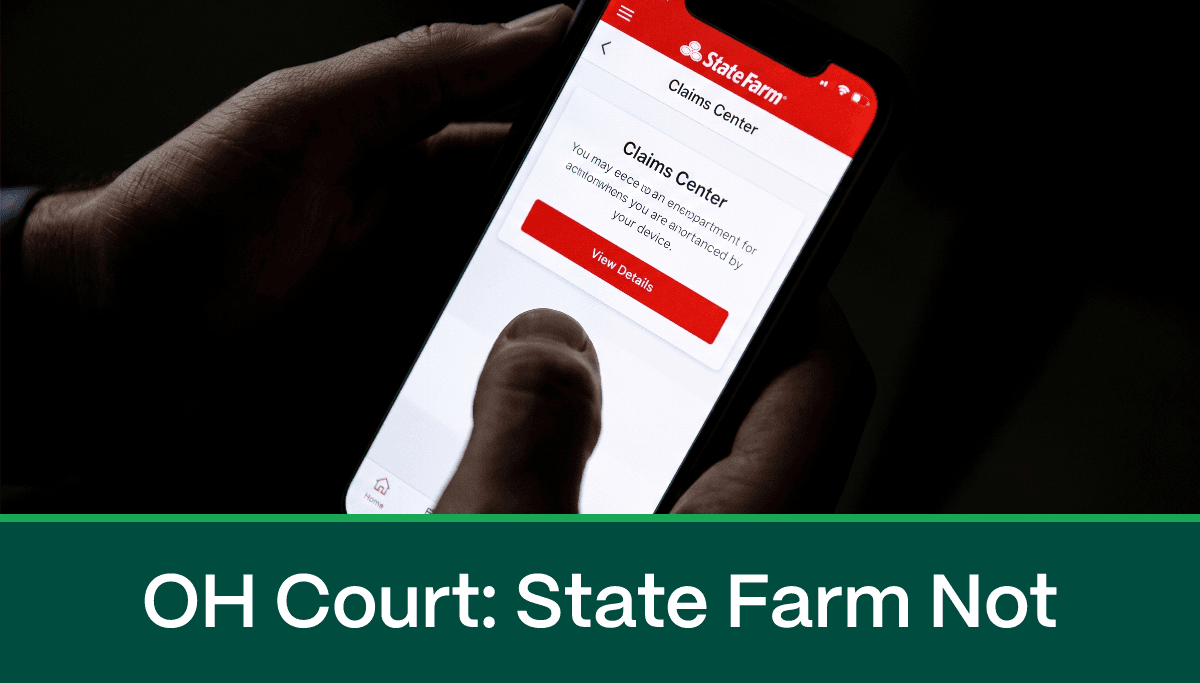
While most policyholders assume their medical payments coverage goes directly to them, an Ohio appeals court just ruled that State Farm acted reasonably when it sent the money somewhere else entirely.
According to Insurance Business, the court upheld a lower court ruling for State Farm on July 28, 2026, rejecting claims of both breach of contract and bad faith in a case that began with a 2019 car accident in Franklin County, Ohio. The decision touches three distinct legal questions that matter to any driver carrying medical payments coverage. Insurance Business reports the driver sued after State Farm routed $4,809.03 of her $5,000 MPC benefit to a third-party subrogation vendor rather than to her directly, and then took nearly four years to issue the remaining $190.07.
The State Farm bad faith ruling is now final at the appellate level, and it sets a clear bar for what "reasonable justification" means in Ohio claims handling.
State Farm Wins Appeals Court Battle Over Medical Payments Payout
The case started simply enough. A Franklin County driver was injured in a 2019 crash she blamed on the other motorist. She carried a State Farm policy with $5,000 in medical payments coverage, a first-party benefit designed to pay medical bills regardless of who caused the accident.
Her health insurer, Medical Mutual of Ohio, stepped in first and covered her accident-related bills. That act set the legal machinery in motion.
Medical Mutual then turned to a third-party vendor called The Rawlings Company to file a subrogation claim against State Farm, essentially asking to be reimbursed for what it had already paid. In October 2020, State Farm sent $4,809.03 of the MPC benefit directly to Rawlings.
The policyholder argued the money should have come to her, not the vendor. She also flagged that the remaining $190.07 sat unpaid until May 2024, a gap of roughly four years. She sued on two grounds: breach of contract and bad faith.
The trial court ruled against her on both counts, and the Ohio appeals court agreed. For Ohio drivers navigating their own coverage questions, this ruling clarifies how subrogation and MPC interact when a health insurer pays first.
How a Subrogation Claim Rerouted the Payout
Subrogation is the legal process that lets one party step into another's shoes to recover a payment. Here is what that meant in practice for this claim.
Medical Mutual of Ohio paid the driver's crash-related medical bills first. Under subrogation principles, it then had a right to seek reimbursement from whoever was ultimately responsible for those costs.
Rather than waiting on the driver's liability claim against the at-fault motorist, Medical Mutual went after State Farm's MPC benefit through The Rawlings Company, its designated vendor for these recoveries. State Farm honored that subrogation claim by paying Rawlings $4,809.03 directly out of the $5,000 MPC limit.
The policyholder's core argument was that the MPC benefit belonged to her. The court disagreed. Because Medical Mutual had already paid her bills, the subrogation right had already vested. Paying Rawlings was not a breach of the policy; it was a legally recognized fulfillment of it.
This dynamic appears more frequently than many drivers realize. The Save Max Quote Index, drawn from 3.3 million+ real quote requests, shows that a significant share of drivers adding MPC to their policies do not know their health insurer can claw back those funds through subrogation if it pays first. Understanding who holds the reimbursement right before a claim happens is critical.
Why the Four-Year Delay on $190 Did Not Count as Bad Faith
Here is the part of the ruling that surprises most people: a nearly four-year wait for $190.07 was deemed reasonable.
The trial court pointed to a specific fact. The driver did not turn over her medical records until after she had already filed her lawsuit, during the discovery phase. That timing mattered enormously.
In Ohio, an insurer commits bad faith when it denies or delays a claim for an "arbitrary or capricious" reason. The standard is deliberately forgiving. Courts look at whether the insurer's decision "lacked a reasonable justification," not whether the insurer made the perfect call.
The court acknowledged that even "foot-dragging" can support a bad faith claim under Ohio law. But the key word is "can." The driver still had to show the delay was unjustified, and the court found she could not. State Farm's position that it needed her medical records to substantiate the remaining balance was found to be a legitimate business reason, not stonewalling.
With the breach of contract claim already resolved in State Farm's favor, and the delay explained by the records dispute, the appeals court found there was no genuine dispute remaining to take to trial.
Drivers in neighboring states face similar good-faith standards. If you are in Indiana and wondering how your insurer's claims obligations differ, state-specific rules can shift the calculus significantly.
MPC vs. Health Insurance: Who Gets Reimbursed and When
Understanding how medical payments coverage and health insurance interact requires following a claim step by step. Here is how the timeline played out in the Franklin County case.
| Car accident occurs | 2019 | Driver injured in Franklin County crash |
| Health insurer pays | Before Oct. 2020 | Medical Mutual of Ohio covers medical bills |
| Subrogation filed | Before Oct. 2020 | Rawlings files claim on Medical Mutual's behalf |
| MPC partial payout | October 2020 | State Farm pays $4,809.03 to Rawlings |
| Driver sues | Before May 2024 | Breach of contract and bad faith lawsuit filed |
| Medical records produced | During discovery | Driver turns over records after filing suit |
| Final MPC payment | May 2024 | State Farm pays remaining $190.07 |
| Appeals court ruling | July 28, 2026 | Ohio court affirms for State Farm |
The sequence shows that by the time State Farm cut its check in October 2020, Medical Mutual had already exercised its subrogation right. The driver's window to receive the MPC funds directly had effectively closed before the insurer acted.
The Medical Records Fight and What Your Policy Authorizes
Buried in the ruling is a second legal fight that gets less attention but has real privacy implications.
The driver sought a protective order against State Farm. She wanted to prevent the insurer from "selling, publishing, sharing, or exchanging" her health information. The court denied the request.
Why? The answer was in her own policy language.
"The policy required her to authorize State Farm to obtain records it 'deems necessary to substantiate' her claims."
And there was a second provision just as important:
The policy "barred her from 'restricting State Farm from retaining and using that information for legitimate lawful business functions.'"
The court's reasoning was straightforward. The driver had agreed to these terms when she purchased the policy. Her concern that State Farm "may sell" her data was speculative, not a showing of real, concrete harm. Without demonstrated injury, the protective order had no legal footing.
This outcome matters because many policyholders do not read their policies closely enough to know they have pre-authorized broad record access. Pennsylvania policyholders and Kentucky drivers operate under similar policy authorization frameworks, even if state-specific privacy statutes add some additional protections.
What this means for you
If you carry medical payments coverage, read your policy's subrogation and authorization language before a claim arises. When your health insurer pays your crash bills first, contact your insurer promptly to ask whether a subrogation claim has been filed so you know who will ultimately receive your MPC benefit. Provide requested medical records as early as possible in the claims process, because withholding them, even unintentionally, can justify delays that courts later deem reasonable. Review the privacy and records-authorization clauses in your policy now so that a future records dispute does not catch you off guard.
FAQ
Can my insurer legally pay my medical payments benefit to a subrogation vendor instead of to me?
Yes, under the Ohio ruling, it can. Once your health insurer pays your medical bills and files a subrogation claim, it acquires the right to reimbursement from your MPC benefit. State Farm's payment of $4,809.03 directly to The Rawlings Company was upheld as a valid fulfillment of the policy, not a breach.
What is the bad faith standard for insurance claims delays in Ohio?
Ohio requires insurers to handle and pay claims in good faith. An insurer commits bad faith when it denies or delays a claim for an "arbitrary or capricious" reason. The legal test is not whether the insurer made the correct decision, but whether its decision "lacked a reasonable justification." A delay tied to a policyholder's failure to produce medical records can meet that justification threshold.
Does my auto insurance policy give my insurer the right to access my medical records?
Most standard policies include language requiring you to authorize the insurer to obtain records it "deems necessary to substantiate" your claims. The Ohio court found that the driver's policy also barred her from restricting State Farm from retaining and using that information for legitimate lawful business functions. Always review these clauses in your own policy documents.
What is medical payments coverage and how does it work with health insurance?
Medical payments coverage, or MPC, is a first-party auto insurance benefit that pays medical bills resulting from a car accident regardless of who was at fault. When your health insurer pays those bills first and then files a subrogation claim against your MPC benefit, the MPC funds may go to the health insurer's recovery vendor rather than directly to you, as this Ohio case demonstrated.
How long does an insurer have to pay a medical payments claim in Ohio?
Ohio does not set a rigid universal deadline, but it does require good-faith handling. The court in this case found a delay from October 2020 to May 2024 on a $190.07 balance to be reasonable because the policyholder withheld medical records until after filing suit. The SMQI reflects that claims disputes involving documentation gaps are among the most common drivers of extended payout timelines.
About Brooke Grissom
Brooke Grissom is an Independent Insurance Analyst at Save Max Auto, licensed in Property & Casualty and Health insurance. She covers data-driven market trends, cross-state premium comparisons, and carrier financial analysis. Read more from Brooke Grissom →
Edited by Cassidy Richey.
Methodology
This article is grounded in the source linked above. Save Max Auto data points referenced here are drawn from the Save Max Quote Index (SMQI), a proprietary instrument reflecting 3,364,317 real consumer quote requests submitted to savemaxauto.com. State and carrier rankings reflect the lifetime dataset; year-over-year shifts reflect a rolling 12-month window. The index is refreshed monthly. External authority figures referenced (NAIC, NHTSA, state regulators) reflect the most recent public data releases available at time of writing.
Sources
- Primary source: Insurance Business, "State Farm avoids bad faith liability in disputed crash payout ruling"