
5 Maryland Cops Exploited Badge Privileges to Run a Staged-Theft Fraud Ring
While most drivers assume a police report is the gold standard of proof in an insurance claim, five Maryland law enforcement officers turned that trust into the foundation of a fraud ring. Insurance Journal reported on July 13, 2026, that a federal judge sentenced former Anne Arundel County police officer Jaron Earl Taylor to three years of...


Published: Jul 14, 2026
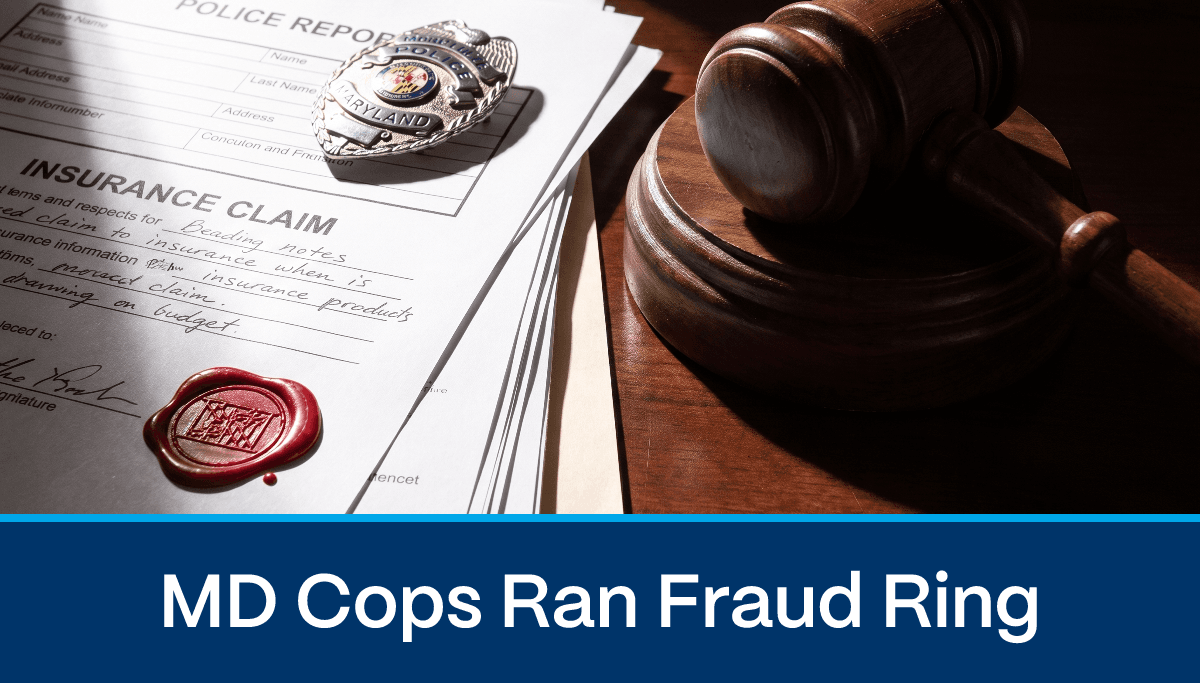
While most drivers assume a police report is the gold standard of proof in an insurance claim, five Maryland law enforcement officers turned that trust into the foundation of a fraud ring.
Insurance Journal reported on July 13, 2026, that a federal judge sentenced former Anne Arundel County police officer Jaron Earl Taylor to three years of probation for conspiracy to commit wire fraud, with the first five months served on home detention. The scheme, detailed by Insurance Journal, ran between August 2018 and February 2020 and ensnared officers from multiple Maryland jurisdictions. At its core, the conspiracy exploited something most insurers almost never question: a sworn officer's own police report.
Officers Sworn to Uphold the Law Became the Fraud Scheme's Engine
Jaron Earl Taylor, of Ft. Washington, Maryland, was an Anne Arundel County Police Department officer. His co-conspirator, Michael Anthony Owen, Jr., of Accokeek, served the Prince George's County Police Department. Together, and alongside three other officers, they built a scheme designed to make insurers pay off unwanted vehicles through fictitious theft claims.
The additional co-conspirators were Candace Tyler, of Bowie; Conrad D'Haiti, of La Plata; and Davion Percy, of Suitland. All five were among a broader group indicted in 2021. The group's core tactic was straightforward: use their law enforcement credentials to write false police reports, then submit those reports to insurance companies as evidence of legitimate losses.
Taylor himself pled guilty to conspiracy to commit wire fraud in June. A federal judge ordered him to pay $38,670 in restitution to the United States Automobile Association, known as USAA. Co-conspirator Owen separately pled guilty to falsifying records, with sentencing scheduled for August 18.
The conspiracy was not spontaneous. Court documents show it was a deliberate, multi-incident operation spanning nearly 18 months, with each officer playing a defined role in manufacturing believable insurance claims.
How the Staged-Theft Playbook Actually Worked
Three specific incidents illustrate exactly how the fraud was executed, each with its own vehicle, insurer, and method of disposal.
The Chevrolet Tahoe (August 2018): Taylor and Owen staged the theft of Taylor's own Chevrolet Tahoe. After Taylor filed a fraudulent police report, the pair stripped the vehicle and drove it into the woods off a Maryland state highway near Largo. Taylor then filed a false claim with USAA.
The Jaguar XKR (January 2020): Owen assisted D'Haiti in avoiding the remaining loan balance on a Jaguar XKR. Working with D'Haiti and Percy, Owen helped orchestrate a fake theft. On January 4, D'Haiti parked the Jaguar behind a shopping center in the town where Percy served as police chief. D'Haiti then paid Percy $350 to arrange for another co-conspirator to tow the vehicle and vandalize it to manufacture a total-loss scenario. Tyler filed the false police report D'Haiti used to substantiate a claim against Liberty Mutual Insurance.
The Infiniti Sedan (January 2020): Taylor and Owen helped a co-conspirator dispose of an Infiniti sedan while that person was on extended overseas duty. The co-conspirator paid Taylor $1,000 to stage the theft. Taylor forwarded the money to Owen, who filed a false police report with PGPD claiming the car was stolen. Instead, the group moved the vehicle to a Camp Springs apartment-complex parking garage, removed its license plates, and replaced them with plates registered to a different vehicle before the owner filed a claim with GEICO.
The professional credibility of a police report, combined with the officers' ability to file those reports themselves, created a nearly seamless paper trail for each claim.
By the Numbers: What Each Fraud Incident Cost Insurers
| Chevrolet Tahoe | August 2018 | USAA | $38,670 paid out | Stripped and driven into woods near Largo |
| Jaguar XKR | January 2020 | Liberty Mutual | $17,585 paid to Navy Federal Credit Union | Towed, vandalized to create total loss |
| Infiniti Sedan | January 2020 | GEICO | Claim denied for fraud | Moved to Camp Springs garage, plates swapped |
The two successful payouts totaled $56,255 in direct insurer losses. The GEICO claim stands apart: it is the only one that was denied, making it the single point where the scheme visibly failed.
Why Insurers Found It Hard to Spot, Until GEICO Didn't
Police-report-backed fraud is among the hardest categories for insurers to flag early. When the person filing the report is also the officer investigating the "theft," the documentation appears internally consistent. There is no conflicting witness account, no timeline gap, and no obvious motive to question.
"The co-conspirators were accused of using their statuses as police officers to assist each other's claims by writing false police reports."
That institutional trust is precisely what made this scheme effective across two separate insurers. Both USAA and Liberty Mutual paid out based on the paper trail the officers created for each other.
GEICO's denial of the Infiniti claim signals that something in that submission triggered a fraud review. The source does not detail GEICO's specific reasoning, but the outcome suggests that anomalies, such as the swapped license plates or the overseas-duty timing, may have raised flags that the earlier claims did not.
For Maryland drivers already navigating some of the highest premiums in the Mid-Atlantic region, cases like this have a direct cost consequence. Every successful fraudulent payout gets factored into actuarial risk models, which in turn push up rates for honest policyholders.
Where Each Defendant Stands Today
The five named co-conspirators are at different stages of the legal process.
- Jaron Earl Taylor (Ft. Washington, MD): Sentenced to three years of probation, first five months on home detention; ordered to pay $38,670 in restitution to USAA.
- Michael Anthony Owen, Jr. (Accokeek, MD): Pled guilty to falsifying records; sentencing scheduled for August 18.
- Candace Tyler (Bowie, MD): Pled guilty to conspiracy to commit bank fraud; sentencing not yet reported in source.
- Conrad D'Haiti (La Plata, MD): Pled guilty to conspiracy to commit mail and wire fraud; sentencing not yet reported in source.
- Davion Percy (Suitland, MD): Convicted at trial by a jury in June 2026 on conspiracy to commit mail and wire fraud; sentencing not yet reported in source.
U.S. Attorney Kelly O. Hayes for the District of Maryland commended both the FBI and the Prince George's County Police Department for their investigative work on the case.
Percy's conviction at trial, rather than through a guilty plea, is notable. It means prosecutors had to present the full evidentiary picture to a jury, which ultimately found him guilty.
What this means for you
Staged-theft fraud of this type directly inflates comprehensive coverage premiums for every honest policyholder in the affected region. Review your comprehensive and uninsured-loss coverage annually, and if you ever receive an unexpected inquiry about a vehicle you own or previously owned, respond promptly and in writing. If you suspect you are being pulled into a fraudulent claim, report it immediately to your insurer's special investigations unit and consult an attorney before signing any documents.
The Save Max Quote Index, drawn from 3.3 million+ real quote requests, consistently shows that states with elevated fraud activity see measurable rate pressure across all policy types, not just theft claims. Shopping your policy annually, particularly in states with documented fraud trends, remains one of the most effective tools available to you. Virginia drivers, for example, can find meaningful rate variance across carriers by comparing quotes regularly, as can Pennsylvania policyholders facing their own complex rating environment.
The Bigger Pattern: Law Enforcement Fraud Is Not Isolated
This case does not stand alone. According to the source, a second, separate Maryland case involved a former Fairmount Heights police officer and a former Prince George's County police officer who were found guilty by a jury of wire fraud, arson, and insurance and bank fraud.
"The fraud schemes involving filing false police reports and falsifying loss claims to obtain funds from an insurance company and three different financial institutions."
That second case extended beyond auto insurance to include arson and bank fraud across three separate financial institutions, suggesting a broader pattern of law enforcement personnel exploiting their institutional access for financial gain.
Regulators and federal prosecutors are clearly treating this as a category worth sustained attention. The involvement of the FBI alongside local police departments in both investigations signals that police officer insurance fraud has risen to a level of federal enforcement priority. For insurers, it reinforces the need to independently verify claims that rely solely on a single officer's report, particularly when that officer has a financial relationship with the claimant.
The SMQI tracks quote behavior across all fifty states, and patterns in New Jersey and New York, where fraud-related rate pressure is well-documented, confirm that institutional fraud of any kind creates lasting actuarial consequences that honest drivers absorb through higher premiums for years afterward.
FAQ
What is police officer insurance fraud and how does it work?
Police officer insurance fraud involves law enforcement personnel using their official authority, particularly the ability to file police reports, to fabricate or corroborate false insurance claims. In the Maryland case, officers wrote fictitious theft reports for each other's vehicles, then submitted those reports to insurers as proof of loss to collect payouts or avoid loan obligations.
How did GEICO detect the fraud when USAA and Liberty Mutual did not?
The source does not specify GEICO's exact detection method. However, GEICO denied the Infiniti claim on grounds of fraud, while USAA paid $38,670 and Liberty Mutual paid $17,585 before the scheme was investigated. Differences in the Infiniti incident, such as the swapped license plates and the overseas-duty context, may have triggered a special investigations review.
What sentences did the Maryland officers receive for insurance fraud?
Jaron Earl Taylor received three years of probation with the first five months on home detention, plus $38,670 in restitution to USAA. Michael Anthony Owen, Jr. pled guilty to falsifying records and faces sentencing on August 18. Davion Percy was convicted at trial in June 2026. Candace Tyler and Conrad D'Haiti both pled guilty; their sentencing dates were not reported in the source.
Does insurance fraud by law enforcement affect my premiums?
Yes. When insurers pay out fraudulent claims, those losses are built into actuarial models that set future rates for all policyholders in a given region or coverage category. The two successful payouts in this case alone totaled more than $56,000, costs that are ultimately redistributed across honest customers through incremental premium increases.
How can I protect myself if I am falsely named in an insurance fraud investigation?
Respond promptly and in writing to any inquiry from your insurer or law enforcement. Preserve all documentation related to the vehicle in question, including purchase records, maintenance logs, and any communications. Report suspicious activity involving your vehicle or policy to your insurer's special investigations unit immediately, and consult a licensed attorney before providing a recorded statement.
About Brooke Grissom
Brooke Grissom is an Independent Insurance Analyst at Save Max Auto, licensed in Property & Casualty and Health insurance. She covers data-driven market trends, cross-state premium comparisons, and carrier financial analysis. Read more from Brooke Grissom →
Edited by Aaren Ramon.
Methodology
This article is grounded in the source linked above. Save Max Auto data points referenced here are drawn from the Save Max Quote Index (SMQI), a proprietary instrument reflecting 3,364,317 real consumer quote requests submitted to savemaxauto.com. State and carrier rankings reflect the lifetime dataset; year-over-year shifts reflect a rolling 12-month window. The index is refreshed monthly. External authority figures referenced (NAIC, NHTSA, state regulators) reflect the most recent public data releases available at time of writing.
Sources
- Primary source: Insurance Journal, "Police Officer Sentenced for Role in Insurance Fraud Conspiracy With Other Officers"