
Nevada Car Insurance Rates Are $72 Above the National Average, and Regulators Are Pointing at Drivers
Full-coverage car insurance in Nevada costs an average of $259 a month, a full $72 above the national average of $187, according to Las Vegas Sun reporting published September 23, 2026. That gap is not random.


Published: Sep 23, 2026
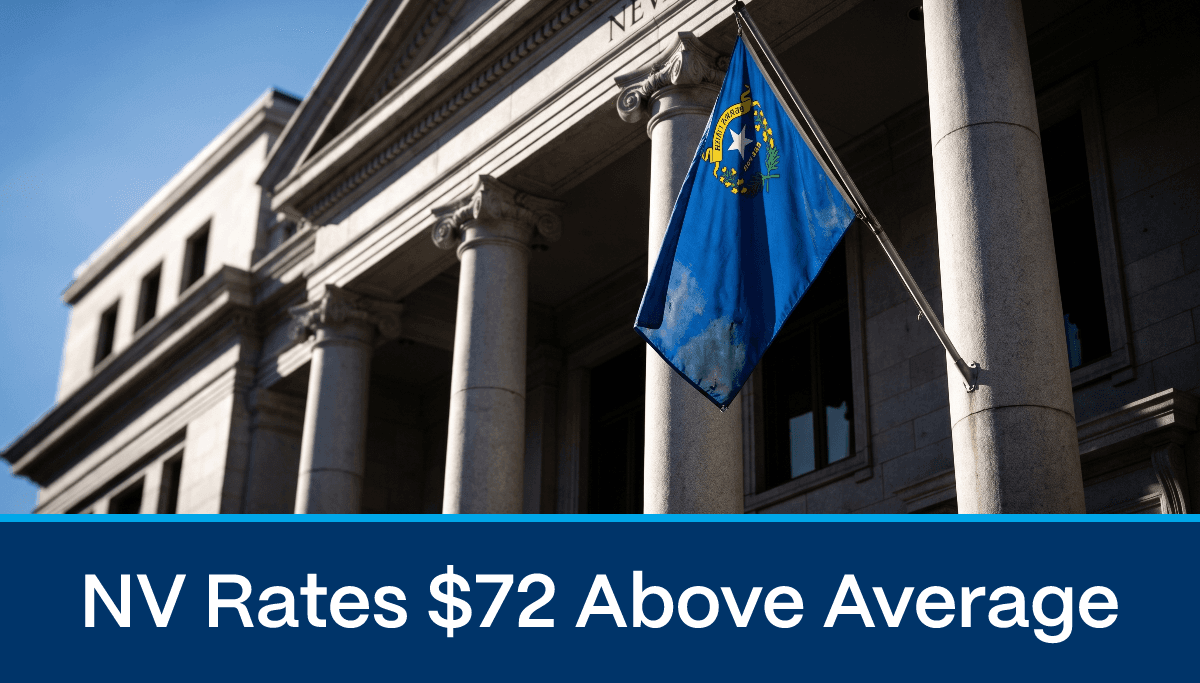
Full-coverage car insurance in Nevada costs an average of $259 a month, a full $72 above the national average of $187, according to Las Vegas Sun reporting published September 23, 2026.
That gap is not random. The Las Vegas Sun investigation found that Nevada's own insurance commissioner places the blame squarely on driving behavior, urban density, vehicle theft, uninsured motorists, and a national repair-cost crisis, a combination that one insurance law expert calls a "perfect storm." The Save Max Quote Index, drawn from 3.3 million+ real quote requests, consistently identifies Nevada among the most expensive states for full-coverage premiums, a pattern that tracks closely with the structural risk factors detailed below.
Nevada drivers pay $72 more a month than the national average, here's why
To understand why Nevada car insurance rates sit so far above the norm, you have to look at the full picture. Nevada drivers pay $259 a month on average for full coverage, which bundles liability, collision, and comprehensive protection. Compare that to the national average of $187, and the gap is $72 every single month.
It gets sharper when you look at neighboring states. Arizona drivers pay just $163 a month for the same coverage, $96 less than Nevadans, despite sharing a similar desert landscape and climate. That kind of spread tells you the issue isn't weather or geography alone.
"People, they just really need to drive better," said Ned Gaines, commissioner of the Nevada Division of Insurance.
Multiple forces are stacking on top of each other: dangerous driving habits, dense urban corridors, a booming nightlife economy, vehicle theft, uninsured motorists, and a national shortage of repair technicians. No single factor explains the full gap. All of them together do.
Dangerous driving habits are the biggest cost driver, regulators say
Start with the behavior behind the wheel. WalletHub ranks Nevada 42nd out of 50 states in its list of best driving states. ConsumerAffairs places Nevada sixth nationwide for aggressive and careless driving.
Those rankings have real consequences. Metro Police recorded 18,109 crashes in its jurisdiction in 2025, averaging about 50 collisions every single day.
"That really is what drives the majority of high rates," Gaines said. "People, they are not driving defensively; they're driving too fast."
Gaines also flagged distracted driving as a growing problem, calling it the leading reason drivers get into accidents. And Nevada's nightlife culture creates elevated DUI rates, according to Christa Rapoport, general counsel for the National Council of Insurance Legislators. DUIs and distracted driving both increase crash severity, not just frequency, and severity is what drives claim costs higher.
CDC data reinforces the concern, ranking Nevada among the top 15 states for accidental deaths per capita. That ranking keeps local risk levels persistently high, giving insurers every statistical reason to price Nevada policies at a premium.
How Nevada's urban density and 24/7 nightlife amplify crash risk
Geography compounds the behavioral problem. Nevada is the second-most urbanized state in the country, funneling over 94% of its population into dense regional corridors. More density means more vehicles on the same roads, more intersections, more opportunities for collisions.
Las Vegas operates around the clock. That 24/7 nightlife atmosphere means peak traffic risk doesn't follow the 9-to-5 pattern that planners and insurers typically model. Crashes happen late at night, when reaction times are slower, visibility is lower, and impaired driving is more likely.
"Specifically at nighttime, because of the 24/7 atmosphere of Vegas," Gaines said, explaining why accident severity tends to be worse in Nevada than in states with similar population sizes.
Rapoport described Nevada's conditions as a "perfect storm" for high car insurance premiums. The density, the nightlife, the DUI culture, and the distracted driving all feed into one another, and every factor that increases crash frequency or severity gets reflected in what you pay each month.
Car theft, uninsured drivers, and repair costs pile on
Beyond driving behavior, three secondary pressures are keeping Nevada car insurance rates elevated. Here is how they break down:
| Vehicle theft rate | 3rd highest in the U.S. | Behind only Washington D.C. and California (first half of 2025, per National Insurance Crime Bureau) |
| Uninsured drivers | 11.1% of Nevada motorists (2023) | Below the national rate of 15.4%, per Insurance Research Council data |
| Repair timeline | 3 to 4 weeks for a fender-bender | Up from roughly 1 week in prior years, per Gaines |
Nevada law requires the Department of Motor Vehicles to suspend a vehicle's registration when liability insurance lapses, even for a single day. Despite that enforcement mechanism, more than one in ten Nevada drivers still operates without coverage.
When an uninsured driver causes a crash, insured drivers' policies often absorb the cost through uninsured motorist or collision coverage. Those payouts get spread across the premiums of every insured driver in the state. Gaines confirmed he recently met with a company struggling with a high volume of uninsured motorist claims.
The theft problem adds another layer. Nevada's third-highest vehicle theft rate in the country means comprehensive claims are more frequent, and more frequent claims mean higher rates for everyone.
Traffic deaths are falling, so why do premiums keep rising?
Here is the paradox Nevada drivers are living with. Vehicle crashes killed 380 people statewide in 2025, down from 420 in 2024, according to preliminary figures from the Nevada Office of Traffic Safety. In Metro Police's jurisdiction, crashes have dropped about 11% since 2021.
The roads are measurably safer. Premiums are not falling.
The explanation lies in claim costs, not claim frequency. A March report from CCC Intelligent Solutions, which analyzes auto claims data, found that a nationwide shortage of repair technicians and increasingly complex vehicle technology are driving up costs even as crash counts decline.
Fewer crashes, but each one costs more to resolve. Repairs that used to take a week now stretch to three or four weeks, according to Gaines. During that extended repair window, insurers pay for rental vehicles. Shops charge storage fees. Parts for newer vehicles with advanced technology are scarcer and more expensive to source.
The SMQI reflects this dynamic in quote data across multiple states: even states with improving safety records are seeing upward pressure on premiums because the per-incident cost of a claim keeps rising. Nevada, with its existing baseline of high-frequency crashes, is particularly exposed to that trend.
Policy fixes on the table: more competition, better infrastructure, low-cost programs
Rapoport addressed Nevada's Legislature Joint Interim Standing Committee on Commerce and Labor during a February 18 meeting in Las Vegas, outlining several paths toward lower premiums.
Her proposals include:
- A California-style low-cost auto insurance program targeted at lower-income drivers, which she argued would reduce the number of uninsured motorists on Nevada roads
- Infrastructure investments such as improved lighting in high-crash corridors, designed to reduce nighttime collision rates
- Simplification of the Nevada Division of Insurance's rate-filing process, which would make it easier for new insurers to enter the market
On the last point, the logic is straightforward. More insurers competing for Nevada customers tends to keep prices in check. If the filing process is a barrier to entry, removing it could bring in carriers willing to write policies at lower rates.
Rapoport noted that reducing crash frequency is what ultimately moves the needle on premiums. Infrastructure improvements "eventually flows through to premium reductions," she said, once they reduce how often crashes occur.
Utah drivers and California drivers both operate under state-specific programs and competitive market structures that offer instructive comparisons for Nevada policymakers weighing what changes might work.
Gaines was direct about where responsibility ultimately sits: "There are probably some things that the Legislature might be able to do, but the No. 1 driver of insurance costs is the number of accidents."
What this means for you
If you are a Nevada driver, shop your full-coverage policy against multiple carriers before your renewal date, because rate variation across insurers can be significant even within the same high-cost state. Consider reviewing your own risk factors, speeding history, distracted driving habits, and DUI convictions all feed directly into your personal premium. Raising your deductible or dropping optional coverages you don't need are tactical moves worth pricing out. Use the Nevada auto insurance guide to benchmark what drivers with your profile are actually paying before you accept a renewal quote at face value.
FAQ
Why is Nevada car insurance so expensive compared to other states?
Nevada car insurance rates are high because of a combination of factors: aggressive driving behavior, a 24/7 nightlife environment that elevates DUI and nighttime crash rates, the second-highest urban density in the country, a third-highest vehicle theft rate, and a national repair-cost surge driven by technician shortages. Nevada's insurance commissioner has stated that driving behavior is the primary driver of elevated rates.
How does Nevada's uninsured driver rate affect what insured drivers pay?
An estimated 11.1% of Nevada drivers were uninsured in 2023, according to Insurance Research Council data. When an uninsured driver causes a crash, the insured driver's own policy often covers the damage through uninsured motorist or collision coverage, and those costs are distributed across the premiums paid by all insured drivers in the state.
Why are car insurance premiums still rising even though traffic deaths in Nevada are declining?
Vehicle crashes killed 380 people statewide in Nevada in 2025, down from 420 in 2024, and Metro Police jurisdiction crashes dropped about 11% since 2021. But premiums continue rising because the cost per claim is increasing, a shortage of repair technicians, longer repair timelines now stretching to three to four weeks, storage fees, rental costs, and more expensive parts for technologically complex vehicles are all pushing claim costs higher.
What is the minimum car insurance required in Nevada?
Nevada requires drivers to carry at least $25,000 in bodily injury liability coverage per person, $50,000 per accident, and $20,000 in property damage liability. Drivers who let their liability insurance lapse, even for a single day, face registration suspension by the Department of Motor Vehicles.
What can Nevada do to lower car insurance rates for drivers?
Proposals presented to Nevada's Legislature include a California-style low-cost auto insurance program for lower-income drivers, infrastructure investments like better road lighting in high-crash areas, and simplifying the Division of Insurance's rate-filing process to attract more insurers to the state. Experts agree, however, that the most direct path to lower premiums is reducing the number and severity of crashes.
About Aaren Ramon
Aaren Ramon is a Senior Analyst at Save Max Auto and owner of Elite Shield Agency. He covers carrier moves, regional insurance markets, and consumer-impact reporting from the agency-owner perspective. Read more from Aaren Ramon →
Edited by Brooke Grissom.
Methodology
This article is grounded in the source linked above. Save Max Auto data points referenced here are drawn from the Save Max Quote Index (SMQI), a proprietary instrument reflecting 3,364,317 real consumer quote requests submitted to savemaxauto.com. State and carrier rankings reflect the lifetime dataset; year-over-year shifts reflect a rolling 12-month window. The index is refreshed monthly. External authority figures referenced (NAIC, NHTSA, state regulators) reflect the most recent public data releases available at time of writing.
Sources
- Primary source: Las Vegas Sun, "Why Nevada drivers face some of the highest car insurance rates in the country"