
Michigan Auto Insurance Rate Bill vs 10% Mandatory Cut: Who's Right
Michigan drivers currently pay 96% more for car insurance than their counterparts in Ohio, a gap that frames the entire fight over whether a mandatory 10% premium cut is the right remedy or a dangerous shortcut.


Published: Jun 19, 2026
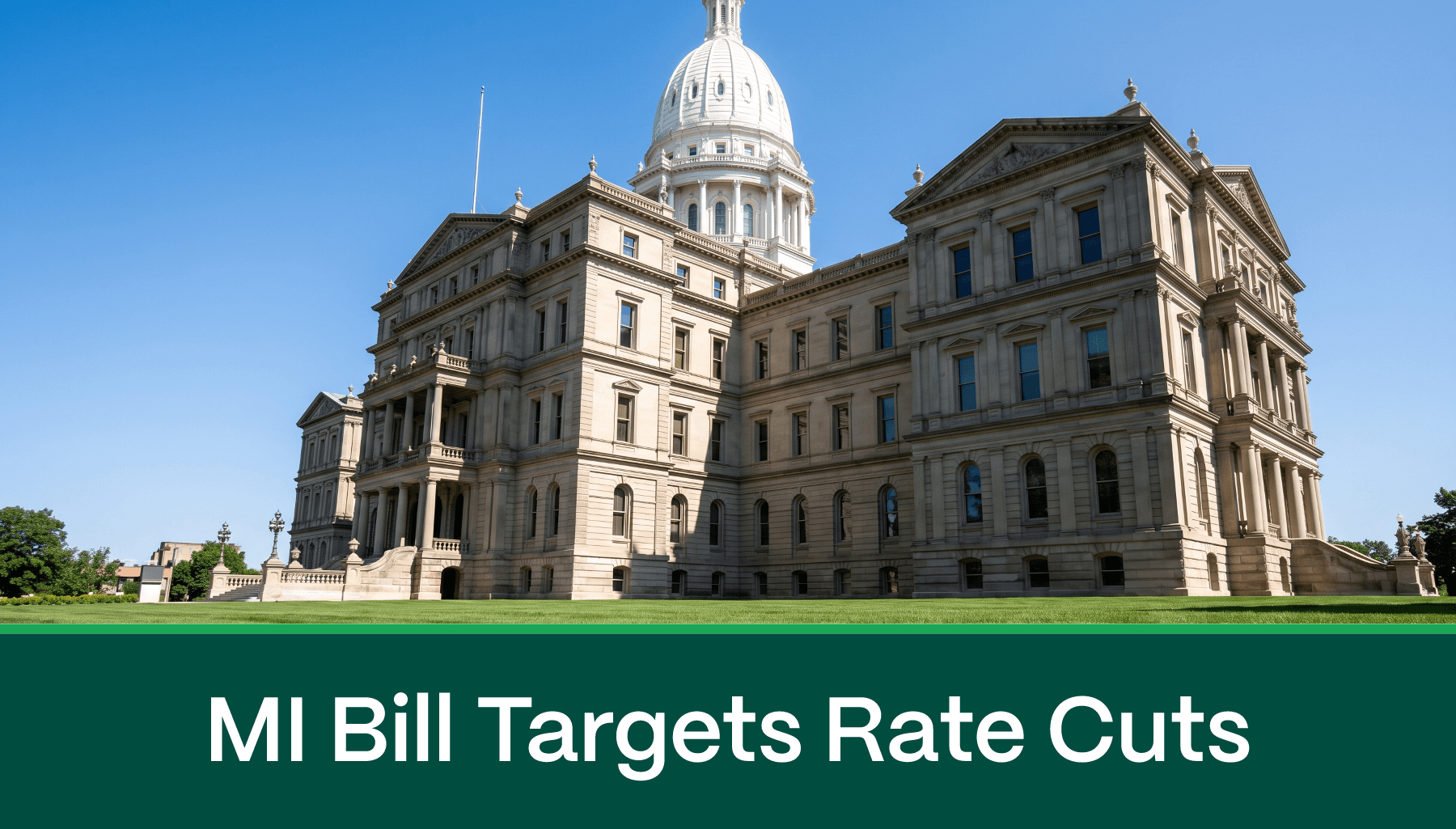
Michigan drivers currently pay 96% more for car insurance than their counterparts in Ohio, a gap that frames the entire fight over whether a mandatory 10% premium cut is the right remedy or a dangerous shortcut.
That disparity, reported by Insurance Business, sits at the heart of one of Lansing's most contentious insurance debates in years. Senate Bill 328 would force every insurer issuing or renewing a Michigan auto policy to slash total premiums by at least 10%, no benefit reductions allowed. The American Property Casualty Insurance Association (APCIA) is pushing back hard, warning the bill repeats mistakes already playing out in California. According to the Save Max Quote Index, drawn from 3.3 million+ real quote requests, Michigan consistently ranks among the most expensive states for auto insurance quotes nationally, a pattern that makes the Michigan auto insurance rate bill debate one of the most consequential in the country right now.
Michigan's rate debate: Reform gains vs. a mandated 10% cut
The backdrop to Senate Bill 328 is a reform story that started with genuine momentum. Michigan's 2019 no-fault overhaul was the most significant restructuring of the state's insurance market in decades. A state-commissioned Milliman analysis published in December 2025 estimated the reform saved drivers an average of $357 per year compared to what they would have paid without the changes.
That is not a small number. Before the reform, Michigan was the most expensive auto insurance state in the nation. After it, states including New York, Louisiana, and Florida surpassed Michigan's average premiums.
Yet by 2024, average Michigan auto insurance premiums were roughly $200 higher per car than they were in 2019, as rate hikes in 2023 and 2024 eroded the earlier gains. That erosion is what gave Sen. Jeff Irwin (D-Ann Arbor) the political opening to introduce SB 328.
The stakes are real for Michigan drivers already navigating some of the highest premiums in the Midwest. Whether a mandated cut helps or harms them depends entirely on which side's economic argument holds up under scrutiny.
What Senate Bill 328 would actually require
The mechanics of the bill are straightforward, even if the consequences are contested.
SB 328, introduced by Sen. Jeff Irwin, would require any insurer issuing or renewing an auto policy in Michigan to reduce total premiums by at least 10%. Crucially, that cut cannot be offset by reducing coverage benefits. A companion measure, SB 329, would prohibit reinstatement fees or higher rates after a coverage lapse.
The Senate Committee on Finance, Insurance and Consumer Protection passed the bill on a 5-3 partisan vote. It has not yet received a full Senate floor vote, meaning the decisive moment is still ahead.
Irwin, who notably voted against the 2019 reform, has been direct about his reasoning.
"Car insurance rates in Michigan are too high. Insurance company profits are soaring, along with our costs as consumers. It's time for the Legislature to stand up to these unjustifiably high car insurance rates."
The bill's framing positions it as a consumer protection measure. The insurance industry's framing positions it as market interference. Both camps are drawing on real data, which is precisely what makes this fight difficult to resolve.
Why the insurance industry says the math doesn't add up
This is where the debate gets quantitative, and the numbers deserve careful attention.
APCIA, the industry's primary lobbying voice on this bill, cited National Association of Insurance Commissioners (NAIC) data showing Michigan insurers still pay out $1.04 in claims and expenses for every $1 collected in premiums. A loss ratio above 1.0 means the industry, in aggregate, is not profitable on underwriting in Michigan. That figure directly contradicts the "soaring profits" framing Irwin has used to justify the bill.
Joe Roth, APCIA's assistant vice president for state government relations, did not soften his opposition.
"Michigan drivers don't need market manipulation, they need solutions that actually work. This bill ignores the root causes of rising costs and instead imposes a policy that has consistently failed in other markets."
The "other markets" reference points squarely at California. APCIA cited that state's insurance market as a cautionary example, where years of strict rate controls triggered insurer exits and coverage shortages. Roth warned: "Now is not the time to put Michigan on the same path toward a disrupted insurance market like California."
The SMQI shows similar dynamics playing out in states where regulatory pressure has outpaced actuarial sustainability, resulting in fewer competitive quotes available to consumers rather than lower prices.
APCIA's preferred remedies are structural: fraud crackdowns, litigation reform, and measures to promote competition. Those are the same arguments that underpinned the 2019 reform.
How Michigan premiums compare to neighboring states, and the nation
Geography puts Michigan's rate problem in sharp relief. According to Bankrate data reported as of January 2025, Michigan drivers pay significantly more than drivers in every bordering state.
| Michigan | Baseline |
| Wisconsin | 63% less expensive |
| Indiana | 82% less expensive |
| Ohio | 96% less expensive |
Those gaps are striking. But context matters: the national average car insurance premium is 55% higher than pre-pandemic levels, according to the U.S. Bureau of Labor Statistics, meaning the cost pressures Michigan is experiencing are not unique. Inflation, rising vehicle repair costs, supply chain disruptions, and litigation costs are pushing rates upward across every state.
For perspective, Ohio car insurance rates and Indiana auto insurance costs both look dramatically cheaper by comparison, but both states have also experienced post-pandemic rate increases driven by the same national forces.
AM Best research cited by APCIA found that average personal auto insurance premiums in Michigan fell 12% between 2019 and 2022 following the no-fault reform, while the national average rose 5% over the same period. That divergence was real. The subsequent reversal, driven by national cost trends, is also real.
The contested record of the 2019 no-fault reform
Both sides of the SB 328 debate have legitimate ground to stand on because the 2019 reform's legacy is genuinely mixed.
The Milliman report documents that premiums dropped year-over-year from 2019 to 2022. The AM Best data confirms Michigan outperformed the national trend during that window. Those are meaningful achievements.
But by 2024, the savings had been partially reversed. Average Michigan auto insurance premiums were approximately $200 higher per car than they were in 2019. Rate hikes in 2023 and 2024 absorbed much of the earlier progress.
Critics, including the Consumer Federation of America, have argued the reform reduced coverage for some drivers without delivering lasting affordability. That critique does not invalidate the Milliman savings estimate, but it complicates the narrative that the 2019 reform was an unqualified success.
The result is a legislature that is genuinely split: one side sees SB 328 as finishing the job the 2019 reform left undone, the other sees it as undermining the structural work still needed. Neither reading is irrational.
What this means for you
If you are a Michigan driver, monitor the Senate floor vote closely. Passage could lower your premium on paper, but if insurers respond by exiting the market or tightening underwriting, your choices narrow. Compare quotes now, before any market disruption occurs, using current rate data available through the Save Max Quote Index. If SB 329 passes alongside SB 328, reinstating lapsed coverage should become less penalizing financially. Consider reviewing your current coverage against neighboring-state benchmarks using Wisconsin auto insurance rates and Ohio car insurance guides to understand where Michigan sits relative to comparable markets.
FAQ
What does Senate Bill 328 actually require insurers to do?
SB 328 requires any insurer issuing or renewing a Michigan auto policy to reduce total premiums by at least 10%, without cutting coverage benefits. Companion bill SB 329 would ban reinstatement fees or rate increases following a coverage lapse. As of the bill's last reported status, it passed a Senate committee but had not received a full Senate floor vote.
Did Michigan's 2019 no-fault reform lower insurance rates?
Yes, initially. A state-commissioned Milliman analysis published in December 2025 estimated the reform saved drivers an average of $357 per year compared to what they would have paid without it. AM Best research also found Michigan's average premiums fell 12% between 2019 and 2022, while national averages rose 5%. However, by 2024, average Michigan premiums were roughly $200 higher per car than their 2019 levels, as post-pandemic cost pressures reversed much of the gain.
Why does APCIA oppose a mandatory 10% rate cut?
APCIA argues that Michigan insurers are already paying out $1.04 in claims and expenses for every $1.00 collected in premiums, according to NAIC data. That loss ratio indicates the industry is not profiting from Michigan policies in aggregate, making a mandated 10% cut mathematically unsustainable without market disruption. APCIA also points to California as a cautionary example of strict rate controls leading to insurer exits and coverage shortages.
How much more do Michigan drivers pay than neighboring state drivers?
According to Bankrate data as of January 2025, Michigan drivers pay 63% more than Wisconsin drivers, 82% more than Indiana residents, and 96% more than Ohio drivers for car insurance.
What could happen if SB 328 passes?
If it passes, drivers would see at least a 10% reduction in their auto insurance premiums in the near term. However, APCIA warns that mandatory rate cuts without addressing underlying cost drivers could prompt insurers to exit the Michigan market, reduce availability, or tighten underwriting standards, potentially leaving some drivers with fewer options at any price point.
About Taleah McGuire
Taleah McGuire is a Regional Analyst at SaveMaxAuto with 11+ years of insurance experience including senior roles at Kentucky Farm Bureau. She covers regulatory news, state-specific reform legislation, and traditional carrier coverage. Read more from Taleah McGuire →
Edited by Aaren Ramon.
Methodology
This article is grounded in the source linked above. SaveMaxAuto data points referenced here are drawn from the Save Max Quote Index (SMQI), a proprietary instrument reflecting 3,364,317 real consumer quote requests submitted to savemaxauto.com. State and carrier rankings reflect the lifetime dataset; year-over-year shifts reflect a rolling 12-month window. The index is refreshed monthly. External authority figures referenced (NAIC, NHTSA, state regulators) reflect the most recent public data releases available at time of writing.
Sources
- Primary source: Insurance Business, "Insurance group urges Michigan Senate to reject auto rate bill"
- U.S. Bureau of Labor Statistics, Consumer Price Index, Motor Vehicle Insurance