
Illinois Leads Every State in Storm Claims Through July 2026
Standing in Kankakee earlier this year, a State Farm leader described storm destruction "unlike anything I'd seen before", and the numbers behind that scene are now reshaping the insurance landscape for millions of Illinois residents.


Published: Sep 18, 2026
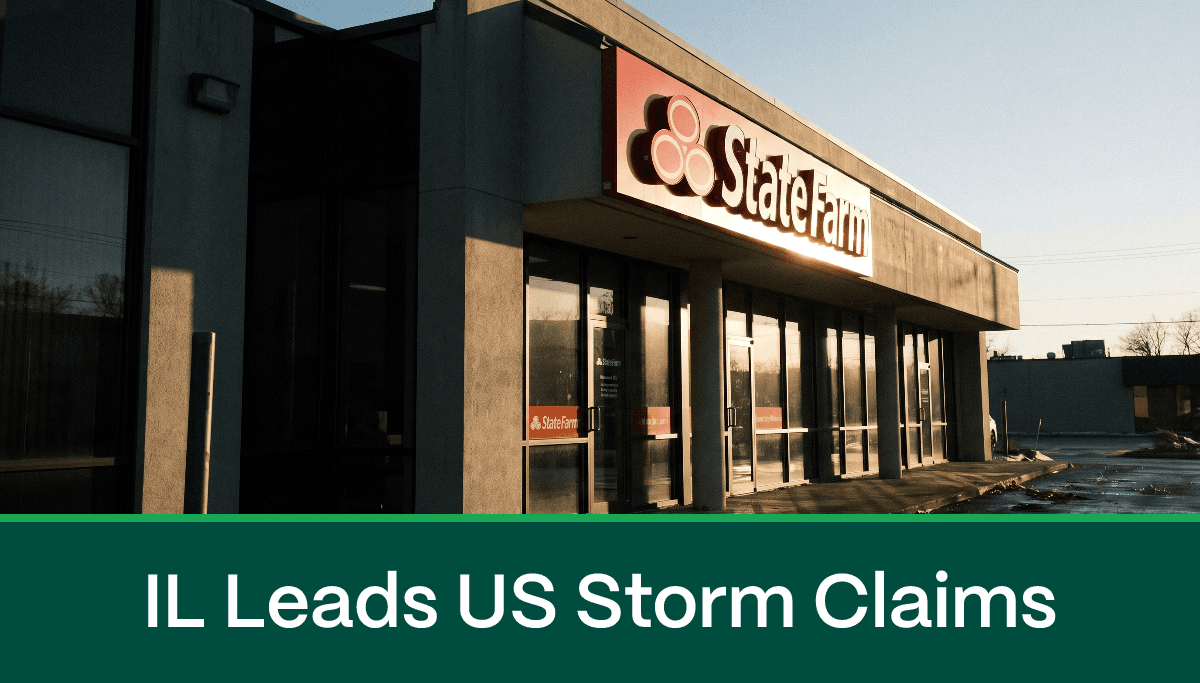
Standing in Kankakee earlier this year, a State Farm leader described storm destruction "unlike anything I'd seen before", and the numbers behind that scene are now reshaping the insurance landscape for millions of Illinois residents.
State Farm reports that through July 2026, its customers in Illinois filed more home and auto catastrophe claims than customers in any other state in the country. That ranking alone signals an urgent reality for anyone holding an Illinois auto or homeowners policy. According to the Save Max Quote Index, drawn from 3.3 million+ real quote requests, Illinois drivers shopping for coverage are increasingly citing severe weather exposure as a top concern driving them to compare rates, a trend that mirrors exactly what State Farm is seeing on the claims side.
Illinois Is Ground Zero for Storm Claims in 2026
Illinois is not merely having a bad weather year. It is outpacing every other state in catastrophe claim volume, a designation that carries real financial weight for policyholders and carriers alike.
Through July, State Farm had already paid more than $799 million in storm-related losses across the state. That figure covers a period that isn't even a full calendar year, which makes the scale even more striking when you consider that Illinois auto insurance policyholders are dealing with vehicle damage on top of widespread residential destruction.
The communities absorbing this damage span the state. Kankakee drew particular attention after one State Farm representative described the destruction there as worse than anything witnessed in years of working Illinois storms. But Kankakee is not an isolated case, it is one chapter in a statewide story that has been accelerating year over year.
A Record-Breaking Tornado Streak Driving the Damage
Three consecutive years. That is the streak Illinois is now on for recording more than 120 confirmed tornadoes annually, according to State Farm.
More than 200 tornadoes were confirmed in Illinois through August 2026 alone. During that same period, State Farm customers filed more than 96,000 weather-related home and auto catastrophe claims across the state. That volume of claims compressed into a single year reflects what happens when a prolonged meteorological pattern collides with densely populated communities and aging housing stock.
The consecutive-year streak matters for a specific reason: it rules out the "once in a generation" framing that sometimes causes homeowners to underestimate future risk. Illinois is not recovering from an anomaly. It is adapting to a new normal.
Neighboring states like Indiana and Missouri sit within the same storm corridor, and drivers and homeowners in those states should watch Illinois trends closely as a leading indicator of what their own markets may face.
By the Numbers: What $799 Million in Losses Looks Like Across Illinois
The financial picture becomes clearer when you place 2026 figures alongside a recent baseline. In all of 2025, State Farm paid $457 million in Illinois hail claims alone, the third-highest hail payout total in the country that year. The 2026 figures, already at $799 million through July, have surpassed that 2025 total by a wide margin with months still remaining in the storm season.
| 2025 Illinois hail claims paid (full year) | $457 million |
| 2025 Illinois hail rank nationally | 3rd highest |
| 2026 Illinois storm losses paid (through July) | $799 million+ |
| 2026 weather-related catastrophe claims filed | 96,000+ |
| 2026 confirmed Illinois tornadoes (through August) | 200+ |
| Consecutive years with 120+ tornadoes | 3 |
"Illinois is on pace for its highest catastrophe claim volume in a decade." , State Farm, September 2026
Each of those 96,000-plus claims represents a family managing a damaged roof, a flooded vehicle, or a totaled car in the middle of an already stressful recovery. The dollar figures are significant, but the human volume behind them is what drives the urgency.
How Stronger Roofs and FORTIFIED Standards Can Cut Future Damage
Recovery is only half the equation. The other half is resilience, building and retrofitting homes so that the next storm causes less damage than the last one.
State Farm operates a Technology Research and Innovation Lab, known as TRAIL, in Bloomington, Illinois. Researchers there study hail, wind, and other severe weather threats to understand how materials and construction practices can better protect homes. The lab's findings translate directly into guidance homeowners can act on today.
One of the clearest applications involves roofing. When building, remodeling, or replacing a roof, qualifying impact-resistant roofing materials can reduce hail damage measurably. State Farm offers premium discounts in many states to eligible homeowners who install qualifying impact-resistant roofing products, a financial incentive layered on top of the structural benefit.
The insurer also partners with the Insurance Institute for Business and Home Safety (IBHS) to advance research-backed construction standards. The IBHS FORTIFIED program provides a framework for building or retrofitting homes beyond standard construction practices so they better withstand severe weather events.
"Programs like FORTIFIED demonstrate how homes can be built or retrofitted beyond standard construction practices to better withstand severe weather." , State Farm, September 2026
For Illinois homeowners, these are not abstract research projects. They are practical tools with measurable cost implications, both in potential damage avoided and in insurance premiums reduced.
Where Insurers Are Showing Up: Customer Care Sites and Claims Support
When the storm passes and families start to assess the damage, where they turn for help matters enormously.
Through August 2026, State Farm had opened seven Customer Care Sites across six Illinois communities. These physical locations give policyholders a place to meet face-to-face with claims teams, ask questions, and take the next steps in their recovery without navigating everything remotely.
The presence of on-the-ground support infrastructure reflects a recognition that digital claims tools, while important, do not replace the need for human contact after a major loss. Families dealing with a destroyed roof or a hail-shattered vehicle benefit from direct access to representatives who understand local conditions.
The six-community footprint also signals that damage in 2026 has not been concentrated in a single area. The spread of care sites across Illinois communities underscores how broadly this storm season has reached into the state.
What this means for you
Review your current home and auto policy limits now, before the next storm arrives, and ask your agent specifically about impact-resistant roofing discounts if you are due for a roof replacement. Use the SMQI to compare rates across carriers and identify whether your current premium reflects your storm-exposure risk accurately. If you are in an affected Illinois community, locate the nearest State Farm Customer Care Site to connect with claims support in person rather than waiting for remote resolution.
FAQ
How much has State Farm paid in Illinois storm claims in 2026?
As of July 2026, State Farm had paid more than $799 million in storm-related losses in Illinois, according to the company's newsroom. That figure already surpasses the $457 million in hail claims alone that State Farm paid across all of 2025 in the state.
How many tornadoes has Illinois had in 2026?
More than 200 tornadoes were confirmed in Illinois through August 2026, according to State Farm. This marks the third consecutive year in which the state recorded more than 120 confirmed tornadoes, indicating a sustained meteorological pattern rather than a single unusual season.
What is the IBHS FORTIFIED program and how does it help Illinois homeowners?
The FORTIFIED program, developed by the Insurance Institute for Business and Home Safety (IBHS), provides construction standards for building or retrofitting homes to withstand severe weather beyond what standard building codes require. State Farm works with IBHS to advance these standards, and research from its TRAIL lab in Bloomington supports the practical application of FORTIFIED techniques for Illinois homeowners.
Can impact-resistant roofing actually lower my insurance premium?
Yes, in many states. State Farm offers premium discounts to eligible homeowners who install qualifying impact-resistant roofing products. The discount is separate from the structural benefit of reduced hail damage, meaning the roofing upgrade can pay off in two ways: lower repair costs after a storm and reduced ongoing premium expenses.
Where can Illinois policyholders get in-person claims help after a storm?
Through August 2026, State Farm had opened seven Customer Care Sites across six Illinois communities. These sites allow policyholders to meet directly with claims teams and get support for the next steps in their recovery rather than handling everything remotely.
About Taleah McGuire
Taleah McGuire is a Regional Analyst at Save Max Auto with 11+ years of insurance experience including senior roles at Kentucky Farm Bureau. She covers regulatory news, state-specific reform legislation, and traditional carrier coverage. Read more from Taleah McGuire →
Edited by Kyle Greenwood.
Methodology
This article is grounded in the source linked above. Save Max Auto data points referenced here are drawn from the Save Max Quote Index (SMQI), a proprietary instrument reflecting 3,364,317 real consumer quote requests submitted to savemaxauto.com. State and carrier rankings reflect the lifetime dataset; year-over-year shifts reflect a rolling 12-month window. The index is refreshed monthly. External authority figures referenced (NAIC, NHTSA, state regulators) reflect the most recent public data releases available at time of writing.
Sources
- Primary source: State Farm, "Illinois Severe Weather: Responding Today, Preparing for Tomorrow"