
Florida Auto Insurance Rates Drop 8% as HB 837 Reshapes the Market
While Floridians spent years watching their premiums climb to near-unaffordable levels, 2026 has brought something almost unrecognizable: broad, multi-carrier rate cuts driven by a legal system that no longer rewards frivolous litigation.


Published: Aug 8, 2026
While Floridians spent years watching their premiums climb to near-unaffordable levels, 2026 has brought something almost unrecognizable: broad, multi-carrier rate cuts driven by a legal system that no longer rewards frivolous litigation.
Insurance Business reports that Florida's top five auto insurers indicated an average rate decrease of 8% for 2026, compared with a staggering +31.7% increase in 2023. That reversal, confirmed by the Florida Office of Insurance Regulation (FLOIR), signals the most significant shift in Florida auto insurance rates in more than a decade. The Save Max Quote Index, drawn from 3.3 million+ real quote requests, consistently shows Florida as one of the most expensive states for personal auto coverage, making this turnaround especially meaningful for drivers in the Sunshine State.
Florida's auto market flips from crisis to rate cuts
Three years ago, Florida's auto insurance market was defined by one uncomfortable truth: carriers were losing money, and drivers were paying for it. The year HB 837 was signed, 2023, the state's top five insurers raised rates by a combined average of +31.7% Insurance Business. Shrinking carrier appetite and rising premiums made Florida one of the hardest personal auto markets in the country.
Now the market is moving in the opposite direction.
GEICO, Florida's second-largest auto insurer, filed two additional rate decreases that will lower premiums for more than 1.3 million policyholders. This is the carrier's third reduction in the past 12 months, contributing to a cumulative $500 million in annual premium reductions over two years. That is not a rounding error. That is a structural shift.
Florida drivers searching for relief on Florida auto insurance have real options today that simply did not exist at the same price points even 18 months ago.
How House Bill 837 rewrote the litigation playbook
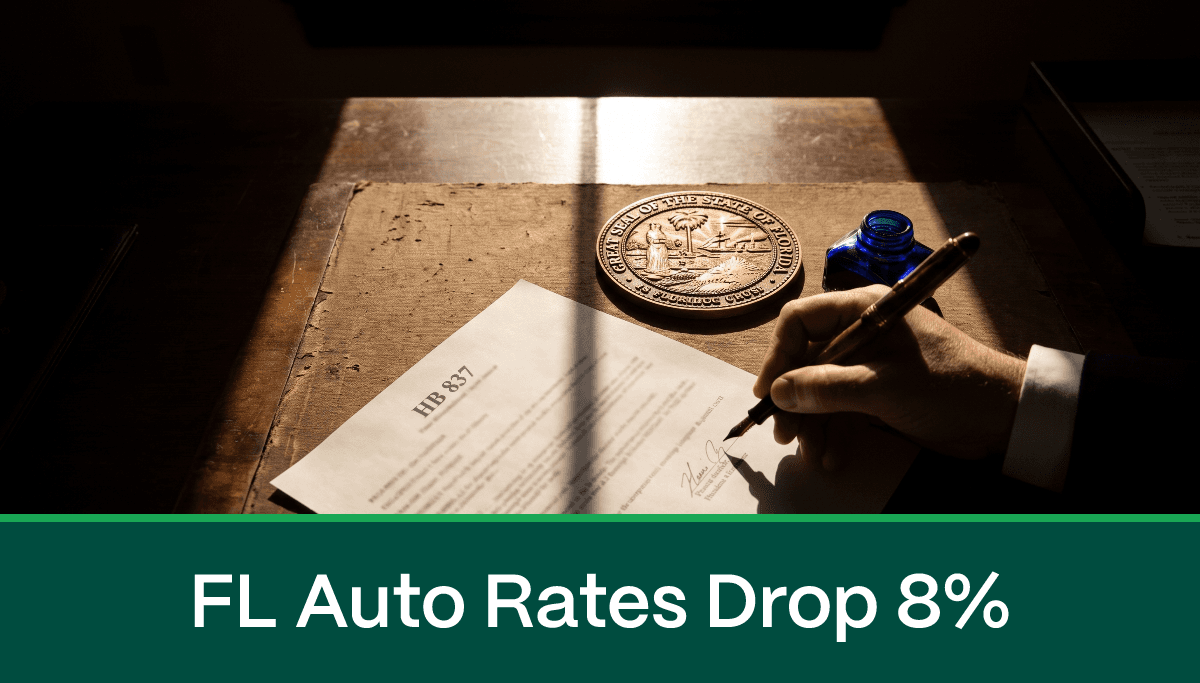
The turnaround does not trace back to a lucky year of mild weather or an unusual drop in accidents. It traces directly to House Bill 837, signed by Governor Ron DeSantis in March 2023.
The law made three foundational changes to civil litigation in Florida.
First, it cut the negligence statute of limitations from four years to two. Second, it adopted modified comparative negligence. Third, and perhaps most consequentially, it ended one-way attorney fee awards in most cases.
That last change is the key to understanding why litigation fell so sharply. One-way attorney fee awards had created a lopsided incentive structure: plaintiffs' attorneys could file suit over minor accidents with little downside risk, because if they won, the insurer paid their fees. Removing that incentive did not just reduce litigation at the margins. It restructured the entire calculus of whether minor accidents were worth litigating at all.
The result was a market that stopped hemorrhaging legal costs, and carriers that could finally price risk rather than litigation exposure.
Litigation filings and loss ratios: the numbers behind the turnaround
"Florida consumers are experiencing tangible benefits of the state's legal system reforms. Premiums are stabilizing, competition is increasing, and homeowners and drivers are seeing real savings while insurance coverage remains readily available.", Sean Kevelighan, CEO of the Insurance Information Institute (Triple-I)
The data behind this statement is compelling. According to data from the governor's office, property insurance litigation filings declined 23% year-over-year from 2023 to 2024, and continued falling each month through 2025. Frivolous property claim litigation fell 25% in the first half of 2025 compared with the same period a year earlier.
Those falling legal costs fed directly into underwriting performance. Florida's personal auto liability loss ratio reached 52.5% in 2025, according to FLOIR. That figure represents the state's lowest loss ratio in 15 years, and the lowest personal auto liability loss ratio in the entire nation.
A loss ratio below 60% is generally considered healthy for personal auto lines. At 52.5%, Florida moved from a market carriers were fleeing to one they are actively competing for. That competition is what drives premiums down for you.
Rate cuts by carrier: who is lowering premiums and by how much
The cuts are not isolated to one carrier. Here is how the market looks across Florida's major players, based on FLOIR data and carrier statements reported by Insurance Business:
| GEICO | Third reduction in 12 months | Cumulative $500M in annual premium reductions over two years; affects 1.3M+ policyholders |
| State Farm | Multiple decreases since fall 2024 | Totaling more than 20% in reductions |
| Allstate | Part of 18-month market-wide trend | CEO cited 5.9% average cut across five largest insurers over 18 months |
| Top 5 market average (2026) | -8% | Covers roughly 78% of Florida's personal auto market |
| Top 5 market average (2025) | -7.4% | Year-over-year comparison shows acceleration of cuts |
| Top 5 market average (2023) | +31.7% | The year HB 837 was signed |
"Florida's insurance market continues to show sustained improvement, and we're committed to making sure our customers feel that improvement directly in what they pay.", Yang Yu, GEICO Chief Insurance Product Officer
State Farm's cumulative cuts exceeding 20% since fall 2024 are particularly notable. State Farm is typically a bellwether for broader market direction. When the country's largest carrier makes aggressive cuts in a state, competitors follow.
Drivers in neighboring states like Georgia and South Carolina are watching closely, as their own markets remain under rate pressure that Florida has now begun to escape.
New risks on the horizon: wildfires and reform fragility
The story of Florida's recovery is real. But the Insurance Information Institute (Triple-I) issued a clear caution alongside its optimistic assessment: reform gains are not permanent, and new risks are emerging.
Florida recorded its most severe drought in more than 25 years in early 2026. Hundreds of wildfires were reported in areas historically considered low risk. That is not the kind of wildfire exposure that Florida carriers have historically priced into their models.
Triple-I emphasized that sustained underwriting discipline and continued policy commitment remain necessary to hold the progress in place. In other words: the legal reforms created the conditions for recovery, but they cannot insulate carriers from catastrophic weather years.
The SMQI will continue tracking quote activity across Florida as these emerging risks develop alongside the reform gains. How carriers respond to elevated wildfire exposure in 2026 and beyond will determine whether the downward rate trajectory holds or flattens.
Drivers in other high-weather-risk states, from Louisiana to Texas, face similar tension between reform potential and catastrophe exposure, a reminder that market conditions can shift faster than legislative calendars.
What this means for you
If you are a Florida driver, this is the moment to shop. Re-quote your current policy now, because carriers competing for market share are filing new rates regularly. Ask your insurer whether the recent GEICO or State Farm reductions have been applied to your renewal, and if not, take that question to a competing carrier. Use specific coverage comparison tools to evaluate whether your current deductible and liability limits still make sense in a softening market where full coverage may now be more affordable than it was 18 months ago.
FAQ
Are Florida auto insurance rates actually going down in 2026?
Yes. Florida's top five auto insurers reported an average rate decrease of 8% for 2026, according to FLOIR data cited by Insurance Business. That follows a -7.4% average decrease in 2025, making two consecutive years of market-wide rate reductions.
Which insurance company cut rates the most in Florida?
State Farm implemented multiple rate decreases totaling more than 20% since fall 2024, according to FLOIR. GEICO filed its third reduction in 12 months, amounting to a cumulative $500 million in annual premium reductions across more than 1.3 million policyholders over two years.
What caused Florida auto insurance rates to drop?
The primary driver is House Bill 837, signed by Governor Ron DeSantis in March 2023. The law shortened the negligence statute of limitations, adopted modified comparative negligence, and ended one-way attorney fee awards in most cases, removing the financial incentive to litigate minor accidents and dramatically reducing carriers' legal costs.
What is Florida's auto insurance loss ratio and why does it matter?
Florida's personal auto liability loss ratio hit 52.5% in 2025, the lowest in 15 years and the lowest in the nation according to FLOIR. A lower loss ratio means carriers are paying out less in claims relative to premiums collected, which creates room to reduce rates while remaining profitable.
Could Florida auto insurance rates go back up?
Triple-I cautioned that the reform gains are not guaranteed. Florida experienced its most severe drought in more than 25 years in early 2026, with hundreds of wildfires reported in areas not historically considered high risk. If catastrophic losses mount, they could offset the underwriting improvements created by litigation reform.
About Aaren Ramon
Aaren Ramon is a Senior Analyst at Save Max Auto and owner of Elite Shield Agency. He covers carrier moves, regional insurance markets, and consumer-impact reporting from the agency-owner perspective. Read more from Aaren Ramon →
Edited by Taleah McGuire.
Methodology
This article is grounded in the source linked above. Save Max Auto data points referenced here are drawn from the Save Max Quote Index (SMQI), a proprietary instrument reflecting 3,364,317 real consumer quote requests submitted to savemaxauto.com. State and carrier rankings reflect the lifetime dataset; year-over-year shifts reflect a rolling 12-month window. The index is refreshed monthly. External authority figures referenced (NAIC, NHTSA, state regulators) reflect the most recent public data releases available at time of writing.
Sources
- Primary source: Insurance Business, "Florida tort reform delivers as carriers slash auto rates across the board"