
Connecticut Auto Insurance Rate Cuts: Major Carriers Slash Premiums Up to 14%
Nineteen personal auto filings from 14 insurers now include rate decreases for Connecticut drivers, marking one of the most concrete early signals of affordability relief the state has seen in years. Insurance Business reported that Connecticut's Insurance Department (CID) identified these filings alongside 19 homeowners filings from 16…


Published: Oct 19, 2026
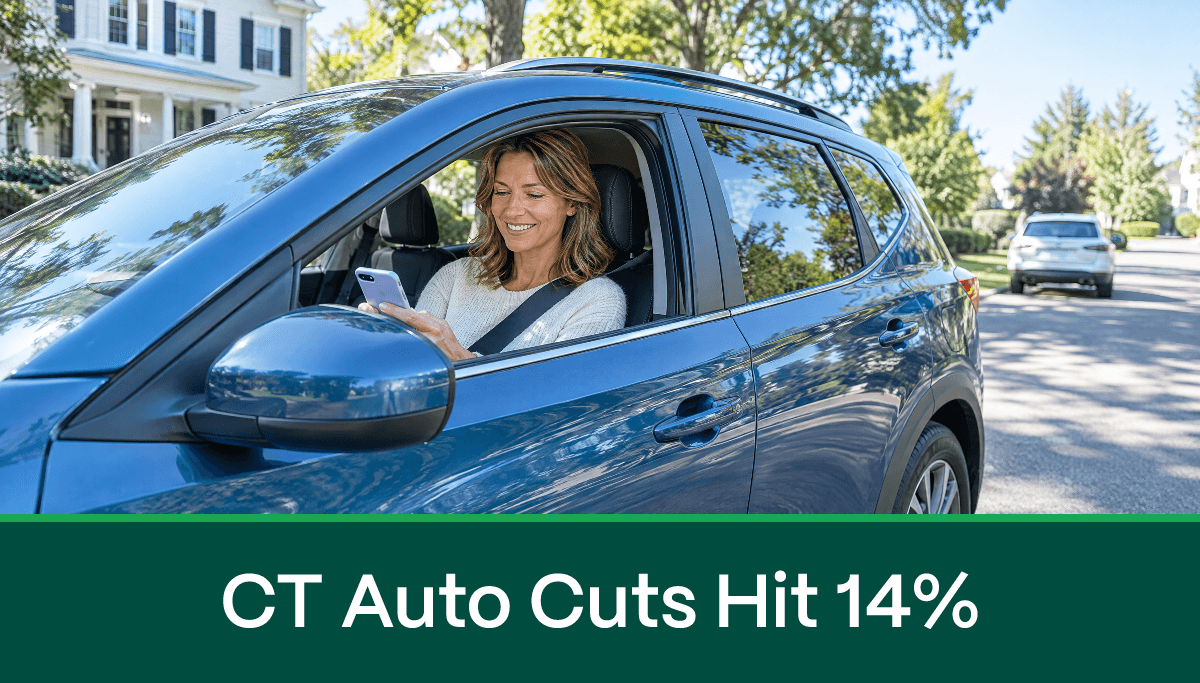
Nineteen personal auto filings from 14 insurers now include rate decreases for Connecticut drivers, marking one of the most concrete early signals of affordability relief the state has seen in years.
Insurance Business reported that Connecticut's Insurance Department (CID) identified these filings alongside 19 homeowners filings from 16 insurers, all carrying premium decreases for at least some policyholders. The CID review puts Connecticut auto insurance rate cuts squarely on the map as carriers shift from years of steep increases toward more competitive pricing. According to Insurance Business, Insurance Commissioner Josh Hershman called the filings encouraging, while cautioning that relief is selective, not universal.
Connecticut flags dozens of rate-cut filings across auto and home
The CID's findings represent a meaningful policy shift.
For years, Connecticut families absorbed double-digit premium increases as carriers worked to restore underwriting margins eroded by claims inflation, supply chain disruptions, and rising repair costs. Now the department is signaling a turn.
"Connecticut families continue to face challenges with insurance affordability, so it's encouraging to see filings that include rate decreases for some policyholders," said Insurance Commissioner Josh Hershman.
The commissioner also made clear that the department will continue verifying that rates are actuarially justified and reflect the actual risks being insured. That dual mandate, affordability and actuarial soundness, frames how CID is approaching the current filing cycle.
The filings span both personal auto and homeowners lines, with carriers including State Farm, Travelers, Liberty Mutual, Farmers, Hanover, Utica, Nationwide, and Merrimack all participating. That breadth across carriers and lines is what makes this moment notable for Connecticut consumers shopping or renewing policies.
If you hold a personal auto or homeowners policy with any of these carriers, your next renewal notice could look meaningfully different from last year's. Whether it actually does depends on your specific coverage, vehicle, location, and claims history.
Which auto insurers are cutting rates, and by how much
The auto decreases vary widely by carrier, and the spread matters.
Farmers Casualty Insurance Company leads the pack with the largest average decrease flagged by the CID: approximately 14% Insurance Business. That is a meaningful cut for any policyholder who qualifies.
Two affiliated State Farm companies reported a combined overall average decrease of approximately 8.4%. State Farm's scale in Connecticut means this filing likely touches a significant slice of the market, even before accounting for which policyholders actually qualify for the reduction.
Liberty Mutual Personal Insurance Company filed an average decrease of approximately 6%, with the CID specifically noting that this filing affects about 11,500 policyholders. That is a concrete number: over eleven thousand Connecticut drivers stand to see lower bills if they fall within the qualifying rating factors.
Other carriers filing auto decreases include Travelers, Hanover, and Utica, though the CID did not publish specific percentage figures for each of those carriers in its review.
The Save Max Quote Index, drawn from 3.3 million+ real quote requests, consistently shows that even a 6% to 8% reduction in base premium can translate to meaningful annual savings for drivers carrying full coverage, making this a strong moment to request a requote if your policy renews in the next 90 days.
Homeowners relief: Liberty Mutual leads with cuts across 30,000 policies
The homeowners side of this story is anchored by one large number.
Liberty Mutual and its affiliates reduced homeowners rates by approximately 5% for more than 30,000 policies Insurance Business. That 30,000-policy footprint makes Liberty Mutual's homeowners filing the single broadest rate action flagged by the CID in this review cycle.
Nationwide, Merrimack, and Utica also filed homeowners decreases, expanding the scope of potential relief beyond any single carrier. However, as with auto, the CID did not publish individual percentage figures for each of these additional homeowners filers.
The department was explicit that rate changes depend on the insurer, the coverage, and individual rating factors. Two neighbors with similar homes and the same carrier could receive very different renewal outcomes depending on their specific risk profiles.
Connecticut drivers comparing their situation to neighboring states should note that Massachusetts auto insurance and Rhode Island auto insurance markets have each followed distinct regulatory trajectories, making direct state-to-state comparisons of premium trends complex.
Rate decreases by carrier and segment: a Connecticut snapshot
The table below summarizes the rate decrease filings flagged by the CID, based strictly on figures reported by Insurance Business.
| Farmers Casualty Insurance Company | Personal Auto | ~14% | Not specified |
| State Farm (two affiliated companies) | Personal Auto | ~8.4% | Not specified |
| Liberty Mutual Personal Insurance Company | Personal Auto | ~6% | ~11,500 |
| Liberty Mutual and affiliates | Homeowners | ~5% | 30,000+ |
| Travelers | Personal Auto | Not specified | Not specified |
| Hanover | Personal Auto | Not specified | Not specified |
| Utica | Personal Auto and Homeowners | Not specified | Not specified |
| Nationwide | Homeowners | Not specified | Not specified |
| Merrimack | Homeowners | Not specified | Not specified |
Carriers not listed may still operate in Connecticut without filing decreases in this cycle. The CID review identified 14 insurers on the auto side and 16 on the homeowners side, meaning several participating carriers are not named individually in the source reporting.
Why rates are falling now: the profitability rebound behind the filings
The rate cuts did not happen in isolation.
After several years of steep premium increases, carriers have largely restored the underwriting margins that were hammered by pandemic-era inflation, parts shortages, and surging claims costs. With margins recovering, competitive pricing pressure has resumed.
The CID's review reflects this industry-wide dynamic. As Insurance Business notes, industry forecasts suggest personal auto premium growth will turn slightly negative nationally this year as underwriting margins improve. That is a significant reversal from the double-digit growth rates that characterized 2022 through 2024.
Connecticut is not the only market where this is playing out, but the CID's proactive identification of specific filings gives consumers an unusually clear window into where the relief is coming from and which carriers are leading it.
Industry forecasts suggest personal auto premium growth will turn slightly negative nationally this year as underwriting margins improve.
For policyholders who absorbed 20%, 30%, or even larger cumulative increases over the past several years, a 6% to 14% reversal does not erase the full impact. But it is a real and measurable shift in direction.
Not every policyholder wins: who may still face increases
The CID was direct about this: rate relief is selective.
Even carriers that filed overall average decreases may still raise rates for specific policyholders based on individual risk factors. The department's message is that aggregate filings do not guarantee individual savings.
Three categories of policyholders are most likely to still face increases, based on the CID's guidance:
- Drivers with recent claims on their record
- Owners of higher-risk vehicles
- Homeowners in geographic areas with elevated exposure to weather or other losses
If you fall into any of these categories, your renewal notice may show an increase even while your carrier's headline filing shows an average decrease. That is not a contradiction. It is how rating tiers work.
The SMQI tracks this pattern consistently across quote requests: carrier-level average decreases often mask wide variance at the individual policyholder level, particularly for drivers with one or more at-fault incidents in the prior three years.
Understanding your own rating factors, not just your carrier's average filing, is what determines your actual premium outcome.
What this means for you
Check your next renewal notice carefully and compare it against last year's declaration page. If your carrier is among those flagged by the CID, contact your agent and ask explicitly whether the filed decrease applies to your policy and rating tier. Connecticut residents can explore current Connecticut auto insurance options to benchmark what competitive quotes look like right now. If you have held the same policy for two or more years without shopping it, this cycle of carrier-level rate reductions makes a remarketing review worth requesting before your next renewal date.
FAQ
Which Connecticut auto insurer filed the largest rate decrease?
Farmers Casualty Insurance Company filed the largest average decrease highlighted by the Connecticut Insurance Department, approximately 14% Insurance Business. State Farm followed with an average decrease of about 8.4% across two affiliated companies, and Liberty Mutual filed approximately 6%.
Will my auto insurance premium automatically go down?
Not necessarily. The CID was explicit that rate changes depend on the insurer, the coverage type, and individual rating factors. Even if your carrier filed an average decrease, your specific premium at renewal depends on your own risk profile, including your claims history, vehicle type, and location.
How many policyholders are affected by Liberty Mutual's auto rate cut in Connecticut?
The CID specifically noted that Liberty Mutual Personal Insurance Company's auto filing affects approximately 11,500 policyholders Insurance Business. On the homeowners side, Liberty Mutual and its affiliates reduced rates for more than 30,000 policies.
Why are auto insurance rates falling in Connecticut now?
After several years of steep increases that restored carrier profitability, underwriting margins have improved enough that insurers are filing more competitive rates. Industry forecasts cited by Insurance Business project that personal auto premium growth will turn slightly negative nationally this year, a reversal from the sharp growth of prior years.
What should I do if my insurer filed a decrease but my premium still went up?
Ask your agent for a breakdown of your rating factors. A carrier-level average decrease does not guarantee individual savings, particularly if you have recent claims, drive a higher-risk vehicle, or live in an area with elevated exposure. Requesting a remarketing review, or shopping competing quotes through a comparison tool, is the most direct way to determine whether a better rate is available for your specific profile. Connecticut drivers can also review statewide pricing context at the Connecticut auto insurance guide.
About Taleah McGuire
Taleah McGuire is a Regional Analyst at Save Max Auto with 11+ years of insurance experience including senior roles at Kentucky Farm Bureau. She covers regulatory news, state-specific reform legislation, and traditional carrier coverage. Read more from Taleah McGuire →
Edited by Kyle Greenwood.
Methodology
This article is grounded in the source linked above. Save Max Auto data points referenced here are drawn from the Save Max Quote Index (SMQI), a proprietary instrument reflecting 3,364,317 real consumer quote requests submitted to savemaxauto.com. State and carrier rankings reflect the lifetime dataset; year-over-year shifts reflect a rolling 12-month window. The index is refreshed monthly. External authority figures referenced (NAIC, NHTSA, state regulators) reflect the most recent public data releases available at time of writing.
Sources
- Primary source: Insurance Business, "Connecticut regulator flags auto and home rate cuts from major insurers"