
Car Insurance Poor Credit Penalty Has Surged 37.7%: What Every Driver Needs to Know
A driver with a spotless record should pay less than someone who caused a crash or got a DUI, but if you have poor credit, that common-sense assumption is now costing you over a thousand dollars a year.


Published: Nov 19, 2026
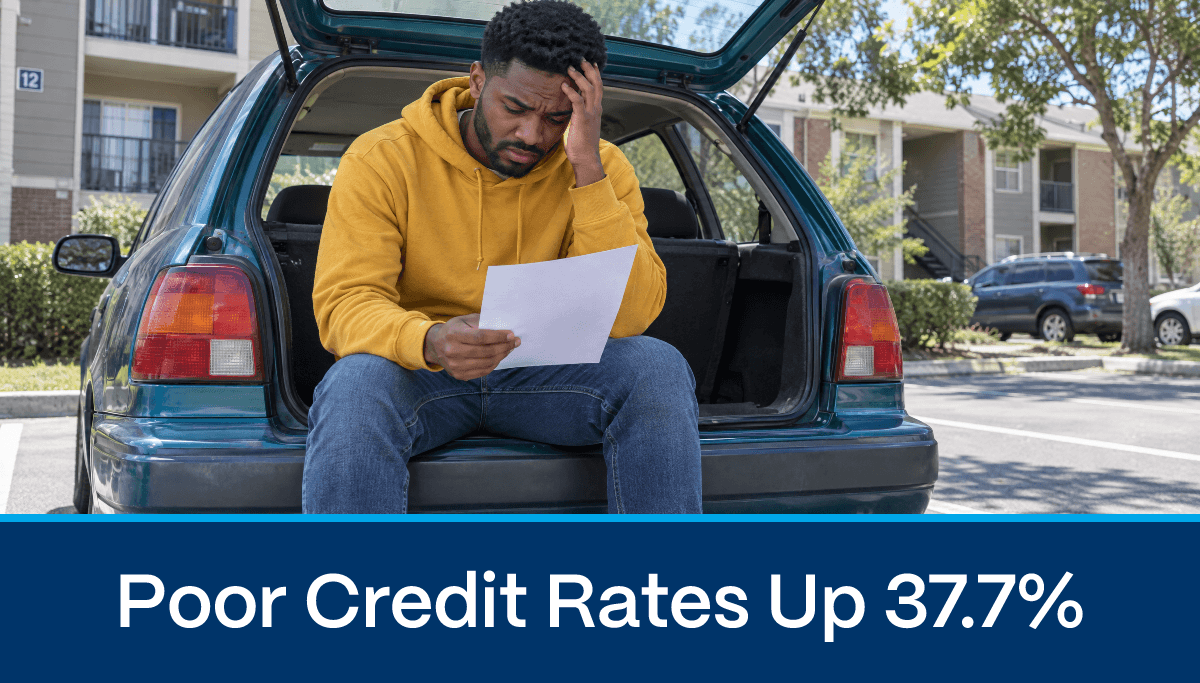
A driver with a spotless record should pay less than someone who caused a crash or got a DUI, but if you have poor credit, that common-sense assumption is now costing you over a thousand dollars a year.
NerdWallet published its 2026 Auto Insurance Rates Report in November 2026, and the findings are stark: car insurance poor credit penalties have outpaced rate increases for good-credit drivers who caused accidents or received DUIs. According to NerdWallet, a poor-credit driver with a clean record saw their median full-coverage premium climb from $2,864 per year in January 2023 to $3,944 by January 2026, a jump of $1,081 in just three years. The good news is that there are concrete steps you can take right now, even before your credit score budges.
Clean Record, Punishing Premium: The Credit Penalty Explained
Here is the part that stings most: the driver in question did nothing wrong behind the wheel.
No accidents. No speeding tickets. No DUI. Yet their premium still surged by more than a thousand dollars over three years, an increase that exceeded what good-credit drivers faced even after causing a wreck or getting a DUI.
"Credit scores are one of the most harmful things that results in you paying higher auto insurance premiums," says Michael DeLong, a research and advocacy associate with the Washington, D.C.-based nonprofit Consumer Federation of America. "The penalties are extremely severe."
DeLong's point cuts to the core of the problem. Many drivers simply do not realize their credit score influences what they pay for coverage. You could have a perfect driving history and still be treated like a high-risk motorist simply because of a number tied to your financial past.
The injustice runs even deeper when you look at the comparison. A good-credit driver with a DUI on their record saw smaller rate increases over the same three-year period than a poor-credit driver who had never filed a claim. That is not intuition, that is the data from NerdWallet's analysis.
For drivers in states like Louisiana, where premiums are already among the country's highest, the credit penalty compounds an already painful insurance environment.
How Much More Drivers With Poor Credit Are Paying Now
The dollar figures tell the story clearly.
Between January 2023 and January 2026, premiums for a poor-credit driver with a clean record rose from $2,864 to $3,944, an increase of $1,081 per year, according to NerdWallet's analysis.
That is a 37.7% surge in just three years. By contrast, a good-credit driver with a clean record saw their premiums rise by only $576 over the same period. The gap between those two numbers, $505, represents the extra annual cost of having poor credit, even with zero incidents on your record.
The SaveMaxAuto Quote Index, drawn from 3.3 million+ real quote requests, consistently reflects this dynamic: poor-credit profiles receive materially higher quotes at the point of purchase, often from the same carriers quoting lower rates to good-credit profiles with worse driving records.
| Poor credit, clean record | 37.7% |
| Good credit, clean record | Lower than 37.7% |
| Good credit, DUI | Lower than poor credit/clean |
| Good credit, speeding ticket | Lower than poor credit/clean |
| Poor credit, DUI | More than 40% (highest of all profiles) |
The most extreme case is the poor-credit driver who also has a recent DUI. That profile saw premiums rise by more than 40%, the largest increase of any profile analyzed. Credit alone is amplifying the impact of every other risk factor on your record.
Why Insurers Tie Your Credit Score to Your Premium
Insurance companies are not using your FICO score directly. What they use is called a credit-based insurance score, similar to a standard credit score but weighted differently to predict the likelihood of filing a claim rather than repaying a debt.
The actuarial case for this practice has been made in peer-reviewed research. A statistical analysis published in the North American Actuarial Journal in 2016 found that average losses per policy were 64.6% higher for drivers with the lowest credit scores than for those with the best credit. Researchers concluded that risk-taking behavior can influence both credit scores and insurance claims simultaneously.
"It helps in predicting expected claims activity and loss costs more accurately," said Norman Niami, a member of the American Academy of Actuaries' Automobile Insurance Committee.
A Federal Trade Commission report to Congress in July 2007 also concluded that credit-based insurance scores were strong predictors of risk even when controlled for income, race, and ethnicity.
That does not make the practice popular. Critics, including DeLong's organization, argue it disproportionately hurts low-income and minority drivers who have less access to credit-building tools and are more likely to carry lower scores through no fault of their own behavior on the road.
The controversy is real, and it has produced legislative responses in at least three states.
Rate Increases Across Driver Profiles: Poor Credit vs. Good Credit
To understand where poor credit ranks among all risk factors, it helps to see the full picture.
NerdWallet analyzed five driver profiles. Here is how the three-year rate increase trajectory broke down:
- Poor credit, clean driving record: 37.7% increase
- Good credit, clean driving record: lower increase than poor-credit/clean profile
- Good credit, DUI: lower increase than poor-credit/clean profile
- Good credit, speeding ticket: lower increase than poor-credit/clean profile
- Poor credit, DUI: more than 40% increase, the largest of all profiles analyzed
The takeaway from that comparison is striking. Poor credit alone produces worse outcomes than a DUI on a good-credit record. When poor credit is combined with a DUI, the increase exceeds every other profile.
For drivers in states like Michigan, where the auto insurance market already carries some of the country's most complex rating structures, or in Georgia, where urban premium pressure is significant, the credit multiplier effect is especially acute.
The SMQI data reinforces this pattern: across the quote requests it captures, poor-credit profiles cluster at the highest quoted premium tiers, even when every other variable, vehicle type, ZIP code, coverage level, is held constant.
States That Ban Credit Scoring, and Why It's Hard to Build Credit Fast
Three states have decided the practice is simply too harmful to allow. California, Hawaii, and Massachusetts prohibit insurers from using credit as a factor in setting auto insurance rates. If you live in one of those states, your credit score cannot legally affect your premium.
For everyone else, the standard advice is to improve your credit. But DeLong is candid about the limits of that guidance.
"If you're struggling at a low-wage job and trying to juggle bills, or if you don't easily have access to a credit card, that advice may not be especially helpful," DeLong says.
Building credit through consistent bill payments and responsible credit card use sounds straightforward in theory. In practice, it takes months. Norman Niami noted that building credit "can produce a noticeable premium decrease in some cases, while producing little or no change in others," depending on whether a new score pushes you into a better rating tier with your specific insurer.
Each insurer sets its own score thresholds. A score that one carrier classifies as "poor" might be rated as "fair" by a competitor. That inconsistency is actually useful information, it means shopping around has real, measurable value.
Drivers in states like California already benefit from credit-score neutrality. Those in neighboring Nevada or Arizona face a very different market reality and cannot rely on a single carrier to give them a fair shake.
What this means for you
Start by comparing quotes from multiple insurers, because a NerdWallet analysis of October 2026 rates found that in about 49.3% of U.S. ZIP codes in states that allow credit scoring, the cheapest insurer for a poor-credit driver was a different company than the cheapest for a good-credit driver. Raise your deductible if you have savings to cover it, sign up for automatic payments to capture small discounts, and avoid filing minor claims like windshield cracks to protect your risk profile. As Bradley Flowers, founder of Portal Insurance agency in Mobile, Alabama, puts it: "When you're in one of these situations, let's save our insurance for the really bad stuff." Finally, if your car's value is low enough that you could replace it out of pocket, dropping collision and comprehensive coverage can meaningfully reduce your premium while keeping liability protection intact.
The Bottom Line on Credit and Car Insurance Costs
The credit penalty is real, it is large, and it has grown faster over the past three years than almost any other risk factor in the market.
A $1,081 annual surcharge for having poor credit, even with a perfect driving record, is not a rounding error. It is a structural feature of how most U.S. insurers price risk, backed by actuarial research but contested by consumer advocates on equity grounds.
What you can realistically expect from the strategies above: meaningful savings in the near term from shopping and coverage adjustments, and potentially lower premiums over a two-to-three-year horizon if you can move into a better credit tier with your insurer. Neither outcome is guaranteed. But doing nothing while paying the full penalty is the most expensive option of all.
FAQ
Does poor credit affect car insurance rates in every state?
No. California, Hawaii, and Massachusetts prohibit insurers from using credit as a factor in setting auto insurance rates. In all other states, credit-based insurance scores are a legal and commonly used rating factor.
How much more do poor-credit drivers pay compared to good-credit drivers?
According to NerdWallet's 2026 analysis, a poor-credit driver with a clean record paid a median of $3,944 per year for full coverage in January 2026, up from $2,864 in January 2023, an increase of $1,081. A good-credit driver with a clean record saw a much smaller increase of $576 over the same period.
Is a credit-based insurance score the same as a regular credit score?
No. A credit-based insurance score is similar to a standard credit score but weighted differently. Insurers use it to predict the likelihood that a driver will file a claim, not to assess creditworthiness for a loan.
Can improving my credit score lower my car insurance premium?
Possibly, but it is not guaranteed. Norman Niami of the American Academy of Actuaries noted that building credit "can produce a noticeable premium decrease in some cases, while producing little or no change in others," depending on whether the new score moves you into a better rating tier with your specific insurer.
What is the fastest way to lower my car insurance rate if I have poor credit?
Comparing quotes from multiple insurers is the most immediate option. A NerdWallet analysis of October 2026 rates found that in about 49.3% of U.S. ZIP codes, the cheapest insurer for a poor-credit driver was a different company than the cheapest for a good-credit driver. Raising your deductible and dropping unnecessary coverage are also near-term levers.
About Cassidy Richey
Cassidy Richey is a Content Writer at SaveMaxAuto with a research background in behavioral psychology. She focuses on the consumer side of insurance shopping, fraud and protection coverage, and Q&A guides. Read more from Cassidy Richey →
Edited by Taleah McGuire.
Methodology
This article is grounded in the source linked above. SaveMaxAuto data points referenced here are drawn from the SaveMaxAuto Quote Index (SMQI), a proprietary instrument reflecting 3,364,317 real consumer quote requests submitted to savemaxauto.com. State and carrier rankings reflect the lifetime dataset; year-over-year shifts reflect a rolling 12-month window. The index is refreshed monthly. External authority figures referenced (NAIC, NHTSA, state regulators) reflect the most recent public data releases available at time of writing.
Sources
- Primary source: NerdWallet, "Car Insurance Soars for Drivers With Poor Credit; Here's What to Do"