
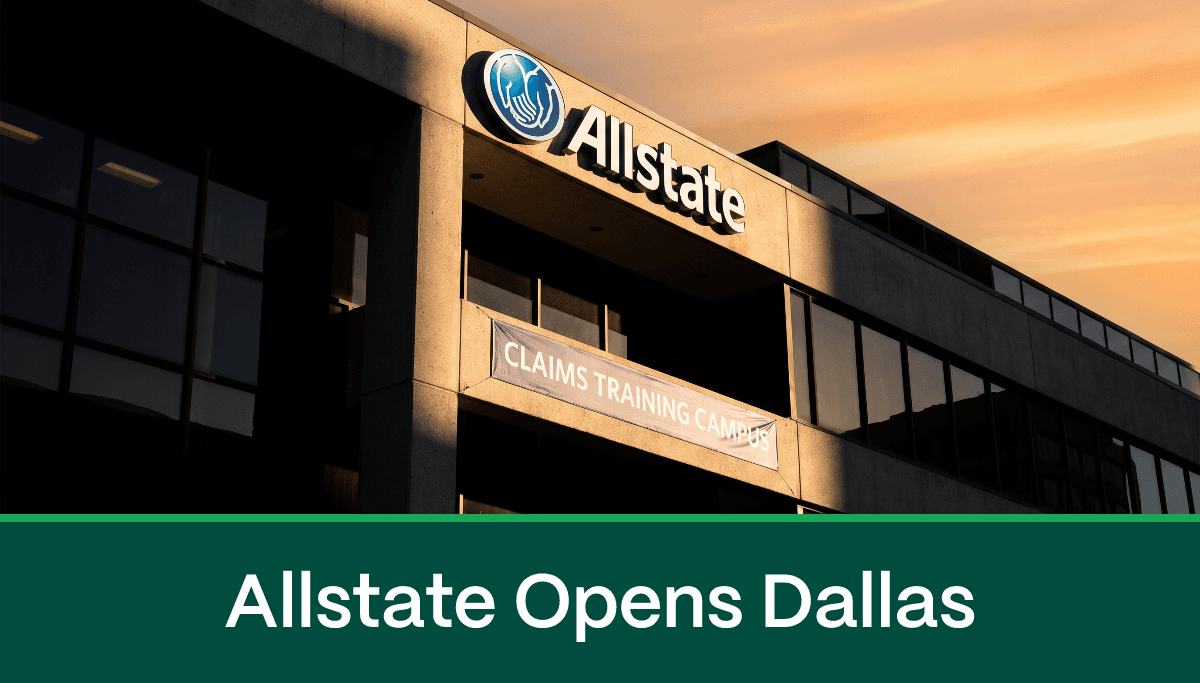
Allstate Opens 33,000-Square-Foot Claims Training Campus in Dallas
What does it actually take to train an insurance adjuster who can walk up to a flood-damaged EV and make the right call on the spot? Allstate just answered that question with a building. Repairer Driven News reports that the company has opened Allstate Claims University in Dallas, a 33,000-square-foot training campus purpose-built for hands-on...


Published: Aug 21, 2026
What does it actually take to train an insurance adjuster who can walk up to a flood-damaged EV and make the right call on the spot?
Allstate just answered that question with a building. Repairer Driven News reports that the company has opened Allstate Claims University in Dallas, a 33,000-square-foot training campus purpose-built for hands-on claims education. According to Repairer Driven News, the facility is designed to put claims professionals face-to-face with real damage scenarios, on real vehicles and inside full-scale homes, before they ever show up at your door. The Save Max Quote Index, drawn from 3.3 million+ real quote requests, consistently shows that claims handling quality ranks among the top factors drivers weigh when switching carriers, which makes this investment worth understanding.
Why Allstate Built a 33,000-Square-Foot Training Campus in Dallas
The answer comes straight from Allstate's own leadership. Mike Fiato, Allstate's executive vice president and chief claims officer, framed the mission this way:
"The investment in Allstate Claims University starts with our people and ends with our customers. When someone's home is damaged by a storm or their vehicle is involved in an accident, they need more than a claim processed: they need an expert who can understand what happened, explain what comes next and help them move forward."
That philosophy shaped every square foot of the Dallas facility. Allstate describes the campus as a place where claims teams sharpen their skills before they arrive at a customer's home or assess a damaged vehicle. The goal is not classroom theory. It is practical, scenario-based readiness.
The timing matters. Vehicles are more technologically complex than they have ever been. Construction methods are evolving. Severe weather events are producing a wider range of damage types. Allstate's own release acknowledges that these forces are making claims more complex across the board, and the university is a direct response to that pressure.
For Texas auto insurance policyholders specifically, this is local news. The campus is in Dallas, meaning the regional claims workforce that serves one of the country's largest auto insurance markets could be among the first to cycle through its programs.
Inside the Auto Lab: Nearly 30 Vehicles and 3.5 Million Claims Data Points
The Auto Lab is the centerpiece of Allstate Claims University's vehicle training program, and its design is grounded in real-world data.
"The Auto Lab was designed using insights from more than 3.5 million claims data points," the release states. "It includes electric, hybrid, and conventional vehicles selected to represent common and complex damage scenarios."
That is a meaningful foundation. Nearly 30 vehicles are staged inside the lab, representing the full spectrum of what adjusters encounter in the field. The selection was deliberate, not random, chosen to mirror the kinds of vehicles and damage patterns Allstate's claims data actually surfaces.
Claims professionals train on the following damage and technology categories:
- Collision damage assessment
- Flood damage evaluation
- Hail impact inspection
- Structural damage identification
- Airbag deployment scenarios
- Camera, sensor, and ADAS system repairs
- Diagnostic tool operation
- Repair demonstration review
That last point deserves emphasis. Hands-on access to diagnostic tools means adjusters are not just looking at a vehicle. They are working through the same technology that a repair technician would engage with, which gives them a much clearer picture of what a repair actually involves and why it costs what it costs.
The Property Lab: Two Full-Scale Homes That Reveal Hidden Damage
The Auto Lab gets significant attention, but the Property Lab is equally ambitious in its design.
Two full-scale, two-story homes sit inside the facility. Each one serves a distinct educational purpose.
The first home recreates damage caused by water, fire, wind, hail, and structural impacts. Adjusters walk through scenarios that mirror real storm and accident conditions, giving them a visual and tactile reference point for what these damage types actually look like inside a home.
The second home takes a different approach entirely. It exposes the building systems and materials that are typically hidden from view, the interior of walls, ceilings, and floors. This matters because some of the costliest home damage is invisible on the surface. A claims professional who has never seen what hides behind drywall may miss damage that a trained eye would catch immediately.
Together, the two structures let claims teams examine both what is visible and what lurks beneath. For homeowners dealing with a storm claim, that distinction can determine whether a settlement covers the full scope of repairs or falls short.
How EV and ADAS Technology Is Complicating Auto Claims Industry-Wide
Allstate is not the only carrier dealing with this challenge. The broader claims environment has shifted significantly as electric vehicles, hybrid powertrains, and advanced driver assistance systems have moved from niche to mainstream.
Here is a snapshot of why vehicle technology is driving up claims complexity across the industry:
| Electric vehicle battery systems | Flood and collision damage assessment requires specialized knowledge; replacement costs are substantially higher |
| ADAS cameras and sensors | Minor collisions can trigger calibration requirements that add repair costs |
| Structural materials | High-strength steel and aluminum require different repair methods than traditional materials |
| Hybrid powertrains | Dual-system vehicles complicate damage triage between mechanical and electrical components |
These factors affect every major carrier, not just Allstate. Drivers in states with high EV adoption rates, like California auto insurance shoppers or Colorado auto insurance policyholders, are already navigating an environment where a seemingly minor fender impact can generate a repair bill that surprises everyone involved.
The SMQI shows that rate sensitivity around comprehensive and collision coverage has increased in markets with higher EV concentration, which tracks logically with rising repair complexity.
What Better-Trained Adjusters Could Mean for Claim Speed and Accuracy
Here is the downstream benefit that matters most to you as a policyholder.
Allstate's release is explicit about the intended outcome: more accurate damage assessments help customers better understand what needs to be repaired, make informed decisions, and move through recovery more quickly and efficiently.
That is a consumer-facing promise, not just an internal training metric.
When an adjuster walks up to your vehicle with genuine familiarity with EV battery assessments, ADAS calibration requirements, or structural damage patterns, several things improve. The initial assessment is more likely to capture the full scope of damage. The explanation you receive is more likely to be clear and accurate. And the back-and-forth that can delay settlements, supplemental claims, disputes over repair scope, confusion about what a specific repair requires, is more likely to be minimized.
Allstate's release puts it this way: that preparation helps teams make more informed assessments, explain repair recommendations more clearly, and provide a more consistent experience throughout the recovery process.
For drivers in high-weather markets like Louisiana auto insurance territory or Florida auto insurance coverage zones, where storm-related claims volume is high, a faster and more accurate claims process has real financial value.
What this means for you
Ask your adjuster directly what training they have received on your specific vehicle type, especially if you drive an EV, hybrid, or a vehicle with ADAS features. Request a written explanation of any damage assessment before you authorize repairs. When you shop or renew coverage, use the Save Max Quote Index as a benchmark to compare how carriers perform on claims handling alongside price. If you are an Allstate policyholder in the Dallas region, your claims team may already be rotating through this facility, which is a reasonable question to raise with your agent.
FAQ
What is Allstate Claims University?
Allstate Claims University is a 33,000-square-foot training campus that Allstate opened in Dallas. It features hands-on learning environments including an Auto Lab with nearly 30 vehicles and a Property Lab with two full-scale two-story homes, designed to train claims professionals on real-world damage scenarios before they work with customers.
How does the Auto Lab help claims adjusters?
The Auto Lab was designed using insights from more than 3.5 million claims data points. It gives claims professionals hands-on experience with electric, hybrid, and conventional vehicles, and trains them on damage scenarios involving collision, flood, hail, structural impacts, airbags, cameras, sensors, and advanced driver assistance systems.
Will Allstate Claims University training affect my claim outcome?
Allstate's stated goal is that better-trained adjusters will produce more accurate damage assessments, clearer repair explanations, and faster recoveries for customers. The direct impact on any individual claim will depend on the adjuster assigned to your case, but the campus is designed to raise the baseline skill level across the claims team.
Why is EV and ADAS technology making auto claims more complicated?
Electric vehicles, hybrid powertrains, and advanced driver assistance systems require specialized diagnostic knowledge and often carry higher repair costs than conventional vehicles. Even minor collisions can trigger sensor calibration requirements. Claims professionals without hands-on familiarity with these systems may underestimate damage scope or mischaracterize repair requirements.
Where is Allstate Claims University located?
Allstate Claims University is located in Dallas, Texas. The 33,000-square-foot campus serves as a training hub for Allstate claims professionals who handle both auto and property claims.
About Brooke Grissom
Brooke Grissom is an Independent Insurance Analyst at Save Max Auto, licensed in Property & Casualty and Health insurance. She covers data-driven market trends, cross-state premium comparisons, and carrier financial analysis. Read more from Brooke Grissom →
Edited by Cassidy Richey.
Methodology
This article is grounded in the source linked above. Save Max Auto data points referenced here are drawn from the Save Max Quote Index (SMQI), a proprietary instrument reflecting 3,364,317 real consumer quote requests submitted to savemaxauto.com. State and carrier rankings reflect the lifetime dataset; year-over-year shifts reflect a rolling 12-month window. The index is refreshed monthly. External authority figures referenced (NAIC, NHTSA, state regulators) reflect the most recent public data releases available at time of writing.
Sources
- Primary source: Repairer Driven News, "Allstate opens campus to teach claims handling with hands-on auto labs"