
New Jersey Bill Bans AI from Denying Auto and Home Insurance Claims
AB 5494 is blunt in its aim. The bill, introduced by Representative Christopher Tully (D-District 38), would flatly prohibit insurance companies from using AI systems to deny claims across three coverage categories: auto, homeowners, and flood insurance.


Published: Sep 18, 2026
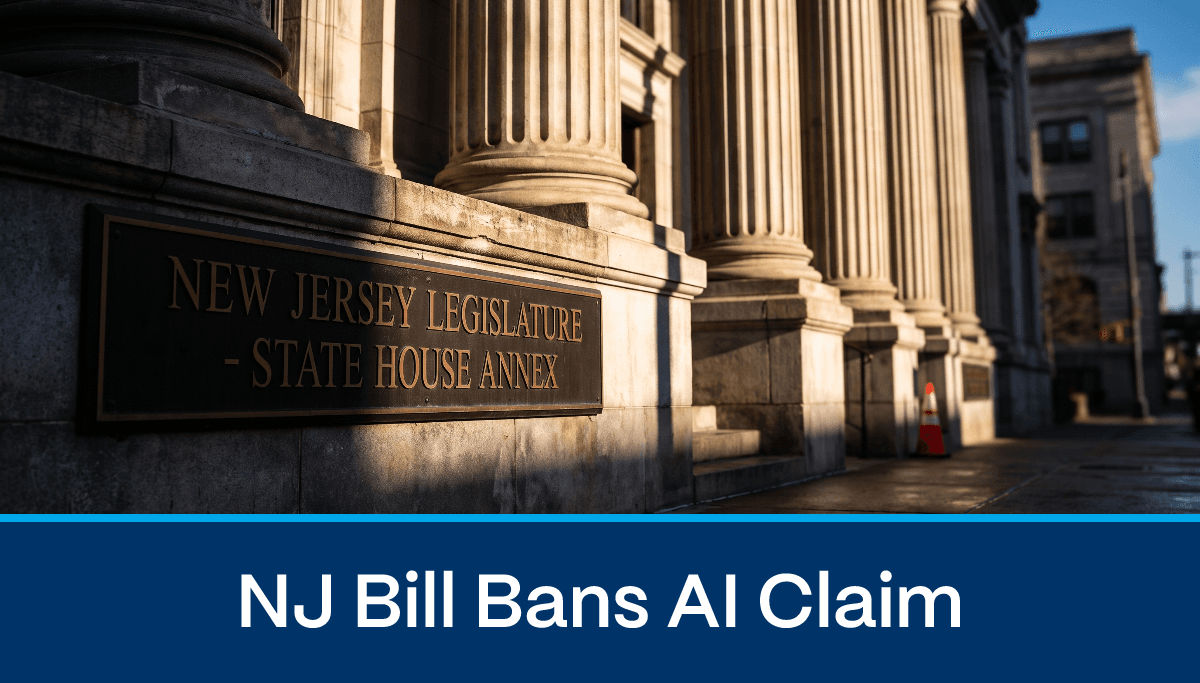
New Jersey moves to ban AI from denying your insurance claim
AB 5494 is blunt in its aim. The bill, introduced by Representative Christopher Tully (D-District 38), would flatly prohibit insurance companies from using AI systems to deny claims across three coverage categories: auto, homeowners, and flood insurance.
Tully chairs the Assembly Science, Innovation and Technology Committee, the same body the bill has been referred to. That gives it an early structural advantage many consumer-protection bills never enjoy.
The bill would take effect immediately upon passage. No phase-in period. No grace window for carriers to retool their systems. If signed into law, insurers operating in New Jersey would face an abrupt change to how they handle claim decisions.
Tully has been one of Trenton's most active legislators on AI issues. The committee he leads advanced multiple AI-related bills in March 2026, covering areas like deceptive advertising and disclosure rules requiring companies to tell consumers when they are not interacting with a human. None of those March bills addressed insurance specifically. AB 5494 fills that gap directly.
What the bill actually says, and what it would cost insurers to ignore it
The penalty structure is where AB 5494 gets real teeth.
Any insurance company found in violation of the act would face a penalty of up to $5,000 per violation according to the bill text as reported. Given that insurers process thousands of claims daily, per-violation penalties could accumulate rapidly, making non-compliance financially dangerous at scale.
The bill's scope is also broader than its headline suggests. It is not limited to auto insurance. It covers:
- Auto insurance claims
- Homeowners insurance claims
- Flood insurance claims
This multi-line scope means the bill would affect nearly every major property and casualty insurer doing business in New Jersey, not just those focused on vehicles. Drivers who also carry home policies with the same carrier would potentially see the bill's protections applied across their entire relationship with that insurer.
The immediate-effect provision is equally significant. Unlike regulations that give industries years to adapt, AB 5494 as written would require compliance from the moment the governor signs it.
Why New Jersey is acting now: the rise of AI in claims handling
AI adoption in insurance claims is not hypothetical. Insurers have been rolling out automated review and decision tools for years, with the pace accelerating sharply as generative AI platforms matured.
Tully framed the urgency plainly in March 2026. "As generative AI becomes more commonplace, it's more important than ever to have safeguards in place to protect New Jerseyans from being duped or deceived," he said.
He continued: "The bills we advanced focus on deceptive advertising, disclosure that a user is not interacting with a human, and creating common sense policies. All with the goal of protecting everyday New Jerseyans as we move further into a digital future."
Those earlier bills laid the groundwork. AB 5494 represents the extension of that philosophy into the insurance space, where the financial stakes of an AI-generated decision can be devastating for a policyholder who has just experienced a crash, flood, or fire.
The Save Max Quote Index, drawn from 3.3 million+ real quote requests, consistently shows that consumers in high-cost states like New Jersey are especially sensitive to claims-handling reputation when selecting a carrier. When AI denials become a perceived risk, shopping behavior shifts.
How this fits into a national patchwork of AI insurance rules
New Jersey is not alone in this fight, but the landscape across states is uneven. Here is how the current regulatory picture compares:
| New Jersey | AB 5494, bans AI from denying auto, homeowners, flood claims | In committee (Sept. 2026) |
| Florida | Companion bills requiring human review of AI claim denials | Died in committee, April 2026 |
| Washington State | New rule: claim investigations may not rely solely on database/estimating software | Adopted |
| NAIC (25 states) | Model Bulletin on Use of AI Systems by Insurers | Adopted by 25 states as of March 3, 2026 |
Florida's failure is instructive. Companion bills that would have created parameters on AI in claims handling and required mandatory human reviews of claim denials did not survive committee in April 2026. The absence of a federal floor means each state is effectively deciding on its own whether algorithmic denials are acceptable.
Washington's approach is notably different in design. Rather than banning AI outright, the Washington Insurance Department adopted a rule stating that a reasonable investigation of a claim may not rely solely on database use, including estimating software and benchmarks gathered from one or multiple databases. It targets over-reliance rather than AI use itself. Drivers in Washington State now have that protection, even without a blanket AI prohibition.
The NAIC's Model Bulletin on the Use of AI Systems by Insurers has been adopted by 25 states as of March 3, 2026. That bulletin does not ban AI in claims. It establishes a governance and oversight framework, urging carriers to ensure AI tools are accurate, reliable, and non-discriminatory.
Federal and industry watchdogs are also circling AI in insurance
The National Association of Insurance Commissioners is not sitting still. In April 2026, the NAIC launched an AI Evaluation Tool pilot program across 12 states. The goal: help regulators actually understand how insurers are using AI in practice, not just how insurers say they are using it.
The NAIC's Big Data and Artificial Intelligence Workgroup has a full 2026 agenda. Its planned work includes researching the use of big data and AI in insurance business operations and monitoring state, federal, and international AI activities, including updates to the regulatory framework for AI oversight.
The workgroup also plans to support broader adoption of the Model Bulletin. With 25 states already on board, the push is toward making voluntary governance standards more universal, even if binding bans like AB 5494 remain rare.
For policyholders in states without strong AI rules, the NAIC framework is currently the primary backstop. It is a soft guardrail, not a hard prohibition. That gap is exactly what New Jersey is trying to close.
What this means for you
If you are a New Jersey policyholder, AB 5494 is not law yet, but it signals where the state is headed. Review any recent claim denial letters carefully and look for language indicating automated or algorithmic processing. If a denial feels inconsistent with the facts you submitted, request a written explanation and ask specifically whether AI tools were used in the decision. As the bill advances, monitor updates to your New Jersey auto insurance rights, and compare your current carrier's claims reputation before your next renewal. Drivers in neighboring Pennsylvania and New York should also watch their own state legislatures, as similar legislation may follow.
Where AB 5494 goes from here
The bill's referral to the Assembly Science, Innovation and Technology Committee, chaired by its own sponsor, is a favorable starting position. Bills stuck in hostile committees rarely get hearings. This one is more likely to move.
But committee advancement is not passage. New Jersey's full Assembly must vote, and then the bill would need Senate approval and the governor's signature. The timeline is uncertain.
If passed, the impact would be immediate by the bill's own terms. Insurers would need to remove AI from the claim denial decision chain on day one. If the bill stalls or fails, as Florida's companion legislation did, New Jersey consumers would be left relying on the NAIC's voluntary framework and whatever internal oversight carriers choose to apply.
The SMQI shows that claims-handling trust is a primary driver of carrier switching in the mid-Atlantic region. Legislative outcomes in Trenton could directly influence where New Jersey drivers shop next renewal.
FAQ
What does AB 5494 actually prohibit?
AB 5494 would prohibit insurance companies from using artificial intelligence to deny auto, homeowners, and flood insurance claims in New Jersey. The bill does not restrict AI use in other parts of the claims process, only in the denial decision itself.
What is the penalty for violating AB 5494?
Any insurance company that violates the act would be subject to a penalty of up to $5,000 for each violation. Because the penalty is per violation, carriers that process large claim volumes through AI systems could face significant cumulative liability.
Did any other state pass a similar law?
Florida introduced companion bills that would have required mandatory human reviews of AI-generated claim denials, but those bills died in committee in April 2026. Washington State adopted a related rule prohibiting claims investigations that rely solely on database use, though it does not specifically ban AI. No state has yet enacted an outright ban comparable to what AB 5494 proposes.
What is the NAIC doing about AI in insurance?
The NAIC launched an AI Evaluation Tool pilot across 12 states in April 2026 to help regulators assess how insurers use AI. The NAIC's Model Bulletin on the Use of AI Systems by Insurers had been adopted by 25 states as of March 3, 2026. The NAIC Big Data and Artificial Intelligence Workgroup also plans ongoing research and monitoring of AI use in insurance throughout 2026.
How can I tell if AI denied my claim?
Currently, there is no universal disclosure requirement for AI use in claim denials in New Jersey. You can request a written explanation of any denial and ask the insurer directly whether automated tools were used. If AB 5494 passes, that concern becomes moot for future denials in the state.
About Kyle Greenwood
Kyle Greenwood is a Writer and Researcher at Save Max Auto with a decade of consumer-content experience. He specializes in explainers, longer-form features, and Q&A guides on the topics auto drivers actually search for. Read more from Kyle Greenwood →
Edited by Taleah McGuire.
Methodology
This article is grounded in the source linked above. Save Max Auto data points referenced here are drawn from the Save Max Quote Index (SMQI), a proprietary instrument reflecting 3,364,317 real consumer quote requests submitted to savemaxauto.com. State and carrier rankings reflect the lifetime dataset; year-over-year shifts reflect a rolling 12-month window. The index is refreshed monthly. External authority figures referenced (NAIC, NHTSA, state regulators) reflect the most recent public data releases available at time of writing.
Sources
- Primary source: Repairer Driven News, "New Jersey bill would ban use of AI in denying auto insurance claims"
- National Association of Insurance Commissioners (NAIC)