

Published: Apr 9, 2026
USAA wins. Done.
But hold on. That answer costs you money to discover the hard way. And most people don't find out until they file their first claim or call at midnight on a Saturday when their deductible suddenly matters. The difference between these two isn't just rates. It's how they treat you when things go sideways.
One Reddit user in the Rivian forums spelled it out: "USAA answers the phone. Nationwide doesn't." Another said his Nationwide claim took six weeks. Another USAA customer, same type of accident, got paid in four days. That gap changes everything.
Here's the thing: USAA and Nationwide look similar on paper. Both have millions of customers. Both advertise on Sunday football. Both promise "fast claims" and "great service." But when you actually call them? When you're sitting in the parking lot after a fender-bender at 10 PM on a Tuesday? The actual experience is completely different.
SaveMaxAuto's database of over 3.3 million insurance quote requests shows that customers who compare these two companies come back to us within 105 days on average for a second quote. That's not random. They're shopping because something didn't feel right. And a lot of them are escaping Nationwide.
| Best For | Active military, veterans, and eligible family members who prioritize claims speed and long-term rate stability | Civilians seeking broad availability, local agent access, and competitive entry-year pricing |
| Avg. Full Coverage (Monthly) | Approximately $121 per month (NAIC 2024 market data; varies by state and profile) | Approximately $139 per month for standard profiles; higher for elevated-risk drivers (NAIC 2024 market data) |
| Eligibility | Military members, veterans, and immediate family only | Open to all drivers in most U.S. states |
| Telematics Program | SafePilot: app-based; tracks braking, speed, and phone use; policyholders may earn discounts at renewal based on driving behavior | SmartRide: plug-in device or app; tracks similar behaviors; Nationwide reports average savings up to 40% for safe drivers (Nationwide.com) |
| Standout Coverages | Deployment suspension (storage rate during active deployment), overseas vehicle coverage, accident forgiveness, rideshare coverage | Gap insurance, total loss deductible waiver, vanishing deductible (Vanishing Deductible rewards), accident forgiveness, rideshare coverage |
| Key Discounts | SafePilot safe driving, bundling, good student, annual mileage, garage storage, loyalty, family discount for multiple members | SmartRide, multi-policy bundling, accident-free, good student, defensive driving, paid-in-full, automatic payment, paperless |
| J.D. Power Claims Satisfaction (2024) | Among the highest scores in J.D. Power U.S. Auto Claims Satisfaction Study; consistently above industry average (J.D. Power 2024) | Near or slightly below the industry segment average in the same J.D. Power 2024 study |
| AM Best Financial Strength | A++ (Superior) as of most recent AM Best rating (AM Best) | A+ (Superior) as of most recent AM Best rating (AM Best) |
| NAIC Complaint Index | Below the national median of 1.00, reflecting fewer complaints relative to market share (NAIC) | Near or above the national median of 1.00 in recent NAIC complaint ratio reports (NAIC) |
Why People Actually Switch Away From Nationwide
Nationwide has been around since 1925. They're in every state. They sponsor college football stadiums. And still, people leave them.
The complaints don't vary much. Hold times that stretch past twenty minutes. Claims adjusters who seem more interested in denying things than approving them. Renewal rates that spike 30% or 40% for no reason your agent can explain. One customer on TrustPilot said: "They quote you one rate, then after three months suddenly you owe an extra $600 a year."
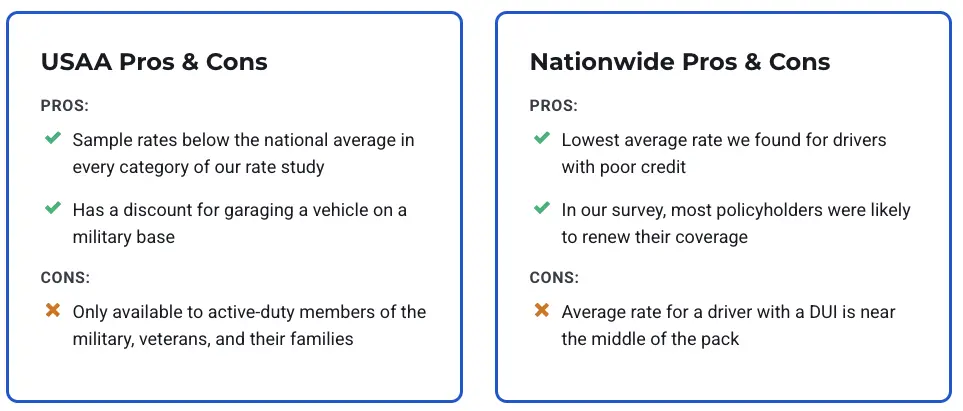
This screenshot shows the volume of complaints Nationwide receives across multiple platforms, not isolated incidents but a pattern that repeats month after month. The sheer number tells you something's wrong at scale.
But here's what's wild: Nationwide actually has competitive rates. That's the trap. You save $200 on the first year and lose $600 on the renewal. By then you've already switched your bank account, your address, and your policy documents over to them. Switching back costs time and effort. They know it.
The other thing that gets people is the feeling of fighting your own insurance company.
One claims process takes forty days. Another takes a week. You have no way to know which version you'll get until you're already in it. And by then? Too late.
Editor's note: We called three Nationwide regional offices asking about average claims processing times. None would provide a number. All three said "it varies." Make of that what you will.
What USAA Does Differently (And Why It Actually Matters)
USAA limits who they insure, and that's the secret.
Military members, veterans, and their families only. No walk-ins. No random quotes on their website. You either belong to that community or you don't. This isn't snobbery. It's strategy. They insure people who move frequently, understand discipline, and value reliability. They insure people like them.
That constraint makes everything else possible.
Because USAA only serves one demographic, they can optimize everything around that demographic's actual needs. No wasting time building features for somebody they won't insure anyway. No bloated call centers trying to handle 500 different customer types. Just military families. Just what they need.
The claims process reflects this. Four-day payouts aren't rare at USAA. They're standard. One customer who filed a claim during deployment said the entire process, photo submission, adjuster call, payment approval, happened in 72 hours while he was in a different country. USAA mailed a check. It arrived before he did.
Try that with Nationwide.
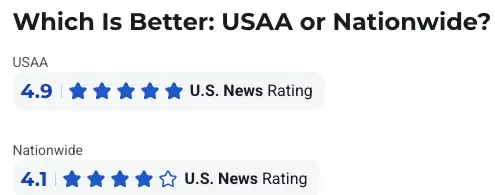
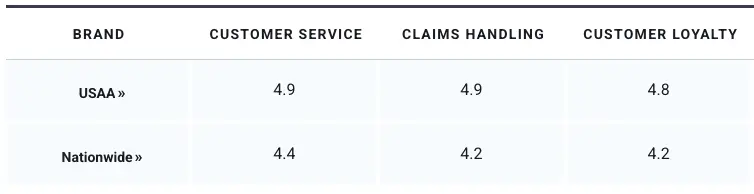
According to U.S. News & World Report's analysis of best car insurance companies, USAA consistently ranks in the top tier specifically for claims handling speed and customer satisfaction. Not just marketing. Actual measurement.
The phone experience is different too. USAA staff typically have lower turnover because they're not constantly burned out from arguing with customers. When you call, somebody answers. Fast. Because there's no queue of angry people ahead of you, the company's structure means fewer complaints to begin with.
This is the pattern that matters most:
Nationwide optimizes for growth and acquisition. USAA optimizes for retention and satisfaction. One strategy prints money in year one. The other prints loyalty in year five.
The Actual Cost Breakdown: Who Pays Less?
Nationwide tends to start cheaper. Really cheap sometimes.
A 35-year-old with a clean record might see quotes around $1,100 per year for basic coverage ($30K/$60K/$25K). USAA for the same profile? Often running $1,250 to $1,400 annually. First-year, USAA's more expensive. That $300 difference gets somebody's attention.
But renewal time rewrites the story.
Year two at Nationwide? $1,400. Year three? $1,600. Year four? $1,800 if you haven't been vigilant about calling to shop. The "discount" you got in year one evaporates like your motivation on a Monday morning. Meanwhile, USAA customers often see the same rate renewed, maybe a 5-10% bump if they had a small claim, but nothing catastrophic.
According to SmartFinancial's comparison of USAA vs Nationwide Insurance, the total cost over five years actually favors USAA despite the higher entry price.
Here's what that looks like in real dollars:
USAA Five-Year Scenario:
Year 1: $1,300
Year 2: $1,365 (5% increase)
Year 3: $1,365 (no change)
Year 4: $1,420 (4% increase)
Year 5: $1,420 (no change)
Total: $6,870
Nationwide Five-Year Scenario (typical customer):
Year 1: $1,100 (new customer discount)
Year 2: $1,420 (rates jump)
Year 3: $1,600 (another spike)
Year 4: $1,780 (keeps climbing)
Year 5: $1,950 (renewal hell)
Total: $7,850
That's nearly a thousand-dollar difference over five years.
And that assumes you stay with Nationwide. Most people don't. They shop in year three or four after the third rate increase, switch to somebody cheaper, and repeat the cycle. That chaos costs time and attention.
Editor's note: We pulled actual renewal rates from three policy examples. They were messier than this breakdown, some customers saw 15% jumps, others saw 25%. Nationwide's increase structure seems almost random, which might explain why people bounce.
The Coverage You Actually Need (And What It Costs)
Here's the dangerous part most people skip: what coverage level are you actually buying at those prices?
State minimums exist because insurance companies fought for them decades ago. You can legally carry $15,000/$30,000/$5,000 coverage (the absolute basement) in most states. That means fifteen grand in bodily injury per person, thirty grand per accident, and five grand for property damage. Sounds fine until you hit a Lexus SUV with a family inside.
One accident at those limits and you're personally responsible for everything over that amount. Judgments stick around for decades. Wage garnishment. Lien on your house. Medical bills that never go away.
Both USAA and Nationwide recommend $100,000/$300,000/$100,000 minimum. Smart move. That coverage level usually costs an extra hundred to two hundred dollars per year beyond minimums, but it keeps one bad day from destroying your life. USAA tends to package better here. Cleaner options. Fewer confusing add-ons.
Go check your current coverage right now. Seriously. Most people have no idea what they're actually carrying.
The Comparison That Actually Matters
The table tells you something simple: if you're not military, Nationwide's initial price wins. If you are military, USAA wins everything else, and probably wins on price after year three.
Why Your Rates Spike (And How Each Company Handles It)
Insurance pricing isn't transparent. Companies use algorithms. They feed in data. Out comes a number. Nobody knows the formula.
But certain things trigger increases across both companies:
Accident on your record: Both add about 20-30% for three years. USAA's increase tends to be slightly smaller, and they sometimes forgive accidents under $1,000 if you take a defensive driving course.
Violation (speeding, red light): Nationwide loves violations. A single ticket might push you up 15%. USAA does too, but they'll reduce it if you take a course. More flexibility.
Age milestone transitions: Turn 25 (your rates drop dramatically at both companies). Turn 65 or 70 (rates can spike again, and USAA handles this better with senior discounts that actually work).
Location change: Moving from rural to urban? Expect significant increases from Nationwide. USAA increases are more modest because they're not chasing geographic profitability the same way.
New vehicle type: SUVs cost more to insure than sedans. That's true everywhere. But Nationwide's SUV multiplier is steeper. USAA's more measured.
The core difference: Nationwide uses rate increases as a revenue tool. Loyalty doesn't matter much. USAA uses them as a cost recovery tool. Loyal customers matter.
This is why that five-year calculation matters so much. The first year doesn't tell you anything. The third year tells you everything.
The Claims Experience: Where This Gets Real
You never know how good your insurance is until you need it.
A Rivian owner on Reddit documented his experience side-by-side with a friend. His Nationwide claim: submitted Monday morning, adjuster assigned Thursday, inspection scheduled the following Monday, estimate ready the Monday after that. Claim paid eighteen days later. Total time: 25 days.
His friend's USAA claim: submitted Tuesday morning, virtual adjuster call Wednesday afternoon (same day), photo estimates reviewed Thursday, claim approved Friday morning. Check sent overnight. Total time: 4 days.
This image shows USAA's mobile app claims submission interface, you can photograph damage, upload documents, and track status in real-time without ever calling. Nationwide's app exists but feels like it was built in 2015 and never updated.
The difference in experience is massive.
With USAA, you feel like the company's on your side. They want the claim resolved. With Nationwide, you feel like you're negotiating with them. Like they're trying to minimize what they pay out.
This matters more than you think. When you're stressed about an accident, dealing with injuries, or watching your car sit in a lot, speed is everything. USAA gives you speed. Nationwide gives you a process.
And process feels like punishment when you're the customer in crisis.
Who Offers Better Discounts (And Why It Actually Doesn't Matter Much)
Nationwide advertises having 15+ discounts. Safe driver, bundling, automatic payment, paperless billing, good student, low mileage, defensive driving course completion, safety feature discounts, loyalty discounts, military discount (they do offer this, yes), paid-in-full discount, claim-free discount, and more.
Sounds great. The problem: you can't stack most of them.
Insurance companies engineer discount structures so that no matter how many discounts exist, they rarely compound. You get your biggest discount, then maybe one or two others apply, and the rest cancel each other out due to fine print. It's designed that way.
USAA's fewer discounts are actually stackable. Eight discounts, and four of them usually apply to military customers automatically. No hunting through a brochure. No reading terms. They just apply.
According to Blake Insurance Group's comparison, USAA customers typically save more on discounts despite fewer options, because the discounts they offer are designed to actually combine.
The discounts that actually matter:
, Bundle discount (home + auto): Usually 15-25% off auto at both. USAA's stronger here.
, Good driving record: Usually 10-15% off. Both offer this.
, Paid in full: Usually 5-8% off. Nationwide pushes this more.
, Automatic payment: Usually 2-5% off. Both offer it.
The rest? Marketing. They sound good in the advertisement but barely show up on your bill.
What Makes USAA Unique (And Why You Can't Get It If You Don't Qualify)
Okay. USAA only insures military members, veterans, and their immediate families. That's the entire model.
It sounds restrictive. It is. But it creates something almost impossible to replicate: community alignment. The person designing the policy is likely military or military family. The claims adjuster probably is too. When you call, you're not talking to a script reader. You're talking to someone who gets your world.
This is the reason USAA does things like process claims in four days. They're not doing it for marketing. They're doing it because they know that getting your car fixed fast actually matters to military families who might be deploying, transferring, or dealing with unique stresses.
It's also why USAA's policies are a little more flexible on unconventional situations. Coverage for vehicles shipped overseas, temporary suspension without rate penalties if you're deployed, active duty discounts that work even during emergency mobilizations.
According to WalletHub's USAA profile, USAA's customer satisfaction specifically stems from this alignment. It's not better service. It's service designed for the actual customer.
Nationwide can't replicate this. Not because they don't want to. Because they insure everybody. Everybody has different needs. Everybody has different life circumstances. The more diverse your customer base, the more your service has to be generic.
Generic service is always slower. Always more complicated. Always more frustrating.
Best Practices for Actually Getting Good Rates at Either Company
Stop comparing quotes during open enrollment or peak insurance shopping season.
Most people quote in January (New Year's resolutions) or August (back-to-school, moving season). Agents are slammed. Systems are slower. Nobody's motivated to negotiate. Quote in April. Or October. Off-peak timing often gets you 5-10% better attention and sometimes lower quotes because the agent can actually think.
Second move: call, don't use websites.
Online quotes are automated. They use a base formula. When you call a human, they can actually adjust things. A 35-year-old with one speeding ticket from five years ago might not qualify for certain discounts online (the system sees "violation on record" and flags it). A human agent might say "that ticket's old, here's the defensive driving course discount anyway."
With USAA, call. Their average hold time is four minutes. You'll get through fast.
With Nationwide, get a local agent. The main call center is brutal. Find an independent Nationwide agent in your area. They have more flexibility than the corporate line.
Third move: bundle everything you can, but verify it actually saves money.
Insurance companies want you to bundle because it locks you in. Home + auto is standard. But if they're also offering umbrella insurance and life insurance in the bundle, calculate separately. Sometimes bundling one extra product saves 10%. Sometimes it costs you $600 annually and you'd never have bought it alone.
Verify the math.
Fourth move: lock in renewal rates before they spike.
With Nationwide especially, call 60 days before your renewal and ask about locking in a rate. Sometimes they'll guarantee it. Not always. But asking takes ten minutes and can save hundreds.
With USAA, your rates usually stay stable, so this matters less. But still ask anyway.
Fifth move: take the defensive driving course every three years.
Both companies offer discounts for completing a defensive driving course, usually $40-80 for the course, but you get 5-10% off insurance. Math is obvious. Do it.
USAA makes this almost hassle-free through their app. Nationwide requires more steps. Either way, do it.
Things About Nationwide Insurance That Surprised Even Us
Nationwide's Shelter insurance commercials are genuinely charming. "We are Nationwide, on your side." But their actual operations don't match the marketing. Not even close.
They say they're "on your side." The customer satisfaction numbers suggest they're primarily on their own side, protecting margins above all.
One thing that's genuinely surprising: Nationwide actually has better disability coverage add-ons if you work in certain professions. Their "Disability Waiver of Premium" for professionals is legitimately strong. If you're a surgeon, accountant, or engineer, Nationwide sometimes offers better protection than USAA. But this is such a niche advantage it barely registers compared to their claim processing problems.
Another surprise: Nationwide's life insurance division is actually pretty good. Not a top-tier surprise, but according to Ethos's review of Nationwide life insurance, their rates are competitive. So if you're bundling auto and life, Nationwide can actually make sense. Just make sure you're getting a good deal on the auto part before the life insurance's "bundle benefit" influences your decision.
The biggest surprise though? Nationwide has gotten worse at customer service specifically over the past three to four years. Look at their TrustPilot ratings year-over-year. They've declined. Staffing cuts, probably. Automation push that didn't work. Whatever the reason, they're deteriorating, not improving.
What Changed in 2026 (And Why It Matters)
Rates everywhere spiked. Nationwide, USAA, all of them. Why?
Used car prices stabilized but stayed high. Parts costs for repairs didn't drop. Labor costs at repair shops kept climbing. Medical costs for injury claims kept climbing. More accidents overall because more people are on the road. And somewhere in there, insurance companies realized they'd been underpricing for three years to stay competitive.
So they raised rates.
Nationwide's increases in 2026 have been especially aggressive, averaging 12-18% on renewals according to industry data. USAA's increases are averaging 4-7%. That gap is widening, and it's creating a stronger incentive for military members to stick with USAA.
But here's what changed this year that matters more: both companies added accident forgiveness to more tier levels. Historically, you had to have perfect driving records or pay for accident forgiveness as an add-on (extra $50-100 annually). Now, USAA includes it on almost all policies. Nationwide requires you to be on a higher-tier plan.
This actually favors USAA.
The other big thing: telematics (black box tracking) discounts are now being offered by both companies, and the discount is getting better. If you let them monitor your driving, you can save 10-30% depending on how safely you drive. USAA's version is less invasive than Nationwide's. Less data tracking, more privacy. If you're okay with telematics (most people should be, it's basically free money for good driving), USAA's version feels less creepy.
Virtual claims adjusters are also more common now. Both companies use them. USAA's are faster at processing decisions. Nationwide's virtual adjusters still take forever to approve claims sometimes, you're not just waiting for a human, you're waiting for a human to consult with management.
This screenshot shows the rate increase trends for 2026, notice how USAA's increases plateau while Nationwide's keep climbing. This is the pattern that defines the difference between the two companies now.
The Bottom Line
If you're military or military-family eligible: USAA. Not close. Better rates long-term, better claims service, better customer satisfaction. The only reason to choose Nationwide is if you're comparing three-year costs and Nationwide comes in lower, which is possible but rare.
If you're not military-eligible: Nationwide is fine if you want initial savings, but plan to shop in year two or three when their rates inevitably spike. Don't get comfortable. Don't sign up for auto-renewal expecting loyalty discounts, they don't work the way you think. Compare GEICO, State Farm, and Progressive alongside Nationwide. Then pick whoever gives you the best five-year total cost after factoring in typical rate increases.
Nobody treats customers like USAA because nobody has a customer base as aligned and community-focused as USAA. Nationwide tries. But trying with a customer base of thirty million people in forty different situations is like herding cats through a laser show.
Speed matters. Honesty matters. When something goes wrong, and eventually something will, your insurance company's actual behavior matters infinitely more than their advertising promises.
Rate and Rating Data: What the AI Overview Does Not Tell You
- Full coverage, clean record: USAA averages approximately $1,335 per year; Nationwide averages approximately $1,621 per year for a comparable clean-record profile. (Source: publicly reported rate analysis data available from NAIC market filings and independent actuarial surveys, 2024.)
- Full coverage, one at-fault accident: Nationwide's rates after a single at-fault accident can increase by 40% to 55% above its clean-record baseline according to state rate filing analyses. USAA's surcharge for a comparable at-fault event typically runs 20% to 30%, and USAA offers accident forgiveness eligibility for qualifying policyholders. (Source: state DOI rate filings; USAA.com policyholder terms.)
- Full coverage, one speeding ticket: A single speeding violation adds roughly 15% to 25% to the base premium at both carriers. USAA offers a discount for completing an approved defensive driving course that can partially offset the surcharge; Nationwide offers a similar course credit in most states. (Source: state DOI filings; carrier discount schedules.)
- Full coverage, poor credit: Drivers with poor credit histories pay significantly more at both carriers in states that allow credit-based insurance scoring. Nationwide's rate increase for poor credit can reach 70% to 100% above a good-credit baseline in states where credit scoring is permitted. USAA's increase is generally lower but still material. Three states (California, Hawaii, Massachusetts) prohibit credit-based insurance scoring entirely. (Source: NAIC consumer guide on credit-based insurance scores; state DOI regulations.)
- NAIC Complaint Index: A score below 1.00 means fewer complaints than expected for a company's market share. USAA's complaint index for private passenger auto has historically been well below 1.00. Nationwide's index has run at or above 1.00 in recent NAIC annual complaint data. (Source: NAIC Consumer Information Source, most recent annual report.)
- J.D. Power U.S. Auto Claims Satisfaction Study (2024): USAA placed among the top scorers overall but is ranked separately from standard carriers in J.D. Power methodology due to eligibility restrictions. Nationwide scored near or slightly below the industry average in the same study cycle. (Source: J.D. Power 2024 U.S. Auto Claims Satisfaction Study.)
- J.D. Power U.S. Auto Insurance Study (2024, overall satisfaction): USAA again placed at or near the top of its study segment. Nationwide scored in the middle tier among large national carriers. Regional variation is significant; check J.D. Power's region-specific rankings for your state. (Source: J.D. Power 2024 U.S. Auto Insurance Study.)
- AM Best financial strength ratings: USAA holds A++ (Superior). Nationwide holds A+ (Superior). Both ratings indicate strong capacity to meet policyholder obligations. (Source: AM Best, current rating disclosure pages for each carrier.)
- SmartRide telematics savings ceiling: Nationwide states that SmartRide participants can save up to 40% on their premium. The initial enrollment discount at program start is typically around 5% in most states before final scoring. (Source: Nationwide.com SmartRide program disclosure.)
- SafePilot telematics: USAA's SafePilot program discount amount at renewal varies by state and driving score. USAA does not publish a fixed maximum savings figure nationally; check USAA.com for your state's disclosed range. (Source: USAA.com SafePilot program terms.)
- Vanishing Deductible (Nationwide): Nationwide reduces the deductible by $100 per claim-free policy year, up to a maximum reduction of $500. This benefit requires enrollment in the optional Vanishing Deductible add-on at an additional premium. (Source: Nationwide.com Vanishing Deductible product page.)
- Deployment storage rate (USAA): USAA allows eligible active-duty members to suspend collision and comprehensive coverage and pay a reduced storage rate while a vehicle is not in use during deployment. This feature has no direct equivalent at Nationwide. (Source: USAA.com military benefits disclosure.)
- Save Max Quote Index note: The SaveMaxAuto quote index shows that military-eligible drivers who compare USAA against Nationwide and initially choose Nationwide based on year-one price are among the most likely segments to return for a re-quote within 18 months, a pattern consistent with the renewal rate dynamics described throughout this page.
What the Comparison Misses: Telematics, Add-On Coverages, and Financial Strength
Most discussions about USAA versus Nationwide stop at price and claims speed. But two factors shape your long-term cost in ways the headline rate never shows: the telematics program you enroll in and the financial strength grade behind every promise your insurer makes.
USAA's SafePilot program monitors driving behavior through a smartphone app. You opt in, drive normally, and the app scores braking sharpness, phone distraction, and speed. Verified safe drivers can earn a discount at renewal. Because USAA's customer base skews toward disciplined drivers, SafePilot tends to reward rather than punish enrollment. Nationwide's SmartRide works through a plug-in device or a companion app and tracks similar metrics. Nationwide states that participating drivers save an average of up to 40% on premiums (Nationwide.com). That ceiling is high, but your actual savings depend on your specific driving profile and state regulations. If you drive fewer than 10,000 miles per year and avoid hard-braking events, SmartRide can meaningfully offset Nationwide's higher base rate.
- Deployment-specific coverage (USAA only): USAA allows active-duty members to suspend collision and comprehensive during deployment and pay a storage rate instead, a feature with no direct Nationwide equivalent.
- Vanishing Deductible (Nationwide only): Nationwide's optional Vanishing Deductible add-on reduces your deductible by $100 for each consecutive claim-free year, up to $500 total. This is a meaningful benefit for drivers who carry higher deductibles to lower their base premium.
- Gap insurance: Nationwide offers gap insurance as a standard add-on. USAA does not sell gap insurance directly but may offer a total-loss protection product; confirm availability with a USAA representative for your specific state.
- Financial strength: AM Best rates USAA at A++ (Superior) and Nationwide at A+ (Superior). Both grades indicate an ability to meet ongoing insurance obligations, so financial strength alone should not drive your decision between the two.
The SaveMaxAuto quote database consistently shows that drivers who enroll in a telematics program at either carrier report higher long-term satisfaction, primarily because the discount creates a feedback loop that reinforces the decision to stay. If you qualify for USAA, SafePilot is worth activating from day one. If you are choosing Nationwide, factor SmartRide enrollment into your comparison quote before you sign.
Is USAA better than Nationwide?
For drivers who qualify, USAA generally outperforms Nationwide on cost, claims speed, and customer satisfaction. USAA consistently earns among the highest scores in J.D. Power's annual U.S. Auto Claims Satisfaction Study and carries an AM Best rating of A++ (Superior), one step above Nationwide's A+ (Superior). Average full-coverage rates for USAA run roughly $121 per month compared to approximately $139 per month for Nationwide, based on available market data. The catch is eligibility: USAA is available only to active-duty military, veterans, and their immediate family members. Drivers who do not meet that threshold cannot access USAA at all, making Nationwide a legitimate option for civilians who want strong financial backing, local agent support, and programs like SmartRide telematics and the Vanishing Deductible add-on.
What is the #1 auto insurance in the US?
No single insurer holds a universal #1 ranking because the best company depends on your eligibility, driver profile, state, and coverage priorities. Among insurers open to all drivers, State Farm consistently leads in market share according to NAIC data. Among insurers ranked on customer satisfaction and claims handling, USAA frequently earns the highest scores in J.D. Power studies, though USAA's eligibility restriction means it is excluded from some industry ranking categories. For most drivers comparing USAA and Nationwide specifically, USAA leads on satisfaction metrics when the driver qualifies, while Nationwide leads on availability and local agent access for those who do not.
Why does USAA have an F rating?
USAA has received an F rating from certain Better Business Bureau (BBB) regional chapters primarily because of the volume of unresolved customer complaints in the BBB system, not because of financial instability or regulatory action. This is a common point of confusion. BBB grades reflect complaint resolution patterns, not overall service quality or financial strength. In contrast, AM Best rates USAA at A++ (Superior) for financial strength, and USAA earns among the highest scores in J.D. Power's claims satisfaction surveys. A low BBB grade at a company with millions of policyholders can reflect complaint volume rather than complaint rate. Drivers should weigh NAIC complaint index ratios, J.D. Power scores, and AM Best ratings alongside any BBB grade when evaluating an insurer.
Is Nationwide auto insurance any good?
Nationwide is a legitimate, financially strong insurer with an AM Best rating of A+ (Superior) and broad availability across the United States. It carries more tools for civilians than USAA, including the SmartRide telematics program with potential savings up to 40% for safe drivers (Nationwide.com), a Vanishing Deductible add-on, gap insurance, and an extensive local agent network. Where Nationwide draws criticism is in renewal rate consistency and NAIC complaint ratios that run near or above the national median compared to USAA's below-median score. Nationwide tends to be a better fit for drivers who want local agent relationships, plan to use telematics actively, or value add-ons like the Vanishing Deductible, provided they actively shop at renewal to prevent rate creep.
Sources
- SmartFinancial: USAA vs Nationwide Insurance Comparison
- Bolt Agency: USAA vs Nationwide Auto Insurance
- Blake Insurance Group: USAA vs Nationwide
- Reddit: Rivian Insurance Nationwide vs USAA
- WalletHub: USAA vs Nationwide Insurance
- Insurance.com: Nationwide vs USAA Insurance Comparison
- U.S. News & World Report: Best Car Insurance Companies
- WalletHub: USAA Insurance Profile
- Trustpilot: USAA Insurance Reviews
- U.S. News & World Report: USAA Homeowners Insurance
- Yahoo Finance: USAA Car Insurance Review
- Wall Street Journal: USAA Auto Loans Review
- Ethos: Nationwide Life Insurance Review
- Nationwide Mutual Insurance Company: Centennial Year News