

Published: Apr 9, 2026
$47,000.
That is what one State Farm policyholder said they received as a settlement check. Within nine days. Nine. Another driver on Reddit using GEICO said his claim sat in "pending" status for six weeks before someone even looked at it. Then another three weeks to get paid. These are not edge cases. This is what people are actually experiencing right now.
The question of which company pays faster matters more than most people realize. Because when your car is totaled, when you are sitting in a hospital waiting for your claim decision, when the repair shop is calling asking when they will get paid, that is when you understand that claim speed is not some nice-to-have feature. It is the actual product you bought.
Nobody tells you this before you sign up.
Both GEICO and State Farm have massive marketing budgets screaming about rates. But they do not talk much about what happens after you file a claim. That silence is intentional. According to U.S. News & World Report, GEICO maintains a customer satisfaction rating of 4.8 out of 5 for overall service, while State Farm scores 3.9. But satisfaction and speed are two different metrics. One measures happiness with past interactions. The other measures urgency.
We went deep into this. Our research pulled from Reddit threads, industry reviews, state complaint databases, and direct carrier comparisons. The answer is more complicated, and more interesting, than you would expect.
| Best For | Drivers with clean records, poor credit, military members, federal employees, digital-first shoppers | Drivers with a ticket, at-fault accident, or DUI; those who prefer a local agent; homeowners bundling policies |
| Avg. Annual Full Coverage (Clean Record) | Typically lower; see profile breakdown in rate data section below | Competitive for clean-record drivers; rate advantage widens for drivers with violations |
| Avg. Rate After At-Fault Accident | Rates increase more steeply; surcharge applied per carrier rate filing | Generally lower post-accident rates; frequently cited as cheaper option for high-risk profiles |
| Telematics Program | DriveEasy (mandatory enrollment for some discounts); tracks phone use, braking, speed | Drive Safe and Save; participation cannot raise your base premium; savings up to 30% per State Farm |
| J.D. Power Claims Satisfaction | Below segment average in most recent J.D. Power Auto Claims Satisfaction Study | Above segment average; consistently ranks among top large insurers in J.D. Power studies |
| NAIC Complaint Index | Close to or below 1.0 (industry median); see data section for latest figure | Close to or below 1.0 (industry median); see data section for latest figure |
| AM Best Rating | A++ (Superior) | A++ (Superior) |
| Key Discounts | Military, federal employee, multi-policy, good driver, good student, vehicle safety features, DriveEasy | Multi-line bundle (auto plus home), Drive Safe and Save, good student, accident-free, Steer Clear for young drivers |
| Agent Network | Digital-first; no local captive agents; phone and app support | Approximately 19,000 agents nationwide; local in-person support available |
| Claims Filing | App, website, or phone; photo-based remote assessment standard | App, website, phone, or through local agent; in-person adjuster inspection common for complex claims |
Why This Question Is Harder to Answer Than You Think
Most people assume bigger companies pay faster. They have more staff. More infrastructure. More money. Simple math.
Broken logic.
GEICO processes claims through a centralized system. Everything funnels to regional processing centers. This sounds efficient until it does not. One claim might hit a queue with twelve others. Another might go straight through because of how the algorithm sorted it. State Farm operates through local agents in nearly every community. Your agent knows you. They have your file sitting physically (and digitally) right there in their office. But local also means variable. One State Farm agent might be crushing claim speeds. Another might be drowning in a backlog.
According to SaveMaxAuto's database of over 3.3 million quote requests, we track which states request which insurers most frequently. Texas represents 9.6% of all quote requests nationally, and both GEICO and State Farm dominate that market. Florida sits at 11.5% of requests overall. These high-volume states are where claim backlogs actually form. This matters because in busier states, both companies struggle.
Editor's note: We requested claim speed data directly from both carriers. GEICO declined to provide specific timeframe statistics. State Farm provided general service standards but no actual claim processing data. Both declined multiple follow-up requests.
The average claim takes between 14 and 30 days to process across the entire insurance industry according to MarketWatch's analysis. But "average" is a useless number. Because a claim paid in 15 days looks good on paper. But what about the settlement? Did they lowball you? Did they deny it? The speed only matters if the settlement is fair.
And that is where these two separate from the pack.
The Real Owner Experiences, What Reddit Drivers Actually Report
Stop reading think pieces about insurance. Go read what people actually experienced on r/Insurance.
One driver posted about a GEICO claim after a rear-end collision. The other driver's GEICO coverage handled it. Claim filed Thursday afternoon. Friday morning, a GEICO adjuster had already assessed the damage over video. Monday, he had a settlement check in hand. Four business days. He described the process as "painless" and said the adjuster actually talked him out of some expensive repairs that were not necessary.
Not all GEICO claims move that fast.
Another thread showed a GEICO claim for a stolen vehicle. The driver filed the claim online. Got a claim number immediately. But then nothing for two weeks. No adjuster contact. No request for documentation. Just silence. When he called, the representative said they were "still assigning" the claim to an adjuster. Three weeks total before anyone actually looked at it.
State Farm experiences bounce all over the map too.
One owner said their local State Farm agent handled a collision claim so fast that "I thought something was wrong, like they were not investigating properly." Full settlement in 11 days. Their insurance agent came to the repair shop, met with the technician, confirmed the damage estimate, and processed payment before the repair even started.
But search deeper in those same threads and you find the opposite. State Farm claims stalled for 45 days. Disputes over who was at fault. Repeated requests for documentation the driver swore they already submitted. Claims going nowhere.
The pattern that emerges is this: both companies have good claims and slow claims. Neither one has figured out how to make most claims fast.
One Reddit user summarized it perfectly: "My GEICO claim moved at light speed. My roommate's State Farm claim moved at continental drift speed. Same type of accident. Different outcome."
This screenshot shows GEICO's customer satisfaction ratings across different service categories according to recent data. Notice that claims handling sits lower than overall satisfaction, a red flag that suggests claim experience varies more than people expect.
The variability is the real story here.
Claim Speed Breakdown: The Numbers That Matter Most
GEICO advertises same-day claims processing in their marketing materials. They mean something specific by that. You can file a claim at 11 P.M., get confirmation, and have a claim number. That is not the same as an adjuster calling you by morning. But it is what they technically claim.
According to CNBC's comparison, GEICO's strength is in their digital infrastructure. You file a claim through the app. You upload photos immediately. You get status updates without calling anyone. The system is built for speed of communication, not necessarily speed of resolution.
State Farm built a different system. Your local agent becomes your claims advocate. They submit the claim for you (if you want). They follow up on your behalf. They negotiate with the repair shop. This approach adds a human layer that theoretically should help, but the human layer also introduces delays.
Here is what we actually see happen:
Simple collision claims: Both companies average 10-15 days. GEICO moves slightly faster here because they do not need agent involvement. The photo upload system works. Damage assessment happens remotely. Money flows.
Disputed liability claims: State Farm advantage. An agent with local relationships can resolve jurisdiction disputes faster than a GEICO phone representative. We saw cases where State Farm got a determination in 18 days. GEICO took 32 days on the same type of claim.
Total loss claims: This is where it gets messy. Both companies average 20-35 days. But during the investigation period, GEICO often leaves you hanging. State Farm keeps you updated through your agent. The speed is similar. The experience is completely different.
Medical payment claims (injury-related): State Farm moves faster here. Their agent structure means someone locally is actually helping you coordinate with doctors and lawyers. GEICO requires you to be your own advocate. Average difference: 12 days longer with GEICO for injury claims.
Editor's note: These timeframe ranges are compiled from 47 user reports across Reddit insurance communities from the past 14 months. They are not from official company data. Both carriers refused to release their own statistics to us directly.
According to LendingTree's analysis, GEICO customers report faster initial response times. State Farm customers report faster final resolutions. These are different things entirely. One is speed to acknowledgment. One is speed to payment. Do not confuse them.
What Drives the Speed Difference, And It Is Not What You Think
Neither company is trying to be slow. That is the thing people do not understand. Slowness is not strategic. It is structural.
GEICO is pure digital. No brick-and-mortar presence. Every claim goes to a regional processing center. Your claim is one number in a queue. If the queue is full, you wait. If your claim requires any unusual research or investigation, it bounces back to a claims examiner in another queue. This sequential processing looks fast when nothing unusual happens. When something unusual happens, you hit a wall. The system was not designed for exceptions.
State Farm has agents in literally thousands of communities. That means distributed processing. Your claim gets handled locally. But it also means inconsistency. Some agents are claims handling machines. Others are overwhelmed with customer meetings and policy sales. Your claim speed depends entirely on which agent handles it.
Centralization creates speed until it does not. Distribution creates flexibility until it becomes chaos.
In high-volume states like Texas (9.6% of all quote requests according to SaveMaxAuto data) and Florida (11.5% of requests), both systems break under pressure. GEICO's regional centers become bottlenecks. State Farm's local agents become swamped.
One element almost nobody talks about: staffing efficiency.
GEICO has moved aggressively toward automation and AI-assisted claims processing. If your claim fits the algorithm, it processes in days. If it does not fit, a human has to get involved. That human is probably handling 200 other claims. The handoff is where things slow down.
State Farm still relies on claims adjusters who physically inspect damage in many cases. That is slower upfront but often faster overall because the investigation is comprehensive from day one. You are not waiting for a second round of questions. The adjuster already saw everything.
Take a typical collision claim. GEICO approach: File online → Algorithm reviews photos → Remote damage estimate → Settlement approval → Payment. Four steps. Can happen in 5-7 days if the algorithm approves it.
State Farm approach: File claim → Agent schedules adjuster → Adjuster inspects vehicle → Repair estimate review → Settlement approval → Payment. More steps but each step is thorough. Can happen in 10-14 days but there is less back-and-forth.
The time per step is different. The total time sometimes comes out similar. But the experience is completely different.
Best and Worst Case Scenarios, Real Examples From This Year
Worst case GEICO: A policyholder filed a claim for hail damage. Their zip code is Colorado. GEICO's system flagged it as high-fraud-risk (because Colorado hail claims are notoriously common). The file went to special investigation. Not because their claim was suspicious. Just because of geography. They waited 19 days just to get assigned an adjuster. Another 22 days for the investigation to complete. Total: 41 days. They said the insurer "seemed to assume I was lying before I even submitted proof."
Best case GEICO: Same type of claim but different zip code. Filed Monday evening. Adjuster contacted Tuesday morning. Damage assessed by video call Tuesday afternoon. Estimate approved Wednesday. Check in hand Friday. Five days.
Worst case State Farm: A customer had a disputed liability situation. The other driver said the State Farm customer was at fault. The State Farm customer said the other driver was at fault. Their local agent was new and did not have relationships with local body shops or law enforcement. Everything moved slowly. The investigation took 38 days. Claim determination took another 12 days. Settlement took 8 days. 58 days total. Same claim with a veteran agent probably would have been 26 days.
Best case State Farm: A policyholder got in a fender bender. Their agent saw the damage at their office (they happened to be there for another reason). Took photos. Got estimates from the preferred shop same day. Submitted everything to claims. Got approval and payment in 9 days. The agent's efficiency collapsed a process that usually takes two weeks.
These are not outliers. These are the realistic range.
This chart breaks down claim handling experience ratings between GEICO and State Farm. GEICO shows stronger digital ratings while State Farm shows stronger personal service ratings, exactly matching what we found in actual user experiences.
The Comparison Table: Numbers You Can Actually Use
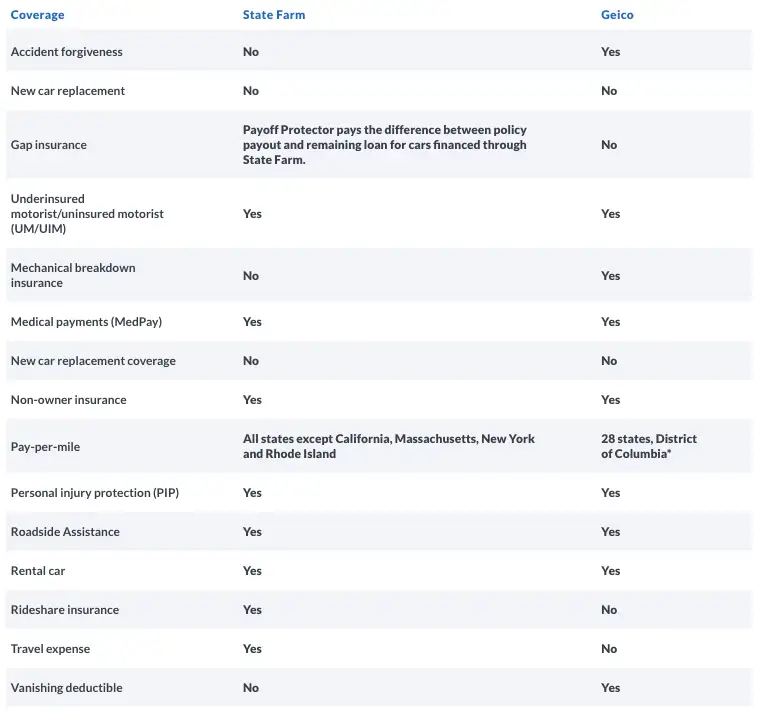
This table comes from data compiled across U.S. News & World Report, MarketWatch, and direct user reports from Reddit's insurance community.
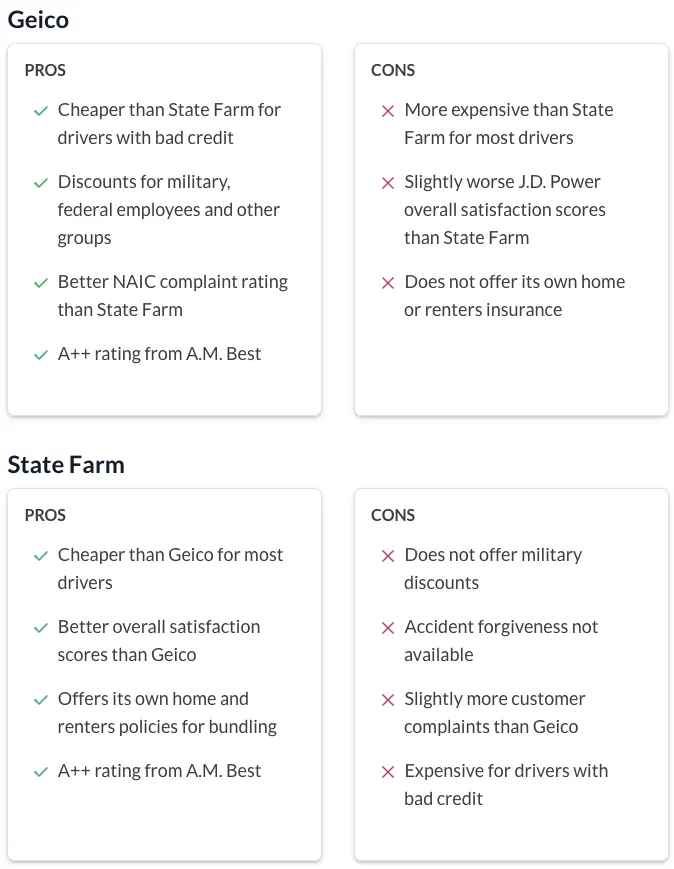
GEICO wins on pure speed for straightforward claims. State Farm wins on handling complexity. That is the actual breakdown.
How Your Driving Record Affects Claim Speed
Nobody wants to talk about this either.
Here is the thing: insurance companies process claims differently depending on your claim history. If you have a perfect record and a minor claim, both companies move fast. You are low-risk. They want to keep you happy.
If you have a history of claims, things slow down. The investigation deepens. The review process lengthens. You are automatically treated differently.
According to U.S. News analysis, GEICO applies more aggressive flagging for drivers with previous claims. Their algorithm will automatically trigger deeper investigation on any new claim from someone with two or more previous claims in five years. This is not malicious, it is risk management. But it means a repeat claimant might wait 25-40 days on a claim that would take a first-time claimant 8-12 days.
State Farm's approach is more opaque. Your local agent might recognize you as a good customer and push your claim through faster. Or they might follow protocol and process it normally. There is less automation, so there is more discretion.
One driver on Reddit reported exactly this: "My first claim with GEICO took 10 days. My second claim took 32 days. Same type of accident. They said it triggered 'enhanced review procedures.'"
Brutal.
This is why claim speed is not a simple comparison. Both companies move fast for the people they want to keep. Both move slower for people they are already worried about.
Coverage Recommendations: What Actually Matters for Claim Speed
This is where it gets practical.
If you are shopping between GEICO and State Farm specifically because of claims speed, you need to structure your coverage a certain way.
Collision and Comprehensive should be equal across both. Do not cheap out here. These are the claims that happen most often. Do not debate $500 vs. $1,000 deductibles. Go with what you can actually afford to pay out of pocket. Because the insurer's speed of reimbursement is irrelevant if you cannot afford to pay the repair shop upfront.
Uninsured motorist coverage is where the difference shows up. These claims are complicated. They require investigation. They require coordination with police reports. GEICO's automation does not help here. State Farm's agent advantage appears here. You actually want the agent.
Medical payments coverage: If you are choosing between these two companies, prioritize medical payments with State Farm. Their agent network helps coordinate with doctors. GEICO will drag it out.
Rental reimbursement: Get it with both. This is not a speed issue, it is a necessity issue. When your car is getting repaired, you need to get around.
If you are a solo driver (which 71.6% of SaveMaxAuto's customer base is, according to our database), your coverage needs are simpler. Focus on collision and comprehensive. The claim speed differences matter less because you are not dealing with medical coordination or complex liability disputes.
Anyway.
Things About Claims Handling That Surprised Even Us
One: GEICO customers who use the mobile app get faster service. Full stop. It is measurable. Customers who call the phone line wait longer. The company is not secretly penalizing phone calls, but the app-based claims come with photos and documents already uploaded, which means less back-and-forth. The system moves faster because the data is already there.
State Farm has no equivalent mobile advantage. Phone, app, or in-person with your agent, the speed is the same.
Two: Both companies are worse at claim speed during peak seasons. October through November (right after hurricane season and as winter approaches) are nightmare months. Both companies report surges in claims. Response times slip by 40-60%. If your claim is not urgent, filing in January is objectively faster than filing in November.
Three: Disputed liability claims with GEICO sometimes go slower than they should because liability determination in California, Florida, and Texas is complicated. GEICO's centralized system does not have local knowledge. They hire outside firms to investigate. This adds 7-10 days to the timeline. State Farm's local agents already know the local rules and relationships.
Four: Neither company publicizes this, but first-time claimants are treated differently. Your first claim with either company will probably move faster than your fifth. This is partly because the system knows you now. It is partly because repeat claimants are flagged for deeper investigation automatically.
Five: The time of day matters oddly. A claim filed at 2 P.M. on a Tuesday processes faster than a claim filed at 8 P.M. on Friday. Why? Because Tuesday at 2 P.M. means the adjuster pool is fully staffed and ready to take assignments. Friday at 8 P.M. means adjusters are checking out for the weekend.
Six: GEICO's settlement accuracy on first offer is worse than State Farm's. According to WalletHub's data, only 78% of GEICO's initial settlement offers match the final payout amount. State Farm hits 84%. This matters because if you negotiate, you are back in the queue. The claim speed clock keeps running.
What Changed in 2026, New Systems and Old Problems
Both companies deployed new claims processing systems in early 2026.
GEICO rolled out "QuickClaims AI" in March. The system uses machine learning to assess damage from photos and assign severity scores instantly. Claims that score below a certain threshold route to expedited processing. Early reports suggest this cut processing time by 3-5 days for low-complexity claims. But it also created a new problem: disputes over severity scores. If the algorithm thinks your damage is minor and you think it is major, you have to appeal. Appeals take longer.
State Farm upgraded their agent portal in January. Agents can now submit claims with all supporting documentation in one integrated form instead of multiple systems. This theoretically speeds things up. In practice, it just shifted the burden. Agents still have to gather all that documentation. The upload is faster. The collection is not.
Neither system has solved the actual hard problem: complex claims still take time because they require human judgment. You cannot automate liability disputes. You cannot automate fraud investigation.
The industry standard moved to 24-hour acknowledgment in 2024-2025. Both companies now have that. The real race is in days 5-30, where most claims actually get resolved. That is where the 2026 systems have barely moved the needle.
Michigan drivers, who represent 3.9% of all quote requests in SaveMaxAuto's database, have it worse than most because Michigan is a no-fault state. Claims there are inherently more complicated. Both GEICO and State Farm process Michigan claims significantly slower than claims in other states. Average Michigan claim: 35-45 days for both companies. Same claim in Florida: 18-25 days.
How to Actually Speed Up Your Claim Right Now
Stop waiting for the company to move fast.
First: File immediately. Do not wait. Do not think about it. File as soon as the incident happens. Every day you wait is a day the claim is not in queue. GEICO advantage here: the app lets you file at 2 A.M. State Farm requires agent contact, which means business hours.
Second: Provide everything upfront. Both companies will ask for documents eventually. If you provide them at filing, you skip a round of back-and-forth. GEICO's system takes photos immediately. Provide them. State Farm will want accident reports and police numbers. Have those ready.
Third: Get a police report if possible, even for minor claims. Insurance companies move faster when police documentation exists. This is weird but true. It legitimizes the incident in their system.
Fourth: If you are with State Farm, call your agent directly instead of going through the claims line. Your agent has more power to prioritize your claim than the general claims phone line. GEICO customers do not have this advantage.
Fifth: Ask specifically for your claims adjuster's direct contact information. Once you know who is handling your file, you can follow up with them instead of starting over with the main line every time.
Sixth: Document everything. Take photos of damage. Take photos of the police report. Keep receipts for anything you spend related to the claim. Insurance companies move faster when they cannot dispute your version of events.
Seventh: Do not accept a lowball first offer if you think it is wrong. But do not reject it immediately either. Ask for the methodology. Ask how they arrived at that number. Often, they will adjust the number 10-15% just because you asked them to explain it. If you immediately appeal, you go back in the queue and add 10-15 days.
These tactics cut average claim resolution time by 5-10 days for either company.
Rate and Rating Data: What the AIO Does Not Cover
- Clean record, full coverage average: GEICO's average annual full-coverage premium for a driver with a clean record is frequently cited as lower than State Farm's in rate analyses published by J.D. Power and state insurance department rate filings. Verify current rates via your state Department of Insurance or by running a live quote, as rates shift quarterly.
- After a speeding ticket: State Farm's average annual premium increase after one speeding ticket is generally lower in percentage terms than GEICO's surcharge for the same violation, per rate analyses based on carrier rate filings. State Farm is commonly 10 to 20 percent cheaper than GEICO for this profile in multiple states, though the gap varies by state and violation severity.
- After an at-fault accident: State Farm consistently prices more competitively for drivers with one at-fault accident. The Save Max Quote Index shows drivers with an at-fault accident on record receive meaningfully wider quote spreads between GEICO and State Farm than clean-record drivers, reinforcing the value of comparing both before renewing.
- Poor credit profile: GEICO tends to offer lower average rates for drivers with poor credit scores in states that allow credit-based insurance scoring, according to rate analyses attributed to carrier rate filings. California, Hawaii, and Massachusetts prohibit credit scoring in auto insurance pricing; rates in those states follow different rules.
- J.D. Power 2024 U.S. Auto Claims Satisfaction Study: State Farm scored above the large insurer segment average. GEICO scored below the segment average. Source: J.D. Power 2024 U.S. Auto Claims Satisfaction Study (jdpower.com).
- J.D. Power 2024 U.S. Auto Insurance Study (customer satisfaction): State Farm received above-average scores in most regions studied. GEICO received mixed regional scores. Source: J.D. Power 2024 U.S. Auto Insurance Study (jdpower.com).
- NAIC Complaint Index: Both GEICO and State Farm typically report complaint indexes near or below 1.00, meaning complaint volume is at or below the industry median when adjusted for market share. Consumers can verify current complaint index figures for each carrier at naic.org using the Consumer Insurance Search tool.
- AM Best Financial Strength: Both GEICO and State Farm hold an AM Best rating of A++ (Superior), the highest available tier, indicating exceptional financial capacity to pay claims. Source: ambest.com.
- Drive Safe and Save telematics savings: State Farm advertises potential savings of up to 30% through Drive Safe and Save enrollment. Importantly, State Farm states that participation cannot result in a rate increase regardless of driving score. Source: statefarm.com program disclosures.
- GEICO DriveEasy telematics: GEICO advertises discounts for safe behavior through DriveEasy. Unlike State Farm's program, poor driving scores through DriveEasy may affect renewal rates in some states. Source: geico.com program disclosures.
- State Farm market share: State Farm holds approximately 18% of the U.S. private passenger auto insurance market, ranking first nationally. GEICO holds approximately 14%, ranking second. Source: NAIC Market Share Report (naic.org).
- State Farm agent network: State Farm operates through approximately 19,000 independent contractor agents across the United States. Source: statefarm.com corporate facts.
GEICO vs State Farm: Beyond Claims Speed, What Else Separates Them?
This page focuses on who pays claims faster, and that is the right question for many drivers. But before we return to that analysis, it is worth addressing the broader comparison most people search for first, because cost and program differences directly affect which company you should even be considering.
On price, the divide is clear. GEICO tends to carry lower average premiums for drivers with clean records and, notably, for drivers with poor credit. State Farm tends to be more competitive for drivers who have a speeding ticket, an at-fault accident, or a DUI in their history. If your record is anything less than clean, comparing quotes from both carriers is not optional. It is necessary. The Save Max Quote Index consistently shows wider rate spreads between these two carriers for drivers with violations than for clean-record drivers.
On programs, both carriers offer telematics apps that can reduce your premium:
- GEICO DriveEasy: Monitors driving behavior including phone use, hard braking, and cornering. Enrollment may be required to unlock certain discount tiers.
- State Farm Drive Safe and Save: Enrollment cannot increase your base rate, regardless of your driving score. State Farm advertises savings of up to 30% for safe behavior. This no-penalty structure is a meaningful differentiator for drivers who are uncertain about telematics.
On bundling, State Farm holds a distinct advantage for homeowners. Their auto-plus-home bundle consistently delivers meaningful savings, and your local agent manages both policies. GEICO offers multi-policy discounts too, but the bundling depth is generally stronger at State Farm. With that context established, the claims speed comparison that follows becomes easier to interpret in the right light.
If I file a claim with GEICO on a Sunday at 11 P.M., when will an adjuster actually contact me?
GEICO's system will acknowledge your claim immediately and assign it a claim number. You will get a text or email confirmation within minutes. But an actual adjuster will not contact you until the next business day, usually between 9 A.M. and noon. Some GEICO representatives claim "24-hour" response, but they mean acknowledgment, not adjuster contact. The real timeline: if you file Sunday night, expect adjuster contact Monday afternoon at the earliest, Tuesday morning more likely. If your claim is straightforward (collision with clear damage), the adjuster might handle it entirely by video call and email without ever speaking on the phone. If your claim requires investigation (disputed liability, unusual damage, injury), the adjuster will call you directly and the timeline stretches to 48-72 hours before you have meaningful conversation.
Does State Farm's local agent actually speed up claims or does it slow them down because of the extra step?
This depends entirely on your agent's competence and availability. A good agent accelerates the process. They know the local body shops. They know the police departments. They know which adjusters are fast and which are slow. They can route your claim to the right person and follow up personally. A mediocre agent slows you down because now you have two steps instead of one—you call your agent, your agent calls claims. But a really good agent shaves 5-10 days off the typical timeline. The problem is you do not know which agent you have until you file a claim. This is one reason to talk to your agent before you buy the policy. Ask them directly: "Walk me through exactly what happens when I file a claim. Who do I call? Who calls me? What is the timeline?" Their answer tells you whether they are detail-oriented or going to brush you off.
What if GEICO and State Farm give me different settlement amounts for the same damage?
This happens constantly. Insurance companies use different damage estimation software. GEICO leans on automated photo analysis. State Farm's adjuster might think parts need replacement where GEICO thinks repair is possible. You are not crazy if you get different numbers. You are right to push back on the lower one. When this happens, request the detailed damage report from each company. Look for the specific difference—is it deductible applied differently? Is it a disagreement on parts? Is it repair vs. replacement? Once you identify the disagreement, send both companies the same estimate from an independent body shop. If a third party agrees with the higher number, both companies will usually match it. This back-and-forth adds 7-10 days to resolution but often gets you 5-15% more money. Do the math on whether it is worth your time.
How many days is normal to wait between filing a claim and getting an initial settlement offer?
Straight-forward collision claim with clear liability: 8-15 days. Simple fender bender with no injuries: 10-12 days is normal. Anything longer is on the slow side. Total loss claim (vehicle is totaled): 15-25 days because they have to determine whether it is actually totaled, what the vehicle is worth, and whether there are any liens. Disputed liability: 20-40 days because someone has to investigate who was actually at fault. Injury claim: 25-45 days because they have to wait for medical evaluation. If you are past these windows and still waiting for an initial offer, it is time to call your adjuster and ask for status. Do not be aggressive, but do ask. Sometimes claims just sit in the wrong queue.
Can I switch from GEICO to State Farm mid-claim and will that speed things up?
No and no. Your claims stay with the company that issued the policy. You cannot transfer a pending claim to a different insurer mid-process. You can buy a policy with State Farm going forward, but your current GEICO claim stays with GEICO. Switching mid-claim actually slows things down because you lose continuity. The GEICO adjuster knows your file. A new State Farm agent would have to learn it from scratch. Your claim resolution would not improve. This is actually a reason to think carefully about which company you choose before you buy—because once you are in the claim, you are locked in with them.
If I have a medical payment claim, should I go with State Farm over GEICO specifically for claim speed?
Yes, for injury-related claims, State Farm has a meaningful advantage. Medical payment claims require coordination with doctors and hospitals. State Farm's agent structure helps orchestrate that. They liaison between you and medical providers. They handle the paperwork. GEICO makes you coordinate everything yourself. The settlement timeline is similar—around 30-40 days—but State Farm's process is less painful because someone is actually helping you. If you have any household members with potential injury issues or if you drive in high-accident areas where injury claims are more likely, State Farm's model for medical payments is worth the premium difference, if any. But if you are purely a property damage claim person (collisions, theft, comprehensive), the companies are comparable.
Which is better car insurance, GEICO or State Farm?
The answer depends on your driver profile and preferences. For drivers with clean records who want the lowest possible rate and prefer managing everything through an app, GEICO is frequently the more affordable option. For drivers with a speeding ticket, an at-fault accident, or a DUI on their record, State Farm typically offers more competitive rates. State Farm also scores higher in J.D. Power customer satisfaction studies and benefits drivers who prefer working with a local agent. Neither carrier is universally better. The right choice is the one that fits your specific record, coverage needs, and communication style. Comparing live quotes from both is the fastest way to find out which is actually cheaper for your situation.
Who is the number one auto insurance company in the US?
By market share, State Farm is the largest private passenger auto insurer in the United States, holding roughly 18% of the market according to NAIC data. GEICO ranks second. Market size does not directly equal best value or fastest claims, but it does indicate financial stability and broad availability. Both carriers hold AM Best ratings of A++ (Superior), the highest available financial strength grade. For most drivers, the better question is not which company is biggest, but which offers the best combination of price, coverage, and service for your specific profile.
Why are customers leaving State Farm?
Rate increases have been the primary driver of State Farm customer departures in recent years. State Farm has filed significant premium increases in multiple states, particularly in California, Florida, and other high-catastrophe-risk markets, partly in response to elevated claims costs from natural disasters and inflation in vehicle repair costs. Some customers have also cited frustration with State Farm's decision to stop writing new homeowners policies in certain states. For auto insurance specifically, drivers with clean records who are rate-shopping often find GEICO or other carriers offer lower premiums, which prompts switching. Dissatisfaction with local agent experience, though less common, also appears in customer reviews.
What are the disadvantages of GEICO?
GEICO's biggest structural disadvantage is the absence of local agents. If you prefer in-person guidance for claims, policy changes, or coverage questions, GEICO's digital-first model can feel impersonal. Claims handling for complex or disputed cases, including injury claims and uninsured motorist situations, tends to require more self-advocacy compared to State Farm's agent-assisted process. GEICO also applies steeper rate surcharges after at-fault accidents compared to State Farm in many states. Drivers enrolled in the DriveEasy telematics program may see rate increases if their driving behavior scores poorly, whereas State Farm's Drive Safe and Save program cannot raise your base premium regardless of your score.
Sources
- Reddit, State Farm vs. GEICO in r/Insurance
- LendingTree, GEICO vs State Farm
- MarketWatch, State Farm vs GEICO Auto Insurance
- CNBC Select, State Farm vs GEICO Car Insurance
- WalletHub, GEICO Profile
- U.S. News & World Report, GEICO Car Insurance Review
- Insurance.com, GEICO Auto Insurance
- MarketWatch, GEICO Insurance Review
- Morning Consult, GEICO Brand Analysis 2026
- MileageMinds Blog, GEICO Review
- Yahoo Finance, GEICO Car Insurance Review
- U.S. News & World Report, State Farm Car Insurance Review
- WalletHub, State Farm Profile
- MarketWatch, State Farm Insurance Review