
costs
vehicles


Published: Feb 27, 2026
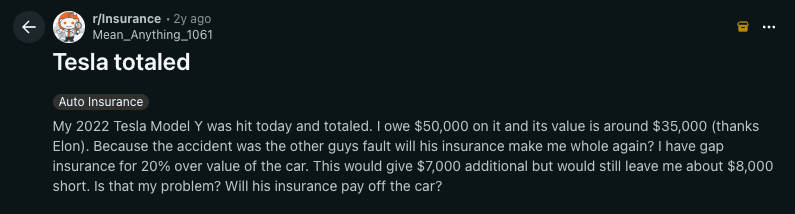
"My 2022 Tesla Model Y was hit today and totaled. I owe $50,000 on it and its value is around $35,000. Thanks Elon."
Real person. Day of the crash. Still owed $15,000 more than the car was worth. Had GAP insurance. Still came up $8,000 short.
That last part is the one most people miss. Having GAP isn't enough on its own, the wrong policy, bought from the wrong place, with a percentage cap buried in the fine print, and you're still writing a check on a car that's in a scrapyard. This guide covers what actually happened here, why it keeps happening to Tesla owners specifically, and how to make sure you're not the next person posting in r/Insurance from the side of the road.
What Tesla GAP Insurance Actually Does
GAP stands for Guaranteed Asset Protection. Here's exactly how it works, step by step:
Step 1, Your car gets totaled or stolen.
Could be an accident, could be theft. Doesn't matter how it happens.
Step 2, Your insurance pays you what the car is worth today.
Not what you paid for it. Not what you owe on it. What it's worth right now on the open market. That number is called the Actual Cash Value, or ACV.
Step 3, If your loan balance is higher than the ACV, you're on the hook for the difference.
Example: car is worth $23,000. You owe $36,000. Your insurer writes you a $23,000 check. The remaining $13,000 is yours to pay, on a car you no longer have.
Step 4, GAP covers that difference.
That's the whole product. One job. Cover the gap between what insurance pays and what you still owe.
Why Tesla owners have a bigger problem than most:
Most cars close that gap within a year or two. You pay the loan down, depreciation slows, and the numbers meet. Tesla owners who bought between 2020 and 2023 didn't get that timeline. Tesla kept slashing new car prices, sometimes $5,000 to $15,000 in a single announcement, and every time they did, used Teslas lost value the same day. Loan balances kept dropping at the normal rate. The gap stayed wide way longer than it would on almost any other car.
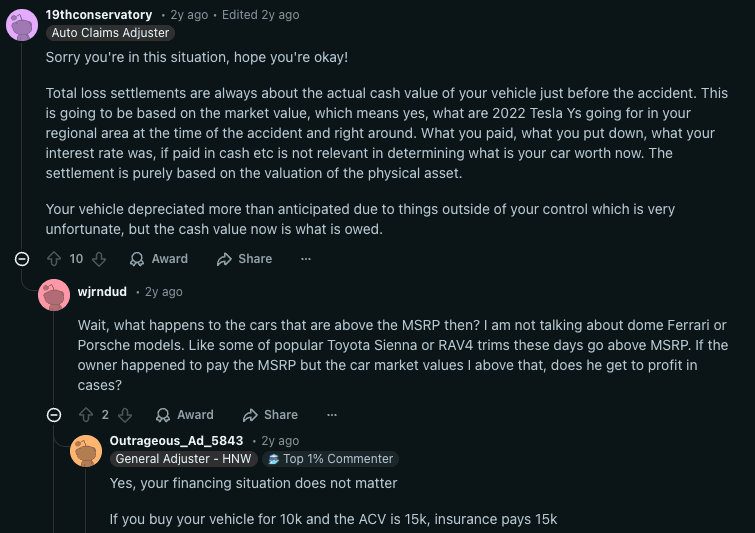
A claims adjuster confirmed it directly in r/Insurance. When your car is totaled, here's what does NOT factor into your payout:
- What you originally paid
- What you put down at purchase
- Your interest rate
- How long you've owned it
One thing factors in. What the car is worth on the day of the crash. That's the check. Everything above that is your problem, unless you have GAP.
The Depreciation Problem That Makes Tesla Different
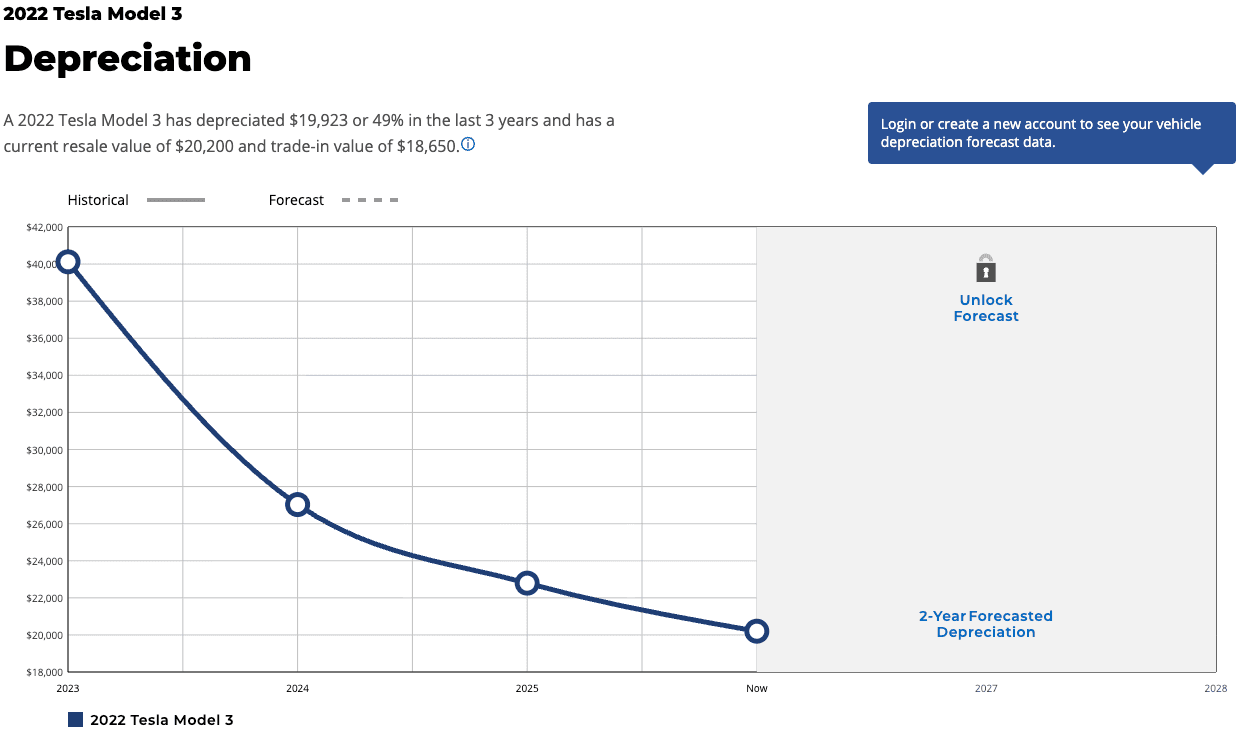
Source: Kelley Blue Book, 2022 Tesla Model 3 depreciation, valid through 3/30/2026
A 2022 Model 3. Bought for around $40,000. Worth $20,200 today in private party resale. That's $19,923 gone in three years. 49%.
2021 Tesla Model Y Depreciation
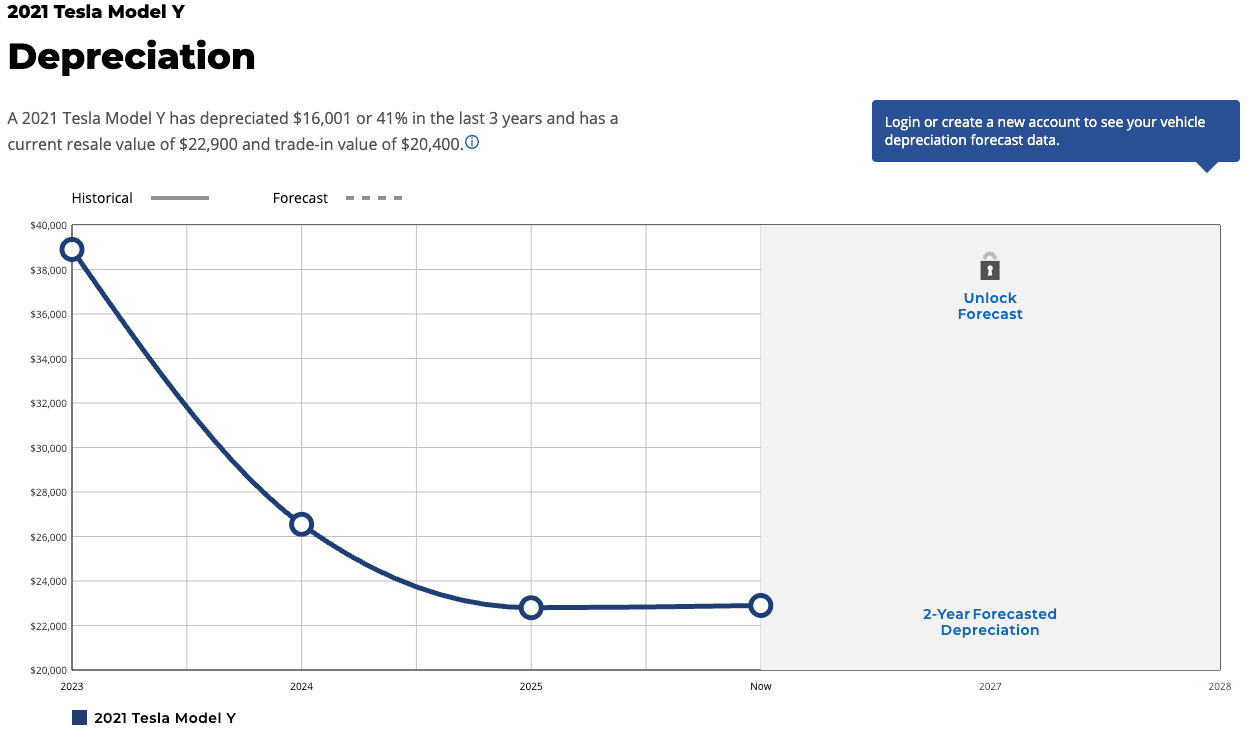
Source: Kelley Blue Book, 2021 Tesla Model Y depreciation, valid through 3/30/2026
The 2021 Model Y lost $16,001. 41% of its value. Gone.
Compare that to a 2022 Toyota Camry, down about 30% in the same window. A 2022 Honda CR-V, around 28%. Tesla is losing value 10 to 20 points faster than either of them. And it has nothing to do with reliability. It's because Tesla kept cutting new car prices and the used market repriced every single time.
The owner who wrote "thanks Elon" was not exaggerating. $15,000 of value gone for reasons that had nothing to do with how they drove the car.
The Math Every Tesla Buyer Should Run Before Skipping GAP
2021 Tesla Model 3 Values and Prices
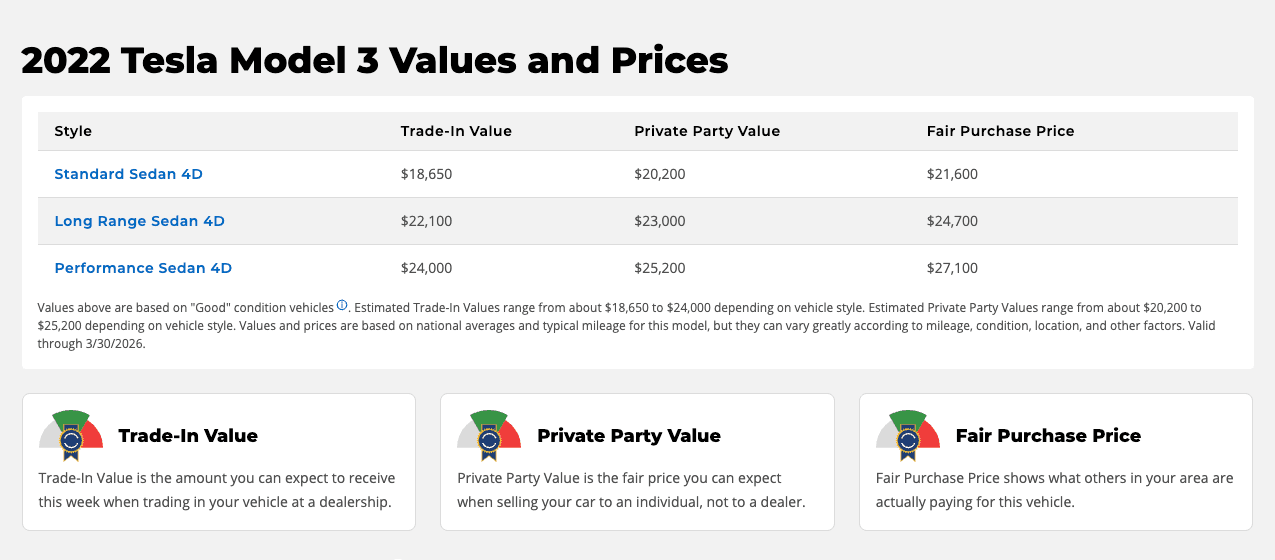
Source: Kelley Blue Book, 2022 Tesla Model 3 current values, valid through 3/30/2026
2021 Tesla Model Y Values and Prices
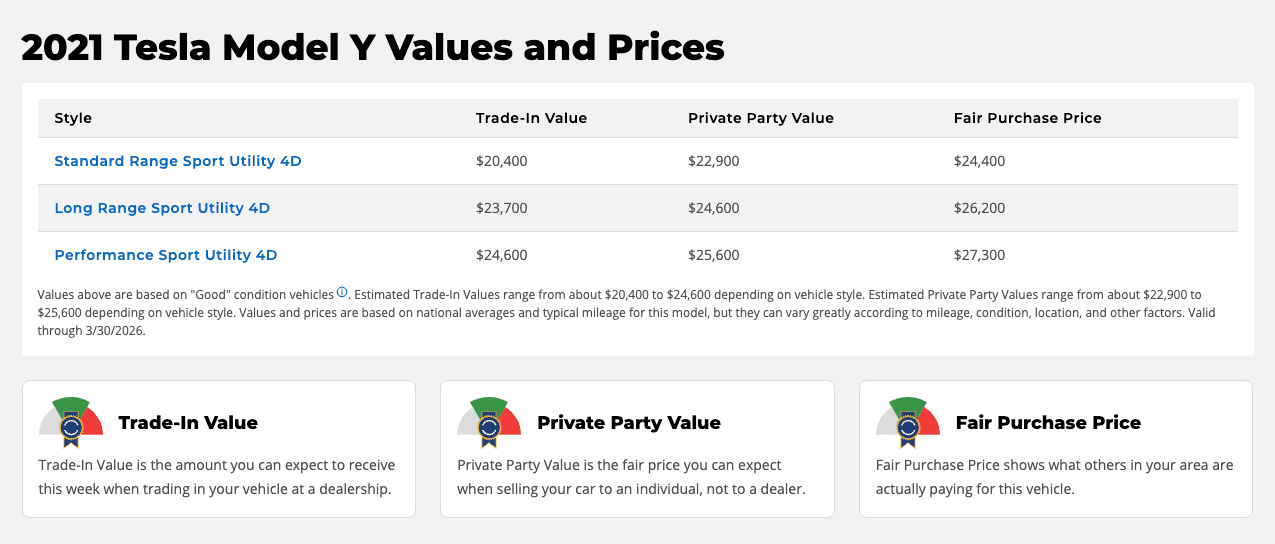
Source: Kelley Blue Book, 2021 Tesla Model Y current values, valid through 3/30/2026
Someone I spoke to online bought their Model 3 Long Range in early 2022 for $62,000. Made every payment. Never missed one. Three years later they still owed $36,000 on it. Then someone ran a red light and totaled it.
Their insurer looked up the car. Said it was worth $23,000. Wrote them a check for $23,000. Still owed $36,000. That $13,000 didn't go anywhere. Still sitting there waiting to be paid, on a car in a scrapyard.
That's not a freak situation. That's what the numbers produce right now on basically any Tesla bought between 2020 and 2023. The Model Y version of this story is a little less dramatic, 2021 Long Range bought at $55,000, three years in, you're looking at roughly a $5,400 gap between loan balance and what KBB says it's worth. Still real money. Still money you owe on nothing.
Quick rule of thumb
Go look up your loan balance right now. Then look up your car's KBB private party value. If the loan number is bigger, you have a gap. If you couldn't write a personal check for that difference tomorrow morning, you need GAP insurance. Your regular insurer adds it for $20 to $40 a year. That's it.
What Real Tesla Owners Have Experienced
Here's what it actually looks like when it happens.
Source: r/Insurance community post, 2024
Source: r/Insurance, Auto Claims Adjuster flair, 2024
Source: r/TeslaSupport community post, 2025
Source: r/electricvehicles community post, March 2026
What the community data tells us
Two things jump out across all of these. One: the people finding out they have a problem are finding out on the worst possible day, the day of the crash. Two: having GAP isn't enough on its own. The owner above had it and was still $8,000 short. Their policy had a 20% cap. So when you buy GAP for a Tesla, ask one question and get the answer in writing: does this cover the full difference between my loan payoff and the ACV, or is there a cap? A 20% cap on a $15,000 gap pays $7,000. You're on the hook for the rest.
The Safety Ratings Are Excellent (But That's Not the Point)
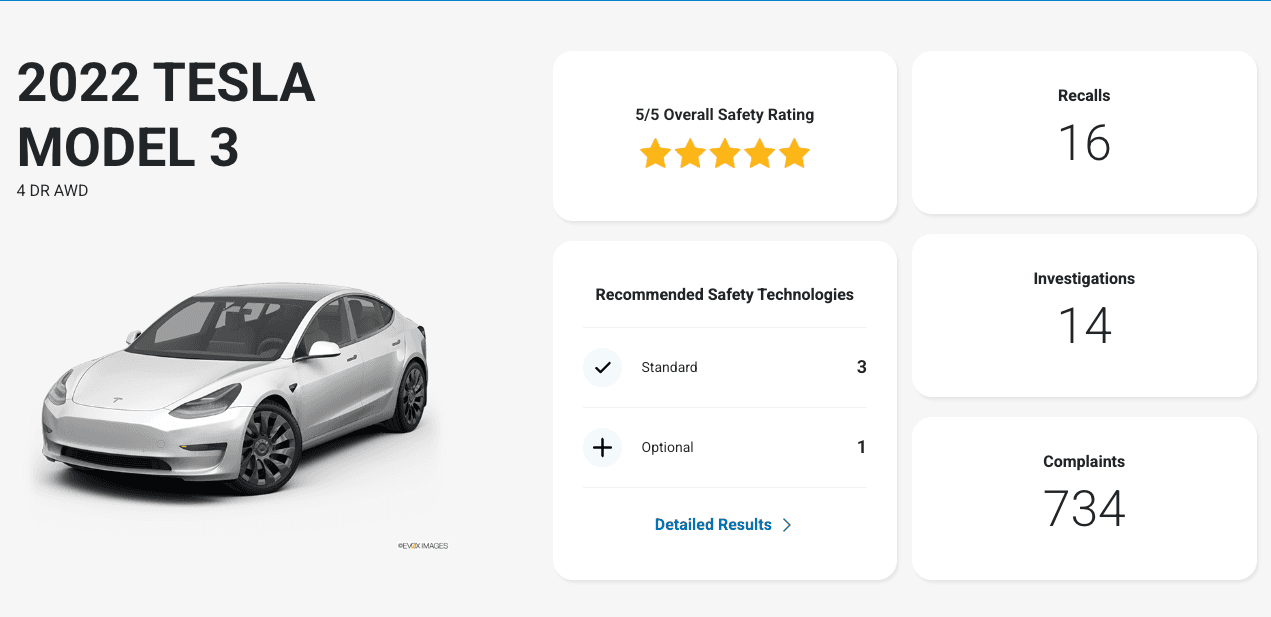
Source: NHTSA, 2022 Tesla Model 3, 5/5 overall safety rating

Source: IIHS.org, 2022 Tesla Model 3, TOP SAFETY PICK+
Five stars from NHTSA. IIHS TOP SAFETY PICK+. The Model 3 genuinely performs well in crash testing and there's nothing misleading about those ratings.
People sometimes hear 'safest car on the road' and think it means they need GAP less. This is backwards. GAP has nothing to do with crash safety. You could drive a tank that literally cannot be totaled and GAP would still either be relevant or not based purely on one thing: is your loan balance higher than what the car is worth right now. A car with a five-star rating and a car with a two-star rating have identical GAP situations if they have identical loan balances and identical KBB values. The crash rating doesn't factor in at all.
What Just Changed With Tesla Insurance in 2026
In August 2025, Tesla Insurance received approval from the California Department of Insurance to raise rates by 12.4% across all California policies. The increase applies at renewal for anyone insured through Tesla's own program in the state.
California is Tesla's biggest U.S. market by a significant margin. A 12.4% rate hike through Tesla Insurance is relevant to anyone who bought GAP coverage through Tesla's own insurance program, because your GAP coverage and your base policy are priced together, and a rate increase on the policy affects the total cost equation.
This is one more reason why buying GAP through your regular insurer or your financing bank, where the coverage is priced separately and doesn't move with Tesla's internal rate decisions, tends to be the more predictable option. If you're currently insured through Tesla Insurance in California and your renewal is coming up, it's worth getting competing quotes before it auto-renews.
Source: Tesla Insurance official coverage page, Tesla.com/support/insurance/coverages
The Recall Number Nobody Talks About
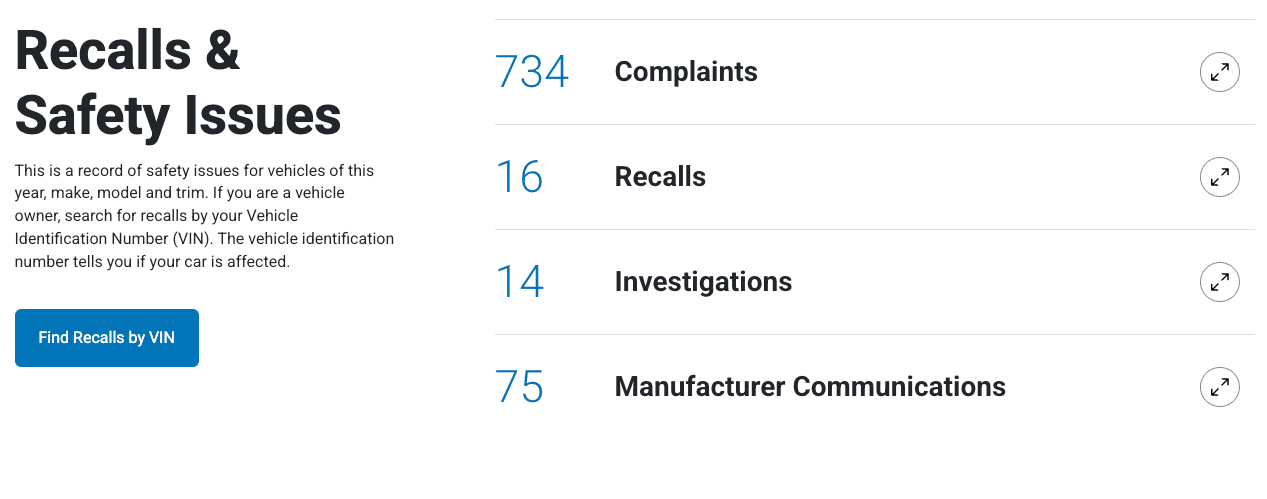
Source: NHTSA, 2022 Tesla Model 3 recalls and safety issues, as of March 2026
What most people don't know: the 2022 Model 3 has 16 federal recalls, 14 open NHTSA investigations, and 734 owner complaints on record. For a car that gets marketed as the safest vehicle on the market, that's a lot of paperwork.
Why does this matter for GAP? Two reasons. First, recalls involving brakes and suspension push repair costs up, and higher repair costs push insurance premiums up, so knowing this affects what you should be paying. Second, and this one catches people off guard: if your car gets totaled and you have an open recall that was never addressed, your insurer can use that as a reason to dispute the valuation during a GAP claim. It doesn't happen all the time but it happens. Go to nhtsa.gov right now, plug in your VIN, and see if anything comes up. Takes two minutes.
When You Actually Need GAP on a Tesla (and When You Don't)
Simple question first: is your loan payoff higher than your KBB private party value right now? If yes, you need GAP. That's the whole test.
The gap is biggest if you bought between 2020 and 2023, put less than 20% down, and financed for 48 months or longer. All three of those? Your loan balance is almost certainly above market value right now.
It's probably already gone if you paid cash, put 30% or more down, or you're five-plus years into a standard loan. Run the math before you cancel anything.
Check it every six months. Loan servicer gives you the payoff number. KBB gives you the value in two minutes. The month the payoff drops below KBB is the month you cancel. No reason to keep paying for coverage you don't need.
Where to Buy Tesla GAP Insurance (And What It Actually Costs)
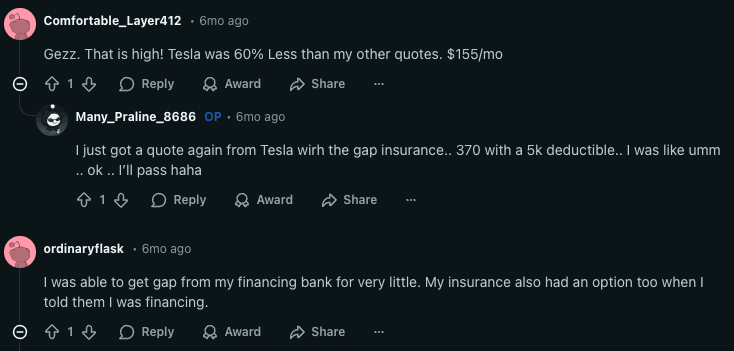
Your regular insurer is the right call. $20 to $40 a year added to your existing policy. Call them before you sign any financing paperwork. Adding it after the loan closes is harder and sometimes more expensive.
if you're concerned about the cost to buy gap insurance for your Tesla Model 3, check out our article here to see a full gap insurance cost calculator.
Your bank or credit union is option two. Not using Tesla's financing? Ask about GAP when the loan gets set up. Credit unions especially will often do it as a one-time flat fee, $200 to $400 added to the loan once, done.
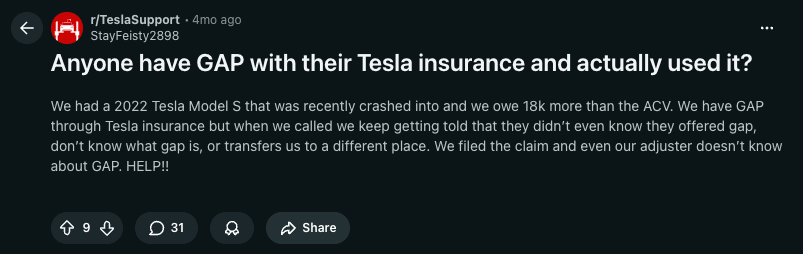
The Tesla dealership is the wrong answer. $500 to $1,200 tacked onto the loan, and then you pay interest on that amount for the life of the loan. The actual cost is higher than the number they quote you. And at least one Tesla owner documented in r/TeslaSupport that after totaling their car, Tesla's own representatives didn't know the company offered GAP coverage. Bounced around, no one knew what to do. Buy it somewhere with a claims process that works.
Editor's note,Editor's if you haven't checked out our Tesla or gap insurance cost comparison article, please do. You'll find a calculator there that helps you compare costs for gap insurance across different methods of purchasing.
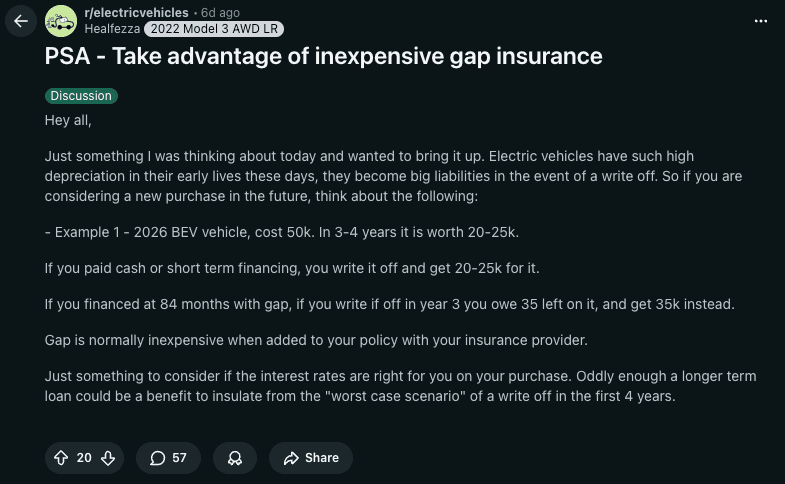
Source: Reddit community discussion, owner got GAP through financing bank
One thing to verify regardless of where you buy
Before you sign anything, ask one question: is there a percentage cap on this GAP policy? Some cap out at 20% or 25% above ACV. On a Tesla where the gap can be $10,000 to $20,000, a 20% cap leaves you holding the rest. Get the answer in writing. You want full coverage of the difference between your payoff and the ACV. No ceiling.
Is Tesla's depreciation really that much worse than other cars?
KBB says the 2022 Model 3 lost 49% in three years. The 2021 Model Y lost 41%. A 2022 Camry lost about 30% in the same window. Tesla is losing value significantly faster and the reason isn't mechanical wear. It's Tesla's own pricing decisions on new inventory. That's the unusual part.
Frequently Asked Questions
Real questions from Tesla owners who went looking for answers after the fact. Here they are before that happens.
Is GAP insurance worth it on a Tesla?
For most people who financed a Model 3 or Model Y between 2020 and 2023, yes. The math is simple: Tesla's price cuts created depreciation that moves faster than loan balances drop. The gap stays open longer than it does on almost any other car. Twenty to forty dollars a year through your regular insurer is a genuinely low number to hold against a five-figure exposure.
How much does Tesla GAP insurance cost?
Through your regular insurer: $20 to $40 a year added to your policy. Through a bank or credit union at loan setup: usually $200 to $400 as a one-time flat fee. Through the Tesla dealership: $500 to $1,200 added to the loan, plus interest on that amount for however long the loan runs. Buy it from your insurer.
Does Tesla Insurance offer GAP?
On paper, yes, in some states. In practice, at least one owner totaled their car, had GAP through Tesla Insurance, and got transferred between multiple Tesla reps who had no idea their company offered it. Their adjuster didn't know either. Buy it through your regular insurer or your financing bank. The claims process will actually work.
How long do you need GAP insurance on a Tesla?
Until your loan payoff drops below your KBB private party value. Check both numbers every six months. For a 2022 Model 3 or 2021 Model Y on a 60 to 72-month loan, you're probably looking at three to four years. The month the loan clears below KBB, cancel it.
What happens if I get totaled and I don't have GAP on my Tesla?
Your insurer pays ACV. Your loan servicer gets that check. If your payoff is higher than the ACV, you pay the difference. The owner who opened this article owed $50,000 on a car worth $35,000. No GAP means writing a $15,000 check on a totaled car. With their capped GAP, it was $8,000. Still a bad day either way.