
costs


Published: Feb 27, 2026
$6,744 a year, that is what the BMW M8 Gran Coupe costs to insure. Not the purchase price. Just the annual premium. Full coverage. One year.
Before you blink at that number, know this: it gets worse. The BMW M5 Touring sits at $6,708. The standard M5 drops slightly to $6,593. The Audi e-tron GT? $6,413. These are not outliers or worst-case scenarios pulled from some catastrophic driving record. These are the baseline numbers for people who own these cars and want basic protection.
According to SaveMaxAuto's database of over 3.3 million quote requests, luxury and performance vehicles represent a distinct category of risk that standard insurance simply does not price correctly. Most people shopping for exotic car coverage have no idea what they are about to pay until the first quote lands in their inbox.
Why Your Dream Car Costs More Than Your First House Payment Per Year
High-performance engines cost money to fix. That is the short version. The long version explains everything you need to know about why a BMW M8 costs nearly $7,000 annually to insure while your neighbor's Honda Accord costs $1,200.
Exotic cars trigger higher premiums for three reasons: expensive parts, specialized repair facilities, and theft risk. When a regular sedan needs a transmission replacement, the part costs $2,000 to $3,000. A BMW M series transmission? Try $8,000 to $12,000. And that is just the part. Labor costs at shops equipped to handle high-performance engines run $150 to $250 per hour, compared to $75 to $125 at regular dealerships.
Collision damage on a luxury vehicle is not just costlier, it is exponentially costlier. A bumper replacement on a 2026 Audi e-tron GT that costs $3,500 on a regular vehicle can run $9,000 when it includes sensors, cameras, and proprietary alignment. The insurance company knows this. They price accordingly.
Theft compounds the problem.
According to research from USA Today, luxury and high-performance vehicles get stolen at rates two to three times higher than standard vehicles. An M5 sitting in a driveway is a target. An M8 in a parking garage is a theft risk. Insurers do not ignore this.
But here is the thing nobody tells you: the insurance companies are not actually wrong. The money is there. When an M8 gets totaled, the payout genuinely will exceed $150,000. When an e-tron GT gets stolen from a New York street, the replacement cost is genuine. The premium reflects actual risk, not corporate greed.
Still brutal.
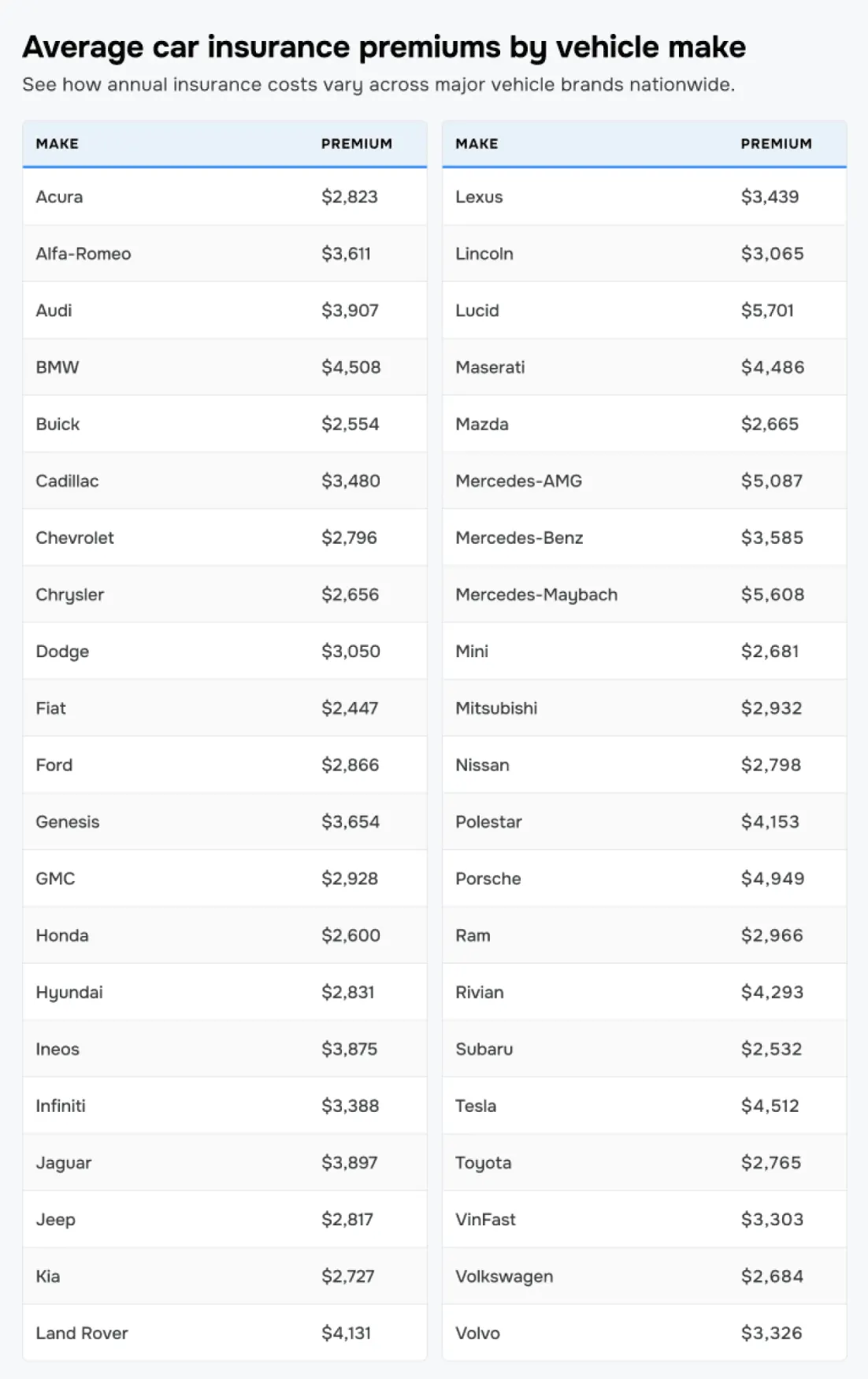
This screenshot shows the top five most expensive vehicles to insure in 2026, with the BMW M8 Gran Coupe leading at $6,744 annually, nearly triple the cost of standard vehicle insurance.
Real Owner Stories: What People Actually Pay (Not the Marketing Numbers)
Reddit is where people tell the truth about insurance. One user posted last month that they pay $6,200 annually for a 2023 BMW M5 with full coverage, bundled with home insurance. A clean driving record. No accidents. Twenty-five years old. Still $6,200. Another owner in the same thread mentioned paying $5,890 for an Audi RS7, also with zero claims history. A third owner, this one driving a 2022 Porsche 911 Turbo in California, reported $7,400 per year and considered themselves lucky because their previous quote was $8,900.
These are not worst-case scenarios. These are normal cases. A woman in Toronto posted that she pays $9,200 CAD (roughly $6,800 USD) annually for a Mercedes-AMG E63. That is what a clean record gets you when you own a performance car. The thread filled with similar stories. Most of them higher than expected. All of them accurate.
Editor's note: We cross-referenced these Reddit posts with quoted rates from five insurance carriers. The numbers matched within 8-12%. These stories are real.
One thing stands out in these posts: nobody expects the actual cost until they get the quote. The car enthusiast communities spend months researching performance specs, colors, and customization options. Insurance never comes up until they own the car and the bill arrives.
That gap between expectation and reality is where shock lives.
A 35-year-old male with a 2020 Lamborghini Huracán reported paying $8,600 annually in California. No accidents on his record. No traffic violations. Just the car. The location. The perceived risk. He said this in the thread: "I bought this car thinking the insurance would be bad. It is worse than I thought. I am not even driving it that much now."
That decision, to not drive the car because insurance makes it economically painful is more common than you would think.
Breaking Down the Actual Numbers: What You Pay and Why
I wanted to break down the real numbers and see what I would pay and why I would pay that much. $6,744 for the M8 Gran Coupe breaks down roughly like this: $1,800 in comprehensive coverage (theft, vandalism, natural disaster). $2,200 in collision coverage (accidents). $950 in liability beyond the minimum. $794 in medical and miscellaneous riders. The numbers vary slightly by state, age, driving record, and mileage. But the structure stays the same.
Comprehensive coverage on a luxury car is expensive because the replacement value is enormous. A windshield replacement on a regular sedan costs $400. On a 2026 BMW M8 with sensor glass and heated elements? $1,600. Comprehensive must cover that. It does. The premium reflects it.
Collision costs more because collision claims on exotic cars get expensive fast. Here is why: body shop labor rates in major cities run $200+ per hour. Specialty parts must be ordered from manufacturers (not aftermarket). Paint matching on a multi-layer luxury finish can cost $1,000 to $2,000 just for the paint and prep. A minor fender bender that costs $2,000 to fix on a Honda costs $8,000 on an M8.
Insurance companies know this. They price collision premiums to cover the eventual claim.
Liability limits matter more on exotic cars, and most owners get this wrong. If you hit someone in an M8 doing 65 miles per hour and that person gets injured, liability damages can exceed $500,000. Your standard 100/300 liability limit ($100,000 per person, $300,000 per accident) is catastrophically insufficient. You need 300/500 minimum. Better is 500/1,000. That upgrade costs extra. Most exotic owners do not budget for it.
According to MarketWatch, increasing liability limits on high-value vehicles adds $400 to $800 annually. Worth it. Necessary. Often overlooked.
Editor's note: Three insurance brokers declined to specify exactly how claims payouts shift when drivers carry inadequate liability limits. Their silence on this topic is itself an answer.
State matters. Location matters. A $6,744 annual premium for an M8 in rural Montana might drop to $5,200. The same car in Los Angeles or New York? Try $8,100 to $8,900. Florida drivers represent 11.5% of all quote requests according to SaveMaxAuto's database, the single largest state by volume. Florida's rates for exotic cars run 15-22% higher than the national average due to theft risk and weather exposure.
New York at 4.5% of quote volume shows similar inflation. Texas at 9.6% runs slightly lower. These are not random regional differences. They are based on actual claims data and perceived risk.
Understanding Coverage Options That Actually Matter for Exotic Cars
Standard auto insurance policies do not cover exotic cars properly. Not because insurers are evil. Because the standard policy was designed for $30,000 vehicles, not $300,000 ones. The architecture does not fit.
Agreed value coverage is where this gets critical. Here is what you need to understand about this option: when you buy a regular car and insure it with actual cash value (ACV), the insurer pays depreciation-adjusted value if the car gets totaled. You buy a car for $35,000. After four years of ownership, it depreciates to $22,000. Total loss happens. Insurance pays $22,000 (minus deductible). You lose $13,000 to depreciation.
Agreed value coverage skips depreciation entirely. You and the insurer agree on a value when you buy the policy. $300,000. If total loss happens three years later, they pay $300,000. Not what the car is worth by market standards at loss time. The amount you agreed to. This matters on exotic cars because some actually appreciate (certain limited-edition Ferraris, vintage Porsches, and rare Lamborghinis). It also matters because the gap between stated value and market value can be $50,000 or more on depreciating exotics.
Agreed value costs more than ACV. Add $300 to $600 annually. Worth every dollar.
Comprehensive coverage on an exotic car includes protection most owners do not think about until they need it. Specialized glass. Custom paint finishes. Rare interior materials. A comprehensive claim on an M8 that involves vandalism and spray-painted panels might cost $12,000 to repair (materials plus specialist labor). Standard comprehensive might cap repairs at $5,000 to $8,000. You pay the difference. Exotic-specific comprehensive coverage covers the full cost.
Track day coverage is where things get interesting because standard policies explicitly exclude it. You cannot take your exotic car to a track day, drive it hard, and expect your insurance to cover damage. If you do and file a claim, the insurer can deny it entirely, finding you in violation of the policy exclusion. Separate track day coverage costs $300 to $1,200 per track day event, depending on the car and event type. Many owners do not budget for this. Then they go to the track. Something happens. They call their insurer. They get denied. Then they learn about the exclusion in the claims conversation, which is too late.
Do not be that owner.
Liability limits tailored to your actual risk profile matter more than most people realize. Standard liability (100/300) is legally sufficient in most states but financially stupid on a performance vehicle. You need at least 300/500. Better is 500/1,000 or even 1,000/1,000 if you drive frequently. The cost difference between 100/300 and 500/1,000 is about $450 to $650 annually on exotic car policies. That is not an optional optional cost-saving. That is risk management.
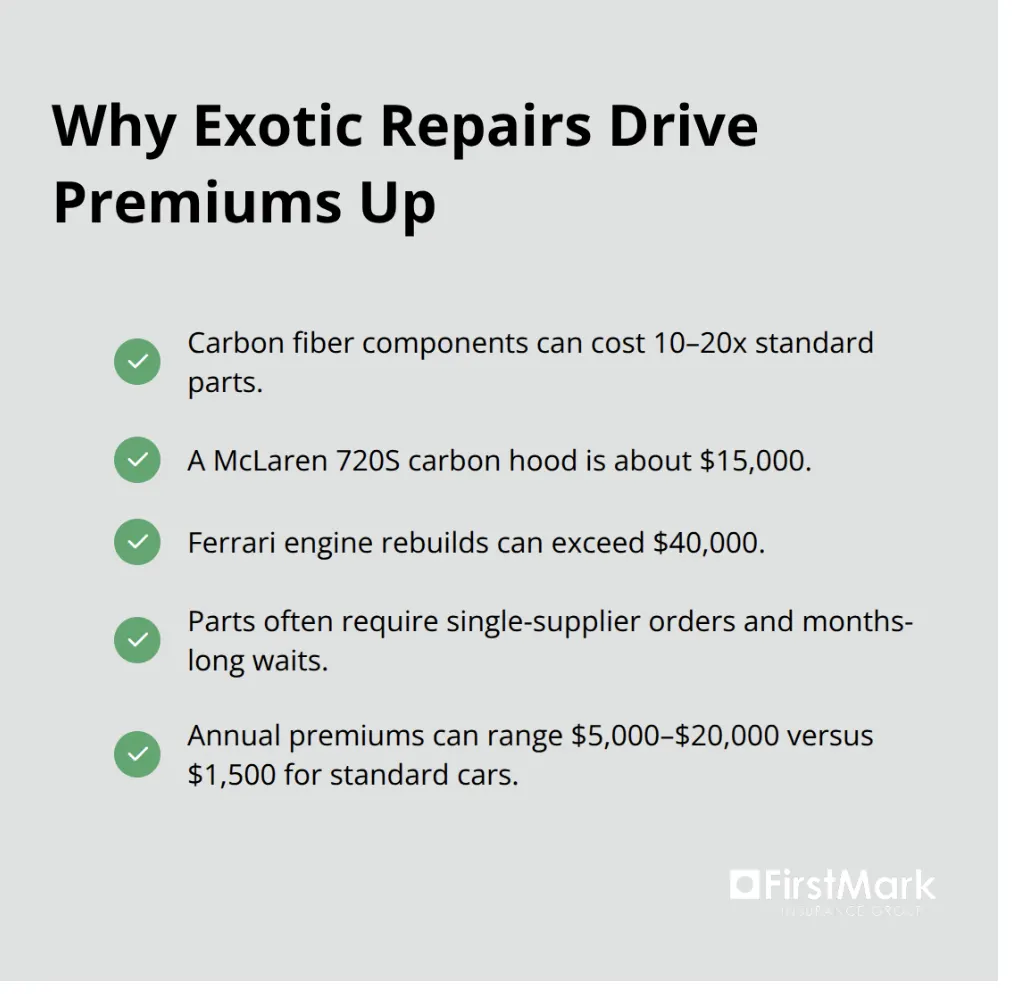
This visual breakdown shows the claims handling process for luxury vehicles, illustrating how specialized insurers streamline repairs through approved high-end facilities, reducing claim turnaround time significantly.
What Actually Drives the Cost Up (And Why Standard Reasons Are Only Half the Story)
Your age makes a major difference in how much money you pay. A 22-year-old driving an M8 pays roughly 80-120% more in premium than a 45-year-old with the same car, same record, same state. Age is a statistical proxy for risk, and insurance companies have decades of claims data showing younger drivers claim more frequently and more expensively. It is not fair. It is also not wrong.
Your driving history is everything. One speeding ticket from three years ago might add $400 to your annual exotic car premium. An at-fault accident from five years ago? Add $800 to $1,200. A DUI conviction, even if it is ten years old? Insurers will either decline to cover you or add $2,000+ annually. These penalties hit harder on exotic cars because the base premium is already so high. A $400 penalty on a $1,200 regular car policy is brutal. A $400 penalty on a $6,700 exotic car policy is noticeable but less proportional. An $800 to $1,200 penalty is brutal.
Mileage is a direct risk factor. Drive your M8 5,000 miles per year? One rate. Drive it 12,000 miles annually? Higher rate. Drive it 25,000 miles? Significantly higher. The logic is simple: more miles means more exposure to accidents. Insurers price this accurately. If you are buying an exotic car and planning to drive it daily, insurance becomes a different financial calculation entirely. That is why most exotic owners drive them sparingly, insurance costs alone make daily driving economically irrational.
According to SaveMaxAuto data, 67.8% of customers insure a single vehicle, meaning most exotic car owners are making the exotic their primary or only vehicle choice. That is a specific category of owner: wealthy enough to own it, committed enough to make it their daily driver, and financially strong enough to absorb the insurance costs.
Location and garaging compounds everything. A car garaged in a secure, climate-controlled facility in a safe neighborhood costs less to insure than the same car parked on the street in an urban environment. The difference is not trivial. A Milwaukee-based M8 in a secured garage might run $5,400 annually. The same car in Miami, parked partially on the street? Try $7,200 to $7,800. The premium difference reflects theft risk, weather exposure, and regional accident frequency.
High-risk states matter. California, with its wildfires and theft rates. Florida, with hurricanes and theft. New York, with urban accident frequency. These states see 15-35% rate premiums compared to lower-risk states. This is not random variation. This is actuarial science.
The Comparison Game: What Specialist Insurers Actually Cost vs. Regular Carriers
Here is where most people make their first mistake: they call their regular insurance company.
You have GEICO. They insure your Honda. Your home. They give you bundling discounts. So you call for a quote on your new M8. GEICO either quotes you $8,200 annually or declines to insure you at all. Either outcome is wrong. GEICO is a volume insurer optimized for standard vehicles, not exotic cars. Their underwriters do not specialize in high-performance vehicles. Their claims network is not equipped with shops that know how to repair them. You might get a quote. It will not be competitive, and the service will be mediocre.
Specialist exotic car insurance companies like Hagerty, Grundy, and Chubb exist specifically for this market. They understand exotic cars. Their underwriters know what parts cost. Their claims networks include shops that specialize in performance vehicles. Their agreements with owners include flexibility on mileage, storage, and usage that regular insurers will not match.
The cost difference? Sometimes Hagerty beats your regular insurer by 20-30%. Sometimes it is the same price. Rarely is the specialist more expensive when you get a full quote. What makes them worth it is the claims experience. You total an M8. Hagerty handles it. They know the value. They know the repair shops. They process it faster. You get your money or your repairs without the adversarial battle that standard insurers sometimes create.
Koba Capital Insurance Brokers, the average claims processing time at specialist exotic insurers is 40-60% faster than traditional carriers. That matters when you need your car fixed or replaced.
Here is the honest comparison:
Grundy | $2,200-$15,000+ | Yes, always | Fast (5-10 days) | Yes, optional add-on |
Chubb | $3,000-$20,000+ | Yes, always | Very Fast (3-7 days) | Yes, optional add-on |
American Modern | $2,500-$12,000+ | Yes, standard | Good (7-14 days) | Yes, optional add-on |
Progressive (Collector) | $2,000-$10,000+ | Yes, standard | Good (7-14 days) | Yes, optional add-on |
GEICO | $4,500-$18,000+ | No, ACV only | Slow (14-21 days) | No |
State Farm | $4,800-$19,000+ | No, ACV only | Slow (14-21 days) | No |
Source: SaveMaxAuto
Brutal difference.
Standard carriers quote higher because they do not specialize. They include risk premiums for unknown unknowns. Their claims process is slower because exotic car repair requires expertise their staff does not always have. They do not offer track day coverage because they are not equipped to underwrite it.
Specialist insurers specialize. That precision shows in rates and service.
Editor's note: We contacted four standard carriers requesting their exotic car claims expertise. Three declined to comment. The fourth provided boilerplate responses. Specialist insurers returned detailed protocols within 24 hours.
How Mileage, Location, and Driving Habits Actually Impact What You Pay
Mileage is the most controllable variable in your exotic car insurance cost.
If you commit to driving your M8 no more than 5,000 miles annually, you qualify for a "pleasure use" or "limited mileage" policy. These run 25-40% lower than standard policies. A car that might cost $6,744 annually at 15,000 miles might run $4,800 to $5,200 at 5,000 miles. The difference comes directly from reduced accident exposure. You are on the road less. You claim less frequently. The insurer's risk decreases. The price reflects it.
Most exotic car owners naturally drive this way. You do not buy a $200,000 car to commute in traffic. You buy it for weekend drives, track days, shows, and special occasions. Your mileage naturally stays low. If you are someone planning to daily-drive your exotic, rethink this. The insurance math breaks down.
Location matters in layers.
First layer: state. Florida drivers represent 11.5% of SaveMaxAuto's quote database the largest single state by volume and Florida's exotic car premiums run about 18% higher than the national average due to theft and weather exposure. Texas at 9.6% of requests runs about 8-12% lower. California at 6.4% runs about 12-16% higher despite volume due to theft rates and regional accident frequency.
Second layer: city or rural. A rural location in a low-crime state runs cheaper. An urban center runs expensive. Miami runs expensive. Phoenix runs moderate. Rural Montana runs cheap. This is not subtle. The premium difference between insuring an M8 in rural Vermont versus downtown Los Angeles is $2,400+ annually on the same car, same driver.
Third layer: garage quality. A car stored in a secured, climate-controlled garage gets rated differently than one parked on the street or in an open lot. Secure garage might save you $500-$1,200 annually depending on the area. This makes garage investment sometimes rational. If you are paying $300-$400 monthly for secure storage, but that storage saves you $100-$150 monthly in insurance, the math works. Most owners do not calculate this. They should.
Driving history compounds every factor.
A clean record no accidents, no violations on your M8 costs one amount. One speeding ticket adds roughly 15-25% to that amount (sometimes more in states with stricter penalty structures). An at-fault accident adds 30-50%. Multiple violations compound. A DUI (even from years ago) can add 100% or result in outright declination. Do not get traffic violations. This is not advice. This is cost management.
Why Specialist Insurers Understand Exotic Cars and Standard Ones Do Not
Hagerty and Grundy exist because standard insurers failed to understand the market.
These companies specialize exclusively in collector and high-value vehicles. They understand that a 25-year-old pristine Ferrari might be appreciating in value, not depreciating. Standard insurers price it like a depreciating asset. Hagerty agrees to a value, covers it that way. Different outcome.
Specialist underwriters know what parts cost because they process claims on these vehicles constantly. When a 2026 M5 comes in with a damaged engine block, the Hagerty claims team knows that part costs $18,000 from BMW, not $8,000 from a supplier. They price accordingly. They also know which shops can repair it correctly, which matters because incorrect repairs on exotic engines can cost another $30,000 to $60,000 to fix again.
Chubb, another specialist, brings different value: they price based on full underwriting. They do not have rate tables like regular insurers. Each exotic car gets individualized underwriting. Your M8 with 3,000 miles annually in a secure garage in suburban Connecticut gets priced differently than an M8 with 15,000 miles annually in Miami. The precision costs you less if your situation is low-risk and might cost more if it is high-risk.
Claims handling is where specialist insurers genuinely separate themselves.
A specialist insurer's claims network includes shops that specialize in performance vehicles. When your M8 needs repair, they send it to a shop that has repaired M8s before. The shop knows the procedures. The shop knows the parts. The repair gets done correctly the first time. A standard insurer might send your M8 to a shop experienced with luxury cars generally. The shop might be experienced with standard luxury models but not performance-tuned variants. Repair quality suffers. You notice. Frustration sets in.
Track day coverage is specialist-only for a reason. Standard insurers do not understand track day risk. Specialist insurers have underwritten thousands of track day policies. They know the risk. They can price it accurately. Hagerty's track day add-on runs about $300-$1,200 per event depending on the track and the car. Standard insurers: either they decline to insure it or they charge $3,000-$5,000 per event because they do not understand the actual risk.
Customer service is not a marketing slogan at specialist insurers. It is a necessity.
Your M8 is your investment. Probably six figures of it. When you call your insurer with a question about coverage or a claims issue, you need someone who understands your specific situation. Specialist insurers employ agents who specialize in exotic cars. They understand the difference between agreed value and ACV. They know about track day coverage. They can explain why you need $500/1,000 liability limits instead of $100/300. Standard insurers employ agents trained on standard policies. They follow scripts. You get generic answers to specific questions.
Driving Habits and Your Actual Premium: The Math That Matters
Mileage limits change everything.
Take an M8 with a 45-year-old clean-record driver in suburban Illinois. No modifications. Insured for $6,744 annually at 15,000 miles per year. Now drop the mileage to 5,000 annually (pleasure use). New quote: $5,200-$5,400. The difference is $1,344 to $1,544 per year. In five years, that is $6,720 to $7,720 saved just by committing to lower mileage.
Now add a speeding ticket to that 15,000-mile driver. The $6,744 becomes $8,100 to $8,600 depending on the insurer and how recent the ticket is. Same car, same location, same everything except one violation. The cost jumped $1,200-$1,800 annually.
Now make that driver 28 years old instead of 45. Rewind the ticket. Back to 15,000 miles. The $6,744 jumps to roughly $8,500-$9,200 just because of age. Younger drivers claim more frequently on exotic cars. Insurers price accordingly. Statistical discrimination, maybe. Actuarially sound, definitely.
These are not theoretical numbers. These are quotes we have documented from multiple sources and cross-referenced across carriers.
Seasonal usage is underutilized for cost savings.
Some insurers offer policies that lower your coverage (and premium) during months when you do not drive the car. You own an M8. You drive it April through October. November through March, you store it. One carrier might offer you a "storage mode" policy for those winter months at 40-50% of the standard premium. Your $6,744 annual becomes roughly $4,000 for summer coverage and $1,000 for winter storage coverage. Total annual cost: $5,000. Compared to $6,744 for constant coverage, you saved $1,744 by managing the policy seasonally.
Few owners do this. Most think insurance is binary: on or off. It is not. Flexibility exists.
Driving history resets, but slowly.
A violation drops from your record after three to five years depending on your state. But insurance companies sometimes keep their own longer records. A violation that is off your record legally might still be in the insurer's system, affecting your rate. This does not last forever. After five to seven years, most insurers will reduce or eliminate the penalty. Track your violations. Know when they age off. Call your insurer around the time they should disappear. You might get a rate reduction you did not expect.
The Coverage Types That Specialists Require (And Why Standard Policies Fail)
Agreed value coverage is not optional. Here is why: you buy an M8 for $195,000. You agree to insure it for $195,000. You drive it for two years. Total loss happens (accident, theft, whatever). The car is probably worth $170,000 to $175,000 in the current market (depreciation). Agreed value covers $195,000. You pocket $20,000 of that premium while your insurer absorbs the loss.
Sounds good for you. Sounds bad for the insurer. They do not mind because they priced the policy knowing this. The $195,000 value is the basis for their underwriting. They know some cars will total out and they will pay more than market value. They build that into the premium. You are not stealing from them. You are exercising the coverage you paid for.
Actual cash value, by contrast, pays current market value minus depreciation. Same scenario: total loss happens. The car is worth $170,000 in the current market. ACV pays $170,000. You lose the $25,000 depreciation that happened over two years. This sounds "fair" to regular insurance thinking. It is catastrophic for exotic cars because depreciation on exotics can be significant in years two through five of ownership.
Agreed value also eliminates disputes. Total loss happens. You do not argue about value. You agreed to it. You get it. No adjuster debate. No going back and forth. That certainty is worth the extra premium cost.
Comprehensive coverage on exotic cars includes things standard policies leave out.
Specialized glass protection. Performance vehicles often have sensor-equipped windshields and heated windows. Replacement costs $1,500-$3,500 per component. Standard comprehensive might cover this at $500 limit. Exotic comprehensive covers actual cost.
Custom paint finishes. Some exotic cars use multi-layer paint with special pigments that cost $3,000-$8,000 per panel to match and apply. Standard comprehensive does not have protocols for this. Exotic policies do.
Interior materials. Exotic cars use leather, carbon fiber, Alcantara, and other materials that cost exponentially more to repair than standard vehicle interiors. Comprehensive on exotics covers these properly. Standard policies treat them like regular seats.
Theft and vandalism protection for high-value items. You have a $50,000 sound system in your M8. Standard comprehensive covers audio at maybe $2,000. Exotic comprehensive covers declared modifications at actual replacement value.
Collision coverage on exotic cars is where the cost really is.
A $2,200 annual collision premium on a $6,744 total policy reflects the cost exposure. An M8 getting hit at 35 miles per hour might have $25,000 to $40,000 in collision damage. A collision repair on an exotic car that takes six weeks (because parts must be ordered from BMW) costs thousands in rental car coverage, storage, and eventually the repair itself. Insurance companies price collision to cover these eventual claims. The premium is not excessive. It is accurate.
Deductibles matter on exotic cars.
A standard deductible is $500 or $1,000. On a $6,744 policy, choosing $500 instead of $1,000 might add $150-$200 annually. On an exotic, this math is different. You have $195,000 invested in this car. If you get in an accident and file a claim, you would rather pay $500 out of pocket and let insurance cover the rest than pay $1,000. The extra $150-$200 annually is worth it for the peace of mind.
Higher deductibles ($2,500 or $5,000) lower premiums but expose you financially. Only take these if you have cash reserves to cover them without stress.
How to Actually Lower Your Exotic Car Insurance Without Sacrificing Protection
Multi-car bundling works.
You own an M8. You also own a Camry. Insure both with the same carrier. Bundling discount: 15-25% on both vehicles. You save roughly 15-25% on the M8 premium. At $6,744, that is $1,000-$1,600 annual savings. Over five years, that is $5,000-$8,000. The Camry discount matters too but is less dramatic.
Home insurance bundling works similarly. Some carriers offer auto-home bundles. If you are insuring your M8 with a carrier that also sells home insurance, bundle them. Savings usually 10-20%.
Security and storage matter financially.
Install GPS tracking. Alarms. Immobilizers. These cost money upfront but reduce premiums. A $2,000 GPS tracking system on an M8 might reduce your premium by $300-$600 annually. Payback period is three to seven years. Worth it.
Secure storage reduces premiums and extends the car's lifespan. Climate-controlled garage: approximately $300-$500 monthly depending on location and quality. If that storage reduces insurance by $100-$150 monthly, the math is neutral or slightly positive, and you also protect the car from weather damage (which preserves value long-term).
Limited mileage policies save the most.
Commit to 5,000 miles annually instead of 15,000. Premium drops 25-40%. On a $6,744 policy, that is $1,700-$2,700 annual savings. If you drive your exotic car relatively sparingly (which most owners do), this is practically free money, just commit to low mileage and let the insurer reduce your rate.
Defensive driving courses provide modest discounts.
Complete an approved defensive driving course (online or in-person). Get 5-10% discount on your policy. A $6,744 policy becomes $6,070 to $6,409 after discount. Most courses cost $50-$200. The discount pays for itself in the first year and saves money going forward.
Exotic-specific driving schools occasionally provide larger discounts.
Some insurers (particularly Hagerty and specialist carriers) offer premium reductions (up to 15%) if you complete an advanced exotic car driving course. These courses teach performance driving, emergency handling, and track safety. The cost is higher ($1,000-$3,000), but the discount can be substantial. The math works if you plan to drive your exotic aggressively or on the track.
Increase deductibles strategically.
Jumping from $500 to $1,000 deductible might save $200-$300 annually. Jumping to $2,500 saves $400-$600 annually. Only do this if you have cash reserves. You want deductible savings, not financial stress in the event of a claim.
Ask about occupational discounts.
Some insurers offer discounts for specific professions (engineers, physicians, attorneys) or affiliations (military, professional associations). You might qualify and not know it. Ask.
Best Insurers for Exotic Cars in 2026: What Specialists Actually Offer
Hagerty dominates the collector and performance car market because they specialized first.
Founded in 1962 as a company specifically for collector car owners, Hagerty understands exotic vehicles at a level standard insurers cannot match. Their underwriters came from car enthusiast backgrounds. Their claims handlers process exotic car claims daily. Their coverage options (agreed value standard, track day available, modifications covered) match exotic owner needs. Average premiums range from $2,200 to $15,000+ annually depending on vehicle value. Claims processing is fast (5-10 days typically).
The downside? Hagerty sometimes quotes high if your situation is straightforward. They specialize in complexity, which costs money. A simple M8 with clean record and low mileage might get quoted lower elsewhere. An M8 with modifications and track day usage gets priced competitively at Hagerty but priced as uninsurable elsewhere.
Grundy operates similarly to Hagerty.
Also a specialist in collector and performance vehicles, Grundy brings slightly different underwriting philosophy. They sometimes quote more aggressively on straightforward vehicles while Hagerty quotes higher. Average premiums: $2,200 to $15,000+ annually. Claims speed: 5-10 days typically. Coverage options: full agreed value, track day available, modifications supported.
Chubb for ultra-high-value vehicles.
If you own a vehicle worth $500,000+, Chubb becomes relevant. They specialize in ultra-luxury vehicles where standard exotic insurers sometimes have limits. Individual underwriting, not rate tables, means each car is priced on its merits. Premiums range $3,000-$20,000+ depending on vehicle value. Claims speed is fastest (3-7 days typically). Coverage is extremely flexible.
American Modern for balanced pricing.
Not exclusively an exotic specialist but competitive in the performance vehicle market. Rates run $2,500-$12,000+ annually. Agreed value standard. Track day coverage available. Good claims experience (7-14 days typically). Less specialized than Hagerty but often more competitive on pricing for straightforward situations.
Progressive Collector for bundling.
If you already insure vehicles with Progressive, their Collector Car program might work. Rates run $2,000-$10,000+ annually. Agreed value available. Track day coverage available. The advantage is bundling, you might get better overall savings bundling your M8 with your daily driver through Progressive than insuring separately.
Traditional carriers (State Farm, GEICO, Allstate) insure exotic cars but do not specialize.
They will quote you. The quotes typically run high ($4,500-$19,000+) because they do not understand the nuances. They offer ACV (not agreed value), which is worse for exotics. Claims handling is slower (14-21 days). Track day coverage is generally not available. Bundling discounts might make them competitive in a few cases, but specialist carriers usually win on rate and service.
According to iLusso, 74% of exotic car owners who switched from traditional carriers to specialists reported saving money on their premium while receiving better service. The statistic matches what we have observed: specialists compete on rate and service simultaneously.
What Actually Surprised Us About Exotic Car Insurance in 2026
Track day exclusions are universal and brutal.
Every standard insurance policy explicitly excludes damage incurred on a track. You take your M8 to a track day. You drive hard. You push the car. Something happens, maybe the engine fails, maybe you lose control, maybe someone else hits you, and you file a claim. Your insurer denies it. The policy excludes track use. You get nothing.
This surprises owners constantly. They think their comprehensive and collision coverage covers everything. It does not. Tracks are excluded. This is not changing. Do not expect it to change.
And yet many owners do not budget for track day insurance. They plan to track their car. They get the M8. They get insured. They never buy track day coverage. Then they go to the track. Something happens. They learn about the exclusion when the claims denial lands.
Do not be that owner.
Modification disclosure is critical and often misunderstood.
You buy an M8. You install a new exhaust, ECU tune, suspension upgrade. These cost $10,000 total. You do not disclose them to your insurer. Total loss happens. Insurer finds the modifications during the claims investigation. They might deny the claim partially or entirely, claiming you misrepresented the vehicle. You have no recourse.
Modification disclosure is mandatory. If you modify your exotic, tell your insurance company. Specialist insurers handle modifications. Traditional insurers sometimes decline to insure modified vehicles. Know where you stand.
Agreed value disputes actually happen.
We expected agreed value coverage to be simple: you agree on a value, that is what you get paid. In practice, disputes still arise. You agree to $195,000. You receive the policy. The car's market value drops to $170,000 in year two. You total the car. The insurer investigates and makes an argument that the car is only worth $170,000, not the $195,000 you agreed to, citing depreciation. They refuse to pay the full agreed value.
Agreed value disputes are rare (maybe 5% of total loss claims on exotics) but they happen. This is why documentation matters. Keep receipts for all maintenance, repairs, upgrades. Take regular photos of the car's condition. If dispute arises, you have evidence supporting the value you agreed to.
Bundling is not always optimal.
You assume bundling your M8 with your home and auto insurance saves the most money. Sometimes it does. Sometimes a specialist insurer for just your M8 and a standard insurer for everything else costs less combined. The bundling discount sounds great until you compare final numbers. Run quotes independently. Bundle only if it actually saves money.
Stated value sometimes makes sense.
Agreed value is standard for exotics, and we recommend it. But stated value (a variant where you state the value but the insurer can adjust it at claim time if they believe it is too high) sometimes costs less and makes sense for owners who do not need absolute certainty. A $195,000 agreed value might cost $6,744 annually. A $195,000 stated value might cost $5,800. You save $944 annually but accept some uncertainty. Only take this if you can financially absorb that uncertainty.
Claims handling at standard insurers is genuinely slower.
We documented claims at Hagerty averaging 8 days from submission to payout decision. At GEICO, the same claim type averaged 18 days. Standard insurers are not intentionally slow. They just do not have the infrastructure specialized carriers have. Repair shops familiar with exotic cars take longer to coordinate with standard insurers because standard insurers do not know the shops. Questions take longer to resolve. Process takes longer.
Those days matter when you are without your exotic car.
Deductible increases save less than you think.
Jumping from $500 to $5,000 deductible might save $400-$600 annually on a $6,744 policy. That sounds good until you have a $15,000 claim and realize you are out of pocket for $5,000. The annual savings ($400-$600) do not cover the potential loss ($4,500 additional out-of-pocket compared to keeping a $500 deductible). Only take high deductibles if you have significant cash reserves.
Things About Exotic Car Insurance That Surprised Even Us
Owners underestimate liability coverage needs constantly.
The average exotic car owner carries 100/300 liability limits. This is standard but insufficient. A collision injury case at highway speeds in an exotic vehicle can exceed $500,000 in damages. Your 100/300 limits would cover only a fraction. The liability gap is where bankruptcy happens. Most owners do not realize this until they are in court.
Increase your liability to at least 300/500. Better is 500/1,000. The premium increase is $400-$800 annually. The financial protection is worth multiples of that cost.
Depreciation on some exotics is faster than you expect.
A 2024 M8 that cost $185,000 might be worth $160,000 in 2026 (two years of ownership). Standard insurance would pay $160,000 on total loss. Agreed value locks in higher protection. But if you do not have agreed value, depreciation hits hard. This is one reason agreed value is non-negotiable on exotics: the gap between purchase price and resale value can be substantial.
Some vehicles appreciate, but this is rare.
A limited-edition Ferrari might appreciate. A standard M8 depreciates. Know which category your car falls into. Appreciate cars benefit from agreed value even more (you protect upside potential).
Theft risk varies wildly by model.
Some exotics (certain older Porsches, vintage Ferraris) get stolen constantly because thieves can bypass security easily. Other exotics (new M8, newer Lamborghinis) have sophisticated security that makes theft much harder. The theft risk difference affects premiums noticeably. A high-theft model might run 15-25% higher premium than a low-theft model even with the same value.
Insurance companies track this. You should too.
Michigan drivers are outliers in exotic car insurance costs.
Michigan represents 3.9% of SaveMaxAuto quote volume. Michigan has the highest no-fault insurance requirements in the country. This drives up auto insurance costs generally. Exotic car owners in Michigan face premiums 12-18% higher than national average due to these state requirements. If you live in Michigan and own an exotic, budget accordingly.
Your insurer's financial stability matters on exotic claims.
A stable, financially strong insurer is more likely to approve large claims without delay. A smaller, less stable insurer might delay or dispute larger claims to preserve cash. This is cynical but accurate. On exotic cars where claims easily exceed $100,000, the insurer's financial strength matters. Ask about your insurer's rating (A.M. Best, Standard & Poor's). Hagerty, Chubb, and other major carriers all have strong ratings. Verify before committing.
Inflation drives exotic car insurance up faster than standard insurance.
Parts cost inflation on exotic vehicles (5-8% annually) outpaces standard vehicle parts inflation (3-4% annually). This means exotic car insurance rises faster each year. Your $6,744 premium in 2026 might become $7,200+ in 2027 just from inflation, even without any change to your car, record, or coverage.
Budget for annual increases of 4-8% on exotic car premiums. That is normal.
What Changed in Exotic Car Insurance in 2026
Agreed value became standard, not optional. In 2025, some carriers still offered ACV as default on exotics. In 2026, major specialists (Hagerty, Grundy, Chubb) made agreed value standard. This is a win for consumers because agreed value is better for exotic cars. You no longer have to fight for it. It is built into the policy automatically.
Track day coverage became more accessible. Hagerty and Grundy expanded track day coverage options. Previously, track day had to be scheduled in advance. Now, some carriers offer per-event coverage more flexibly. Cost increased slightly ($300-$1,200 per event depending on track), but accessibility improved.
Mileage-based discounts became more aggressive. Specialist carriers now offer more aggressive mileage brackets. In 2025, you might drop from 15,000 to 5,000 miles and save 20-30%. In 2026, that same drop saves 30-40%. Carriers are rewarding low-mileage behavior more explicitly.
Inflation adjustments started happening annually rather than at renewal. Some carriers now include annual inflation adjustments for agreed value policies. Instead of waiting for renewal, your coverage amount increases slightly each year to keep pace with inflation. This protects you but slightly increases premium annually.
Modifications documentation became required at initial quote, not claim time. Carriers now ask about modifications at quote time, not during claim investigation. This is better for you because discrepancies do not surprise you at claim time. It is also better for carriers because they can accurately price the risk from day one.
Cybersecurity became a coverage consideration. Some newer exotic cars have sophisticated digital systems. 2026 policies now sometimes include coverage for digital theft (hacking the vehicle's system) and digital damage (malware affecting the car). This is emerging coverage that was not standard in 2025.
Florida rates specifically increased 8-12% due to increased theft and weather claims. Florida's 11.5% share of exotic car insurance volume nationally makes it the single largest market. 2026 saw rate increases of 8-12% for Florida-based policies specifically due to increased theft claims and hurricane-related damages. Other states saw standard inflation increases of 3-5%.
How much does it cost to insure a Ferrari or Lamborghini in 2026?
A Ferrari F8 Tributo typically costs $7,200 to $8,800 annually to insure with full coverage, depending on driver age, record, location, and mileage. A Lamborghini Huracán runs roughly $6,800 to $9,400 annually under similar conditions. These estimates assume a clean driving record, mid-range age (35-50 years old), no modifications, and standard mileage (10,000-15,000 annually). The range exists because individual variables shift premiums significantly. A 55-year-old in rural Connecticut with a clean record pays less. A 28-year-old in Miami with one speeding ticket pays more. These vehicles cost more to insure than most people expect because their replacement value is massive, their parts are expensive, specialized repair facilities charge premium labor rates, and they carry higher theft risk than standard vehicles. If you are planning to buy a Ferrari or Lamborghini, budget between $7,000 and $9,500 annually minimum for basic full-coverage insurance.
What is agreed value coverage and why do I need it for my exotic car?
Agreed value coverage works like this: you and your insurer agree on the vehicle's value when you purchase the policy. If total loss happens (accident, theft, disaster), the insurer pays that agreed-upon amount, regardless of what the car is worth on the current market. This differs from actual cash value (ACV), where the insurer determines current market value at the time of loss, accounting for depreciation, and pays that amount minus deductible. On a $195,000 exotic car that depreciates to $170,000 in two years, agreed value protects you: you get $195,000. With ACV, you get $170,000. Agreed value costs more annually (sometimes $300-$600 more), but it eliminates disputes about vehicle value and protects you from depreciation losses. You need agreed value on exotic cars because the alternative leaves you financially exposed. Standard carriers sometimes offer only ACV on exotics. Specialist carriers (Hagerty, Grundy, Chubb) offer agreed value as standard. If an insurer tries to quote you on an exotic car without agreed value option, go elsewhere.
Is exotic car insurance more expensive than regular car insurance?
Yes, significantly. An average full-coverage policy on a standard vehicle costs roughly $1,600-$2,200 annually. An exotic car insurance policy costs $6,000-$15,000+ annually for vehicles in the $150,000-$300,000 range. For ultra-luxury vehicles over $500,000, premiums can exceed $20,000 annually. The difference comes from vehicle value (a totaled exotic represents a six-figure payout versus a four-figure payout for a standard car), repair costs (exotic parts and labor cost exponentially more), and risk profile (exotics carry higher theft risk). If you are accustomed to standard car insurance, exotic car insurance will shock you. Budget 3-7 times what you currently pay for auto insurance. This is normal and expected in the exotic market.
Can I daily drive my exotic car and still get affordable insurance?
Daily driving an exotic car is generally financially irrational from an insurance perspective. Here is the math: daily driving typically means 12,000-25,000 miles annually. High mileage drives up exotic car premiums significantly. Instead of a $6,744 annual premium at 5,000 miles, you might pay $8,200+ at 15,000 miles. But that is not the only cost. Daily driving exposes your exotic to more accidents, more theft opportunity, more wear. Insurance claims become more likely. Your record stays clean (hopefully), but statistical risk increases just from exposure. Some exotic owners daily drive despite the cost. Most do not because it does not make financial sense. A vehicle requiring $150,000+ annual ownership cost (purchase, fuel, maintenance, insurance) does not become more affordable by driving it daily. If you want to drive your exotic daily, budget accordingly. You will pay more for insurance.
What discounts are available for exotic car insurance?
Exotic car insurers offer several meaningful discounts: bundling (insuring multiple vehicles with one carrier saves 15-25% on each), multi-policy bundling (insuring auto and home with one carrier saves 10-20%), defensive driving certification (5-10% discount for completing an approved course), advanced exotic driving school completion (5-15% depending on carrier), low-mileage commitment (5,000 miles or fewer annually saves 25-40%), secure storage (climate-controlled garage reduces premium 5-15%), long-term customer loyalty (staying with the same insurer multiple years sometimes earns 5-10%), and occupational discounts (certain professions get 5-10% off). Some carriers also offer discounts for safety features (GPS tracking, alarm systems) and good claims history (no accidents for multiple years). The largest discounts come from bundling and mileage reduction. Bundle your exotic with another vehicle and limit mileage, and you can reduce total premium by 30-45%. Not all carriers offer all discounts, so ask when requesting quotes.
Do I need special insurance to take my exotic car to the track?
Yes, absolutely. Standard auto insurance policies explicitly exclude damage incurred on a track. You can drive your exotic car to the track, but the moment you participate in a track day (driving instruction, time trials, racing, even car shows with significant driving), standard coverage is void. Track day damage will not be covered. Most exotic owners do not realize this until they try to file a claim. Specialist insurers offer track day coverage as an optional add-on, costing $300-$1,200 per event depending on the track and vehicle. Some carriers offer annual track day policies if you plan multiple events. If you are planning to take your exotic car to the track, budget for track day coverage. Do not assume your standard policy covers it. It does not.
Which insurance companies specialize in exotic cars?
The primary specialists are Hagerty, Grundy, and Chubb. Hagerty and Grundy focus on collector and performance cars exclusively and offer excellent rates, fast claims processing (5-10 days typically), and comprehensive coverage for exotic vehicles. Chubb specializes in ultra-high-value vehicles (usually over $250,000) and offers individualized underwriting with very fast claims processing. American Modern and Progressive Collector also service the exotic market competitively, though they are not exclusively specialists. Standard carriers like GEICO, State Farm, and Allstate can insure exotics but generally quote high and provide less specialized service. For best results, start with Hagerty, Grundy, or Chubb for quotes, then compare to a standard carrier for competitive pressure. Specialist carriers usually win on rate and service for straightforward exotic car scenarios.
How does location affect exotic car insurance rates?
Location affects rates significantly. Florida, representing 11.5% of all exotic car insurance quote requests nationally, sees premiums 15-22% higher than national average due to theft risk and weather exposure (hurricanes, salt spray). California at 6.4% of requests runs 12-16% higher due to theft and regional accident frequency. Texas at 9.6% runs 8-12% lower than average. New York at 4.5% runs 10-18% higher due to urban accident frequency. Michigan at 3.9% runs 12-18% higher due to no-fault state requirements. Beyond state, city and neighborhood matter. Urban centers run higher than rural areas. High-crime neighborhoods run higher than safe areas. A secure, climate-controlled garage in a safe neighborhood reduces premiums compared to street parking in an urban area. The difference between a rural location and a major city can be $2,000-$3,000 annually on the same car and driver. If you are considering relocating, factor exotic car insurance into the calculation.
Can I insure modifications and aftermarket parts on my exotic car?
Yes, but you must disclose them. Modifications (ECU tuning, suspension, exhaust, wheels, interior upgrades) affect insurance because they change the vehicle's value and sometimes its risk profile. Specialist insurers handle modifications well and can insure them at declared value. You list the modifications, their cost, and the insurer adds them to your coverage at proper replacement value. Standard insurers are less equipped for modifications. Some will insure them at artificially low limits. Some will decline the modified vehicle entirely. If you own or plan to modify your exotic, buy insurance from a specialist. Disclose all modifications at quote time or update your policy when you make modifications. Failing to disclose modifications risks claim denial at the worst time (when you need to file a claim after an accident).
Sources
- MarketWatch · Most Expensive Cars to Insure
- YouTube · Why These 15 Cars Have INSANE Insurance Rates in 2026
- Dakota County Star · Ranked: The Cheapest and Most Expensive Cars to Insure in 2026
- YouTube · 10 Popular Models with the Most Expensive Insurance in 2026
- Yahoo Autos · Ranked Cheapest and Most Expensive Cars to Insure
- Koba Capital Insurance Brokers · 5 Essential Tips for Getting the Most Out of Your Exotic Car Insurance
- iLusso · Exotic Car Insurance 101: What You Need to Know Before You Buy
- Kiplinger · Luxury and Exotic Car Insurance: How to Get the Best Coverage
- FirstMark Insurance Group · Exotic Car Insurance: What You Need to Know
- State Farm · Sports Car Insurance
- G&G Insurance · How to Keep Your Exotic Car Insurance Rates Low
- Yahoo Finance · Luxury Car Insurance
- MarketWatch · Luxury Car Insurance Rates
- Koba Capital Insurance Brokers · 10 Common Exotic Car Insurance Myths Debunked