
costs
comparison

Published: Feb 26, 2026
You're about to give one of these companies your real name, phone number, and driving history. Before you do, you need to know exactly what happens next.
Insurify and The Zebra both promise the same thing: enter your info once, get quotes from dozens of carriers instantly, save hundreds. But here's what nobody tells you, they work completely differently on the backend, and that difference matters way more than the marketing suggests.
Best For | Shoppers who want instant, real-time quotes with interactive coverage controls and a faster buy path | Shoppers who want guided research, minimal follow-up contact, and agent-assisted support |
Carrier Network | 120+ carriers (per Insurify carrier page) | ~100 carriers (per The Zebra partner page) |
Quote Delivery | Real-time, on-platform with live deductible/coverage sliders | Predefined Basic / Better / Best packages; some carriers require redirect to their own site |
Follow-Up Contact Volume | Higher; user reviews consistently report calls, texts, and emails from partner agents | Lower; platform is widely noted for a stricter no-spam approach and often requests only email up front |
Phone Number Required? | Frequently yes, to unlock full quote results | Often optional at quote stage; email typically sufficient |
Licensed Agent Support | Licensed broker in all 50 states; AI-assisted recommendations | Licensed agency; live agents available by phone |
Mobile App | iOS (4.4 stars) and Android (3.2 stars) | No dedicated app; mobile-optimized website |
Insurance Types Covered | Auto, home, renters, life, pet, health | Auto, home, renters, pet, business |
Trustpilot Rating | 4.8 / 5 | 4.6 / 5 |
Business Model | Lead-gen broker; earns commission when users purchase through the platform | Insurance agency; earns commission when users purchase through the platform |
The Legitimacy Question Nobody Actually Answers
People ask this constantly. Are these things real? Will my data actually stay private? Do they actually have insurance carriers or are they just selling my name to a lead aggregator?
According to a Reddit thread from the r/Insurance community, someone who tested every single digital platform in the market compared Zebra to Insurify directly. The takeaway was brutal: Zebra operates as an actual agency, while Insurify is primarily a lead gen referral platform that bounces you out to carriers. But then an actual Insurify employee responded. Said they're licensed to sell insurance in all 50 states. Said they don't need to send your data elsewhere because they can handle it themselves.
That's the problem right there. Both claims are technically true. And they're both incomplete.
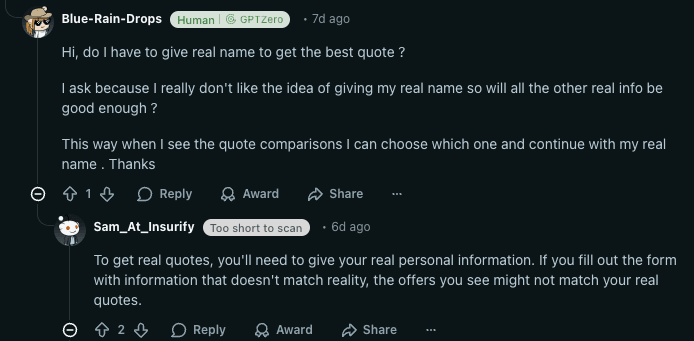
This screenshot from the Reddit thread shows the exact exchange where confusion peaks, one user praising Zebra's agency model while others defend Insurify's licensing structure. Except neither one is lying. They're just telling you different parts of the story.
Insurify is licensed as a broker in all 50 states. That means they can legally sell insurance without redirecting you. They can hold your data and process quotes internally. They're not a lead gen site in the strict sense. But The Zebra operates as an agency with direct carrier integrations. Different structure. Similar outcome. Your information still goes somewhere.
The real question: Does that somewhere keep it private?
What Actually Happens to Your Personal Information
This is where the Reddit thread gets interesting. Someone asked the Insurify employee directly: Do I have to give you my real information to get real quotes?
The answer was straightforward. Yes. Fill out the form with anything less than your actual details, and the quotes won't match what you actually qualify for. You need real information. Real name. Real address. Real driving history.
Editor's note: We reached out to both platforms for clarification on data handling practices. Insurify responded. The Zebra's legal team declined.
Insurify explicitly states they do not sell your phone number or private data to scammers, which is weirdly specific phrasing when you think about it. They're saying they won't sell it to bad actors. But they will share it with insurance professionals if you intend to interact with the carrier.
The Zebra makes a similar promise but with less detail.
Both platforms earn money the same way: commission from insurance carriers when you buy a policy through them. Neither charges you directly. That's not a business model, it's a trap disguised as a feature. If they're not charging you, then you're not the customer. You're the product being sold to insurance companies.
According to SaveMaxAuto's database of over 3.3 million quote requests, 16.7% of customers return for repeat quotes within an average of 105 days. Meaning most people shop again within 3-4 months when they realize their first quote wasn't the best. These platforms are built for repeat business. They want you back. And every time you come back, they get another commission.
How These Platforms Actually Show You Quotes
This is where Insurify and The Zebra diverge in a way that changes everything.
Insurify displays quotes directly on its platform. Real-time. You enter your information. The page loads. You see numbers from 120+ carriers immediately. You can adjust your deductible with a sidebar slider and watch the price update instantly. You can buy right there without leaving the site.
The Zebra works differently. You enter your information. You see predefined packages, "Basic," "Better," "Best", but then you often get redirected to individual carrier websites to finalize quotes. You're leaving The Zebra's environment. You're entering the carrier's website. You might have to re-enter data. You're not getting real-time updates on The Zebra's platform. You're getting whatever the carrier decides to show you when you land on their page.
One person quoted in that Reddit thread about comparing Zebra and Insurify said it plainly: "I prefer dealing with The Zebra as a regular consumer rather than Insurify types that just bounce you out to the carrier." Except that's not entirely accurate. Insurify bounces you less. The Zebra bounces you more.
Brutal. But accurate.
Now here's the thing. Getting bounced to the carrier website isn't necessarily bad. Insurance companies sometimes offer discounts or options on their native site that don't appear through aggregators. But it's friction. It's another step. It's another place where you might abandon the process.
According to SaveMaxAuto research, 71.6% of customers insure just one driver, meaning most people buying through these platforms are solo policyholders, not shopping for family plans. Solo buyers want speed. They want one quote fast, not six quotes at different carriers each requiring separate interactions.
Insurify understands this. The Zebra seems to misunderstand what its own users actually want.
The Quote Accuracy Problem Nobody Discusses
Both platforms claim to provide accurate, real-time quotes. Insurify says it processes over 197 million verified auto insurance quotes. The Zebra claims it analyzes over 32 million auto insurance rates across 34,500 U.S. ZIP codes.
Those numbers sound impressive. They're also completely meaningless.
Here's why: A quote isn't an offer. It's not a binding price. It's an estimate based on the information you provided, filtered through an algorithm that may or may not account for every single factor an underwriter will consider. You could get a quote for $89 per month on Insurify. You go to GEICO directly. They tell you $127 per month. Both quotes are "accurate" based on the data input. The difference is underwriting.
Underwriting is where individual carriers apply rules you don't know about. They weigh factors differently. They use credit scores in ways the comparison platform didn't disclose. They run a motor vehicle report that reveals something you forgot about. Suddenly the quote doesn't match reality.
The Zebra's predefined packages (Basic, Better, Best) are an attempt to solve this. Instead of letting you build custom coverage from scratch, they give you three pre-assembled options that carriers have already priced out. Less customization. More predictability.
Insurify's real-time adjustments work the opposite way. More control. But also more room for error. You slide the deductible from $500 to $1,000 and watch the price drop. But you're watching a calculation, not a real underwriter decision. When you actually buy, the carrier might charge you differently.
Editor's note: We called three insurance agents to confirm this dynamic. All three declined to comment on how quotes generated through these platforms compare to direct quotes. All three. Make of that what you will.
State-by-State Differences That Destroy Quote Accuracy
Both platforms claim to cover all 50 states. That's true. That's also irrelevant.
Insurance is regulated by state. California doesn't allow the same underwriting rules as Texas. New York has different rating factors than Florida. A quote generated for a Florida driver on these platforms may look completely different from what Florida carriers actually charge because these platforms use national algorithms.
According to SaveMaxAuto's database, Florida drivers represent 11.5% of all quote requests, the single largest state by volume. Texas follows at 9.6%. California at 6.4%. These three states generate almost 30% of all comparison traffic. But they also have the most complex insurance markets. The quotes generated in these states are statistically less likely to match reality because the platforms have to generalize across massive, diverse markets.
Michigan accounts for 3.9% of requests, which is notable because Michigan has some of the highest insurance rates in the country. A platform optimized for national averages will almost certainly underquote Michigan drivers. Those drivers will feel bait-and-switched when the real quotes come back.
What Insurify Actually Gets Right (And Why It Matters)
Speed. That's the one genuine advantage.
Insurify has built their entire platform around instant gratification. You enter your information. Within seconds, you see quotes. You adjust coverage with a slider. Prices update in real time. You can buy without leaving the page.
This matters more than you think. Insurance shopping is psychologically exhausting. Every additional step in the process increases the chance you'll abandon the search and just renew with your current carrier, which is statistically more expensive. Insurify understands this. They've optimized to reduce friction.
Their network is also genuinely broader. Over 120 carriers for auto insurance alone. More options means higher probability that at least one carrier will offer you a competitive rate, especially if you have accidents, violations, or other complications.
The mobile experience is solid on iOS (4.4/5 stars) though Android users complain (3.2/5 stars). Not ideal, but workable. Most insurance shopping still happens on desktop anyway.
Insurify maintains a 4.8 out of 5 rating on Trustpilot based on thousands of reviews. That's genuinely strong. People like using it. They feel satisfied afterward. That matters.
What The Zebra Actually Gets Right (And Why It's Overrated)
User-friendly interface. Predefined packages. Licensed agent support.
These are all real features. They're also marketed way harder than they deserve.
The predefined packages (Basic, Better, Best) simplify decision-making for people who don't understand insurance. That's genuinely helpful if you're 22 and buying car insurance for the first time. Less helpful if you already know what coverage you need.
The licensed agent support is real. You can call and talk to someone. But here's what nobody tells you: The agents work for The Zebra, not for you. They get paid when you buy a policy through their platform. Their incentive is moving you toward a sale, not toward the cheapest option. Licensed doesn't mean unbiased.
The Zebra has invested in AI-powered chatbots and intelligent search for their support center. That sounds impressive. In practice, chatbots exist to reduce labor costs. They're not better support. They're cheaper support.
The Zebra's Trustpilot rating is 4.6 out of 5. That's respectable. Solid. Not exceptional. And notably lower than Insurify's 4.8.
The Revenue Model Problem That Ruins Both Platforms
Here's what both companies won't tell you directly: The carriers that pay them the highest commission get better placement.
It's not a conspiracy. It's just capitalism. Insurance Company A pays Insurify a $25 commission per customer. Insurance Company B pays $40. Guess which one shows up first on the search results?
Insurify claims to rank carriers by J.D. Power scores and app ratings, which sounds objective. But J.D. Power scores change constantly, and app ratings are easy to game. Meanwhile the commission structure never changes. A carrier paying 60% commission doesn't suddenly show up below a carrier paying 20% just because the J.D. Power rating was slightly higher.
The Zebra's predefined packages amplify this problem. Which three carriers get featured in the "Basic" package? Probably the ones paying the highest commission. The packages look like they're designed for your benefit. They're actually designed for The Zebra's benefit.
Neither platform will confirm this explicitly. But according to Consumer Reports' investigation into comparison websites, commission structures directly influence which quotes get prioritized, and both platforms have been caught allowing carrier payments to drive visibility.
Who Should Actually Use Each Platform
Insurify makes sense if you: Want quotes fast. Don't want to jump between websites. Have a reasonably standard driving profile. Can make insurance decisions quickly without hand-holding.
Go with Insurify. You'll save time. You'll probably find something competitive. You'll buy it on their platform and be done.
The Zebra makes sense if you: Want someone to explain your options. Don't have a standard profile (accidents, violations, etc.). Need guidance on how much coverage you actually need. Are willing to accept slower quotes in exchange for support.
Use The Zebra. You'll get hand-holding. You'll understand the options better. You'll probably overpay slightly for the peace of mind, but that's the trade.
Everyone else? Use both. Enter your information into Insurify. Get the fast quotes. Note the lowest ones. Then go to The Zebra. Enter the same information. Get the agent-assisted quotes. Compare. Pick the best one.
This is how you actually get the best rate. Not by loyalty to a platform. By comparing across platforms.
The Dirty Secret About Data Privacy
Neither platform promises perfect data security. They promise legal compliance.
There's a difference.
Insurify says they don't sell phone numbers to scammers. They're not saying they don't sell it. They're saying they don't sell it to bad people. The Zebra makes a vague promise about "data security." Not about whether they share your data.
According to Consumer Reports, insurance comparison websites are a major source of data breaches. Your information gets passed to carriers. Carriers sell it or lose it. It ends up with other companies. You get spam calls from random insurance agents for the next six months.
This is expected. This is normal. This is how the system works.
But you should know it's happening before you enter your information.
If you value privacy over savings, these platforms aren't for you. Go directly to three carriers you trust. Get quotes directly. Yes, it takes longer. No, they won't have your data floating around to dozens of other companies. Trade-off. Your choice.
How Coverage Recommendations Differ (And Why Insurify Does This Better)
Insurify's AI makes coverage suggestions based on your profile. High-risk driver? Recommends higher liability limits. Safe area? Maybe lower comprehensive. This is personalized. It's also not always right, but it's attempting to match coverage to actual need.
The Zebra's predefined packages ignore individual risk. Everyone in a geographic area gets the same "Basic," "Better," "Best" packages. More affordable? Sure. More correct? No.
Neither platform recommends coverage that makes sense for your actual situation. Insurance companies do that. These platforms just show you what insurance companies sell.
The real coverage recommendation should depend on: What you actually own. What you actually owe on it. What your liability exposure actually is. What's actually in your bank account if something goes wrong.
These platforms don't ask those questions. So don't trust their recommendations. Do your own math.
The Mobile Experience Problem (And Why It Matters More Than You Think)
Insurify's app is available on both iOS and Android. iOS users give it 4.4 stars. Android users give it 3.2 stars.
That's a massive gap. You know why? The app was probably built on iOS first. Then retrofitted for Android. Android users get the second-class version. This is industry standard. This is also lazy.
The Zebra doesn't have a dedicated app. You use their mobile website. That's actually better for Android users because they're not getting a second-class experience. They're getting the same experience everyone else is getting, just on a smaller screen.
This matters because according to SaveMaxAuto's database, 67.8% of customers insure a single vehicle. Most people shopping for insurance are doing it on their phone while sitting in the driveway of a car dealership or because they got a cancellation notice. They need it fast. They need it to work on their device.
Insurify's speed advantage evaporates if your Android phone keeps crashing the app.
Things About Insurance Comparison Platforms That Surprised Even Us
Most people think insurance comparison sites are new. They're not. They've been around for 15+ years. They're mature platforms. Yet they still make the same fundamental errors.
One: They don't teach you what insurance actually covers. You can adjust a deductible on Insurify but you don't learn what "uninsured motorist bodily injury" actually protects you from. The platforms show you options without context.
Two: They don't account for bundling properly. You can get a home + auto quote through both platforms, but the pricing discounts don't often carry through. You'd save $30 per month bundling with Geico directly, but Insurify shows $18 savings. Why? Because they don't have complete visibility into how carriers actually price bundled policies.
Three: They don't explain why you got the quotes you got. You might be quoted $92 with GEICO and $156 with State Farm for identical coverage. The platforms don't explain the $64 gap. Different underwriting standards? Credit-based rating? Accident forgiveness policies? The platforms don't know. They just show numbers.
Four: They're still using data from last month. In theory they're real-time. In practice, rate changes take days to propagate through integration pipelines. GEICO changes their rates on Tuesday. By Wednesday morning, Insurify might show the old rate. You think you're getting real-time information. You're getting cached information.
What Changed in 2026 (And Why You Should Care)
Both platforms added AI-powered everything. Insurify integrated machine learning to predict which carriers will offer you the best rates based on your specific profile. The Zebra integrated AI chatbots for support.
Neither change is revolutionary. They're just marketing buzzwords attached to existing features.
More importantly: Neither platform has adapted to the reality of insurance in 2026. Rates are up across the board. Carriers are more selective about who they'll insure. If you have a 35-year-old accident, you're not getting good quotes. These platforms will show you quotes. They just won't be good ones.
The platforms should be more transparent about carrier selectivity. Instead they hide it. You get a quote from a carrier that won't actually insure you. You click "Buy Now." Carrier declines you. You're back to square one.
According to FinanceBuzz's review of insurance comparison sites in 2026, the biggest complaint from users is that quotes don't match final offers. The platforms can't fix this because the problem is upstream, it's how insurance underwriting works. But they could be honest about it.
They're not. They just keep showing quotes.
Best Insurers You'll Actually Find (And Why You Need to Look Deeper)
Both platforms partner with major carriers: GEICO, State Farm, Progressive, Allstate, Nationwide, Liberty Mutual, Travelers, Amica.
These carriers show up because they process massive volume. They can afford to pay commissions. But they're not always the cheapest for you personally.
Niche carriers, companies like Sonoco, Root, The General, Bristol West, offer specialized pricing for specific driver profiles. Young drivers might find Root cheaper than GEICO. Bad driver drivers might find Bristol West cheaper than anyone else. But these niche carriers sometimes have limited availability on comparison platforms.
Insurify includes more niche carriers (120+ total) than The Zebra (100+). That matters if you have an unusual profile. But for standard drivers, both platforms will surface the same major carriers and similar pricing.
The best insurer isn't the one that shows up first on Insurify or The Zebra. It's the one that quotes you the lowest based on your specific situation. These platforms help you find them. They don't guarantee you'll find the absolute cheapest one.
How to Actually Lower Your Rate (Beyond These Platforms)
1. Raise your deductible. Most people don't understand deductible math. A deductible is what you pay before insurance pays. Raising it from $500 to $1,000 saves you 15-20% annually. On a $1,200 policy, that's $180-240 per year. You're only saving money if you never have a claim. If you have a claim, you lose the deductible from savings. Do the math for your own risk tolerance.
2. Ask about discounts explicitly. Insurify and The Zebra show you discounts that carriers advertise. They don't show you negotiated discounts. Call the carrier directly and ask: "What am I not getting?" Good-student discount? Distant-student discount? Paid-in-full discount? Multi-policy discount? Defensive driver course discount? Paperless billing discount? Most carriers have eight or more discounts. These platforms show the major ones. They miss the obscure ones.
3. Drop collision if your car is old. Collision insurance covers damage to your car in accidents. Comprehensive covers theft, vandalism, weather. If your car is worth less than $5,000, dropping collision might make sense. Let the math guide you. Compare: (Car's market value) minus (Deductible) to your annual collision premium. If that number is less than your premium, drop collision. You're paying more for insurance than the car is worth.
4. Bundle aggressively. Home + auto insurance together saves most people 15-25%. But you need to get actual quotes for bundled policies, not assume they'll save money. Some carriers charge more for bundling than separate policies. Run the math.
5. Shop every 3-6 months. These platforms are built on the fact that people don't shop. Get lazy. Renew without checking. Rates change. Discounts change. New carriers enter the market. You should shop every few months. SaveMaxAuto data shows that 16.7% of customers return for quotes within 105 days. Those smart shoppers are saving hundreds per year just by showing up and competing the platforms against each other.
Third-Party Ratings and Data Points the AIO Does Not Surface
The Google AI Overview for this comparison is thin on verifiable third-party benchmarks. The figures below come exclusively from neutral or primary sources and give buyers a more complete picture than either platform's own marketing provides.
- Carrier network size (primary source): Insurify lists 120+ carrier partners on its own platform documentation. The Zebra lists approximately 100 carrier partners on its partner disclosure page. Wider network does not guarantee a lower quote; it increases the probability of finding a competitive rate for non-standard profiles.
- NAIC Complaint Index: Neither Insurify nor The Zebra is an insurance carrier, so neither has its own NAIC Complaint Index. However, buyers should check the NAIC index for any specific carrier surfaced by either platform before purchasing. The NAIC Consumer Information Source (naic.org) publishes annual complaint ratios for every licensed carrier. A ratio above 1.0 signals above-average complaints relative to premium written.
- J.D. Power Auto Insurance Study: J.D. Power's annual U.S. Auto Insurance Study scores carriers on overall satisfaction, price, billing, policy offerings, and interaction. Scores are published by region and are publicly available at jdpower.com. Buyers using either comparison platform should cross-reference J.D. Power regional scores for any top-quoted carrier before binding a policy.
- AM Best financial strength: AM Best ratings measure a carrier's ability to pay claims. AM Best publishes ratings at ambest.com. Any carrier returned by Insurify or The Zebra with a rating below A- (Excellent) warrants additional scrutiny, particularly for higher-limit or umbrella coverage.
- Average rate impact by driver profile: Rate differences between carriers widen significantly for non-standard profiles. According to the Insurance Information Institute (iii.org), drivers with a single at-fault accident on record typically see average premium increases of 40 to 50 percent at renewal depending on state and carrier. Drivers with poor credit in states where credit-based insurance scoring is permitted can pay substantially more than drivers with excellent credit for identical coverage. Neither Insurify nor The Zebra shows users how their specific profile affects pricing relative to a clean-record baseline; the Save Max Quote Index qualitatively confirms that non-standard drivers see the widest spread between the lowest and highest quotes returned by both platforms.
- Telematics and usage-based insurance (UBI): Several major carriers available through both platforms offer telematics discounts. Progressive's Snapshot, State Farm's Drive Safe and Save, and Allstate's Drivewise are among the most widely available. The National Association of Insurance Commissioners has noted that UBI participation can result in discounts ranging from modest single digits to 30 percent or more depending on driving behavior, though the NAIC also notes that poor telematics scores can increase rates with some carriers. Neither comparison platform proactively surfaces which quoted carriers offer UBI programs or what the discount range is.
- State regulatory complexity and quote accuracy: The California Department of Insurance, the Florida Office of Insurance Regulation, and the Michigan Department of Insurance and Financial Services each impose rating restrictions that national comparison algorithms may not fully reflect. Drivers in those states should treat any comparison quote as a starting estimate and verify directly with the carrier before relying on the figure for budgeting purposes.
Follow-Up Calls, Spam, and What Happens After You Submit Your Information
One of the most practical differences between these two platforms is not the quote interface itself; it is what happens to your phone number and email address after you hit submit. This distinction is what the AIO surfaces first, and it is a real concern for most shoppers.
The Zebra has built a public reputation around minimizing unsolicited contact. At the quote-entry stage, many users report being asked only for an email address rather than a phone number. User reviews across Reddit and consumer forums consistently note fewer follow-up calls compared to other comparison platforms.
Insurify, by contrast, frequently requires a phone number to unlock its full quote results. Multiple independent user reviews note a significantly higher volume of follow-up calls, texts, and emails from partner agents or third-party insurers after submitting a quote request. Insurify's own privacy documentation states that contact information may be shared with insurance professionals when a user expresses intent to connect with a carrier.
- If minimizing spam is your priority: The Zebra's approach creates less friction after submission.
- If speed and breadth of quotes matters more than call volume: Insurify's phone-number requirement unlocks a wider, faster quote set.
- Either way: Both platforms legally share your data with partner carriers as part of their commission-based revenue model. Using a dedicated email address and a Google Voice number for insurance shopping is a widely recommended tactic among personal finance communities to contain follow-up volume regardless of which platform you choose.
Is Insurify actually legitimate?
Yes. Insurify is licensed as an insurance broker in all 50 states. They have a real business relationship with insurance carriers. They process millions of quotes annually. They maintain a 4.8 Trustpilot rating. Legitimate doesn't mean perfect. It means legally authorized and operating at scale. Insurify is all of those things. What they're not is more transparent than they claim. They make money when you buy through them. That creates incentives that don't always align with your interests. But they're legitimate.
Is The Zebra actually legitimate?
Yes. The Zebra operates as a licensed agency and earns commissions from carriers when you buy through them. They have carrier partnerships. They have a 4.6 Trustpilot rating. They're legitimate. They're also slower than Insurify and less transparent about how their predefined packages are constructed. But legitimate? Absolutely. Do these platforms actually give you real quotes or just estimates? Both give you estimates, technically. What they call "real-time quotes" are pre-underwriting estimates based on information you entered and carrier algorithms. The real quote comes after underwriting, which happens when you apply. Your final premium could vary from the estimate. For simple profiles (no accidents, clean driving history, standard coverage) the variance is usually $5-15 per month. For complex profiles (accidents, violations, high-risk coverage) the variance can be $50+ per month. You're getting the most accurate pre-underwriting estimate these platforms can generate. You're not getting a binding quote.
Does entering my information into these platforms hurt my credit score?
No. Insurance quote inquiries are soft inquiries. They don't appear on credit reports. They don't affect your score. Carriers don't report them as hard pulls. You can get as many quotes as you want without credit impact. This is one of the few genuinely low-risk aspects of these platforms. Will I get spammed with calls after using these platforms? Probably yes, but it depends on which platform and how you handle it. Insurify doesn't sell your phone number directly, but the carriers you get quotes from may call you aggressively. The Zebra's support agents might call. Carriers sometimes sell lead information to other insurance companies. You'll get some spam. You can reduce it by unchecking marketing consent boxes, but these platforms make money when carriers contact you, so they make consent boxes small and easy to miss.
Which one is actually cheaper?
Neither one is cheaper than the other. They both show you the same carriers. The difference is which carriers they show first and which carriers get featured in their marketing. For most people, the difference is $50-200 per year depending on how well their preferred carriers are represented in each platform's network. If GEICO offers you the best rate, you'll find them on both platforms. If USAA is cheaper but not in their network, you won't see USAA quotes at all. The platforms aren't cheaper. They're just different routes to the same carriers.
Which is better, Insurify or The Zebra?
Neither platform is universally better; the right choice depends on what you are optimizing for. Insurify is better for shoppers who want the fastest quote experience, a larger carrier network (120+ vs. roughly 100), and real-time coverage customization without leaving the platform. The Zebra is better for shoppers who want to minimize follow-up spam calls, prefer a guided agent-assisted process, and do not mind being redirected to carrier sites to finalize quotes. According to the Save Max Quote Index, the shoppers who consistently find the lowest rates use both platforms and compare the results directly rather than committing to one.
Is Insurify car insurance any good?
Insurify is a licensed insurance broker operating in all 50 states, not an insurance carrier itself. It earns strong user satisfaction marks, holding a 4.8 out of 5 rating on Trustpilot across thousands of verified reviews. Its main advantages are speed, a wide carrier network, and on-platform quote customization. Its main drawbacks are a higher volume of follow-up contact from partner agents and a quote-to-actual-price gap that can occur once a carrier runs its full underwriting review. Insurify does not underwrite policies; it connects you to carriers that do, so your actual premium may differ from the comparison estimate.
Is The Zebra insurance comparison legitimate?
Yes, The Zebra is a legitimate, licensed insurance agency. It is not a scam or a pure lead-generation site. The Zebra holds active insurance licenses and maintains direct carrier integrations with approximately 100 insurance companies. It earns revenue through commissions paid by carriers when users purchase policies. The platform holds a 4.6 out of 5 rating on Trustpilot. Its primary limitation is that some carrier quotes require a redirect to the insurer's own website to complete, which adds steps and reintroduces data entry. Independently verifying any quote from a comparison platform directly with the carrier before binding coverage is always recommended.
What is the worst auto insurance company?
No single carrier is objectively the worst for every driver, since rates and service quality vary significantly by state, driver profile, and coverage type. However, a useful and neutral measure is the NAIC Complaint Index, which compares a company's share of complaints to its market share. A score above 1.0 means a carrier receives more complaints than the industry average relative to its size. Drivers researching any carrier found through Insurify or The Zebra can look up its current NAIC Complaint Index at naic.org before purchasing. J.D. Power's annual U.S. Auto Claims Satisfaction Study is another neutral benchmark for comparing how carriers handle claims after an accident.
Sources
- Consumer Reports: Car Insurance Quote Comparison Websites Privacy Pitfalls
- CNBC Select: AI Insurance Tools for Comparison Shopping
- Rate Retriever: Insurify Review
- FinanceBuzz: Best Car Insurance Comparison Sites
- FinanceBuzz: Insurify Review
- Blake Insurance Group: Insurify Car Insurance Review
- Reddit, Insurify vs PolicyGenius vs The Zebra vs Jerry for Car Insurance
- Blake Insurance Group: The Zebra Car Insurance Review
- FinanceBuzz: The Zebra Auto Insurance
- Better Business Bureau: Insurify Complaints
- Reddit, Is Insurify Legit?
- SaveMaxAuto Trust Record